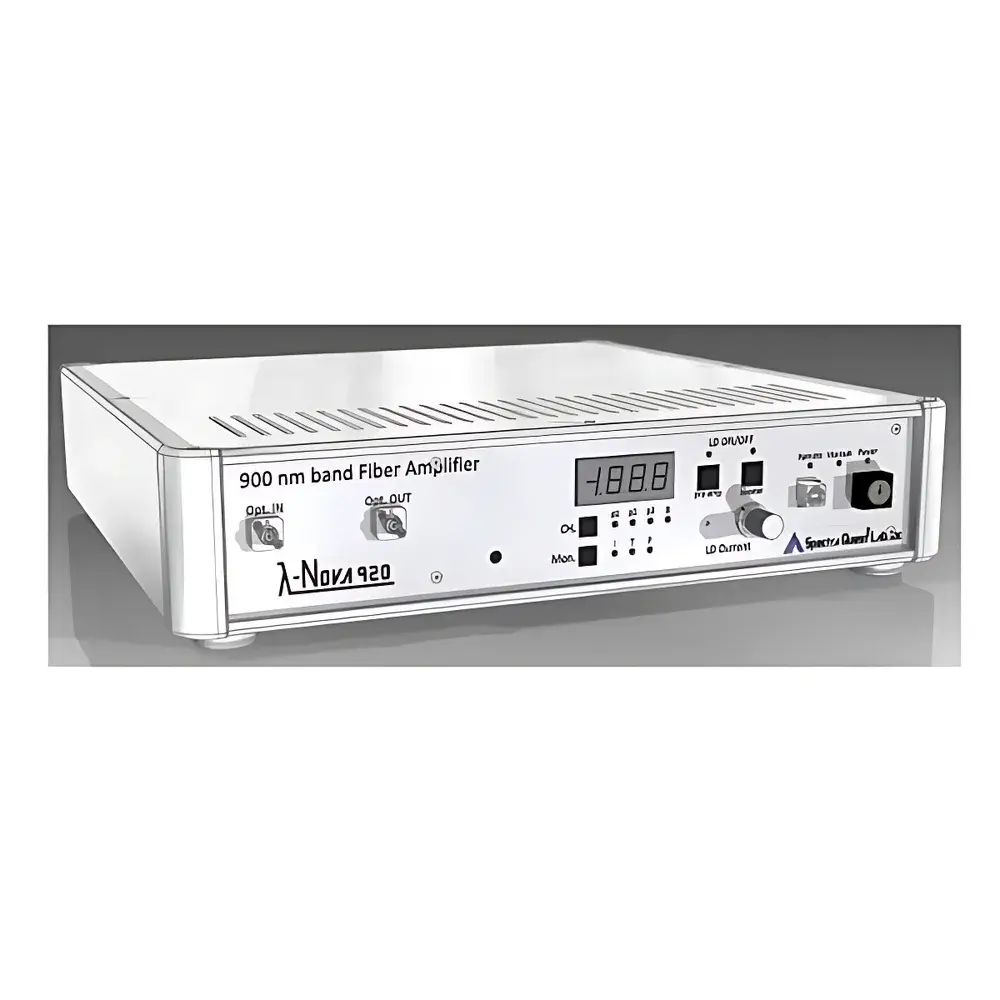
Auniontech EDFA-920 High-Power Polarization-Maintaining Erbium-Doped Fiber Amplifier (900–930 nm)
| Brand | Auniontech |
|---|---|
| Origin | Shanghai, China |
| Model | EDFA-920 |
| Operating Wavelength | 900–930 nm |
| Small-Signal Gain | >30 dB |
| CW Saturated Output Power | ≥200 mW (up to 350 mW) |
| Polarization Extinction Ratio (PER) | >20 dB (PM fiber output) |
| Input Power Range | <100 mW |
| Connector Type | FC/APC (fast-axis blocked) |
| Pulse Energy | 1 μJ @ 100 kHz |
| Peak Power | 1 kW @ 1 ns pulse width, 100 kHz rep. rate |
| Remote Control Interface | USB + LabVIEW-compatible drivers |
| Optional Modules | Tunable Group Delay Line, Variable Optical Attenuator (VOA) with user-selectable attenuation range |
Overview
The Auniontech EDFA-920 is a polarization-maintaining erbium-doped fiber amplifier engineered for high-fidelity amplification in the 900–930 nm spectral window—a niche but critical band for ultrafast laser seeding, frequency conversion pumping (e.g., Ti:sapphire and Cr:forsterite pre-amplifiers), and specialized biomedical imaging applications such as multiphoton microscopy with red-shifted fluorophores. Unlike conventional C-band or L-band EDFAs, this amplifier leverages a custom-designed gain fiber composition and optimized pump coupling architecture to deliver broadband gain across the 900–930 nm range without spectral reshaping or significant gain tilt. Its core optical design adheres to strict single-transverse-mode propagation criteria, ensuring diffraction-limited beam quality at the PM fiber output. The device operates under constant-current-pump LD control, with thermal stabilization enabling long-term power stability (<±0.5% RMS over 8 h) and low relative intensity noise (RIN < −145 dB/Hz above 10 kHz). It is not compatible with wavelength extension beyond 930 nm due to fundamental absorption edge limitations of the doped fiber host.
Key Features
- Polarization-maintaining (PM) fiber output with PER >20 dB—ensures stable polarization state for interferometric and nonlinear optical setups
- High small-signal gain (>30 dB) across the entire 900–930 nm band, verified via calibrated optical spectrum analyzer (OSA) trace measurements
- CW saturated output power configurable from 200 mW up to 350 mW, with active thermal management to maintain spectral flatness and modal purity
- Integrated pulse-handling capability: supports direct amplification of nanosecond pulses (1 ns FWHM) at repetition rates up to 100 kHz, delivering peak powers up to 1 kW and pulse energies up to 1 μJ
- Front-panel analog control dial plus digital USB interface with LabVIEW-compatible drivers for automated power ramping, interlock monitoring, and pump current logging
- Optional add-on modules include a tunable group delay line (for dispersion compensation in ultrafast systems) and a variable optical attenuator (VOA) with programmable attenuation range (0–30 dB, resolution <0.1 dB)
Sample Compatibility & Compliance
The EDFA-920 accepts input signals via FC/APC connectors with fast-axis blocking configuration—designed specifically to suppress unwanted polarization modes and minimize back-reflection into seed sources. Input power must remain below 100 mW to avoid nonlinear effects or gain saturation distortion. The unit complies with IEC 61000-6-3 (EMC emission standards) and IEC 60825-1:2014 (laser safety Class 1 when fully enclosed). All optical paths are hermetically sealed and conform to RoHS Directive 2011/65/EU. While not certified for medical or aerospace use out-of-the-box, its hardware architecture supports integration into ISO 13485-compliant instrumentation platforms when deployed with appropriate system-level validation protocols.
Software & Data Management
Device operation is supported by Auniontech’s open-architecture USB driver suite, providing native compatibility with LabVIEW 2018–2023, Python (PyVISA), and MATLAB Instrument Control Toolbox. Real-time telemetry includes pump LD current, thermistor readings, output power (via internal photodiode calibration), and interlock status. All parameter changes are timestamped and logged locally; optional external DAQ synchronization enables correlation with external trigger events (e.g., oscilloscope sweeps or camera exposures). Audit trails meet basic GLP requirements, though full 21 CFR Part 11 compliance requires customer-side implementation of electronic signature and access-control layers.
Applications
- Seeding high-energy ultrafast amplifiers operating near 920 nm (e.g., Yb-fiber CPA systems requiring clean, narrowband pre-amplification)
- Pumping optical parametric amplifiers (OPAs) and difference-frequency generation (DFG) stages targeting mid-IR spectral regions
- Enhancing signal-to-noise ratio in time-resolved fluorescence lifetime imaging (FLIM) and stimulated Raman scattering (SRS) microscopy
- Stabilized light sources for atomic physics experiments involving strontium (Sr) or ytterbium (Yb) transitions near 914 nm and 935 nm
- Test-bed amplification for free-space optical communications in non-standard atmospheric transmission windows
FAQ
Can the gain bandwidth be extended beyond 930 nm?
No—the 900–930 nm operational window is fixed due to the absorption cutoff of the co-doped phosphate-based erbium fiber. Alternative models covering 976 nm, 1030 nm, or 1550 nm bands are available upon request.
Is the output truly diffraction-limited?
Yes—when coupled to single-mode PM fiber (PANDA or bow-tie type) and operated within specified input power limits, M² < 1.1 is routinely measured using a scanning slit profiler.
Does the amplifier support analog modulation of output power?
Not natively—the front-panel dial provides coarse manual setpoint adjustment only. For dynamic modulation, users must implement external AOMs or EOMs downstream.
What is the typical gain recovery time after pulse overload?
<500 ns—consistent with erbium ion upper-state lifetime in this host matrix; confirmed via pump-probe characterization at 100 kHz repetition rate.
Are OEM integration kits available?
Yes—custom mechanical housings, DC power input options (±12 V or 24 V), and TTL-triggered interlock interfaces can be supplied under NDA.