
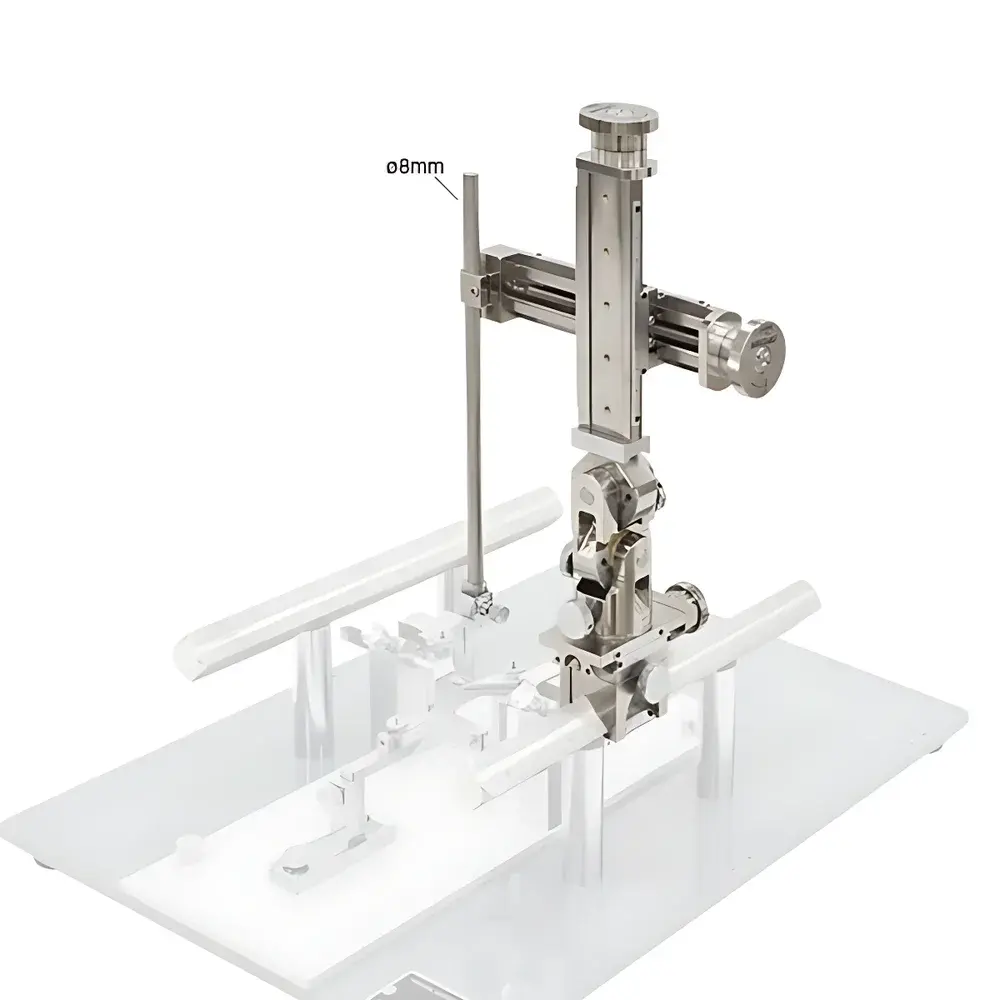
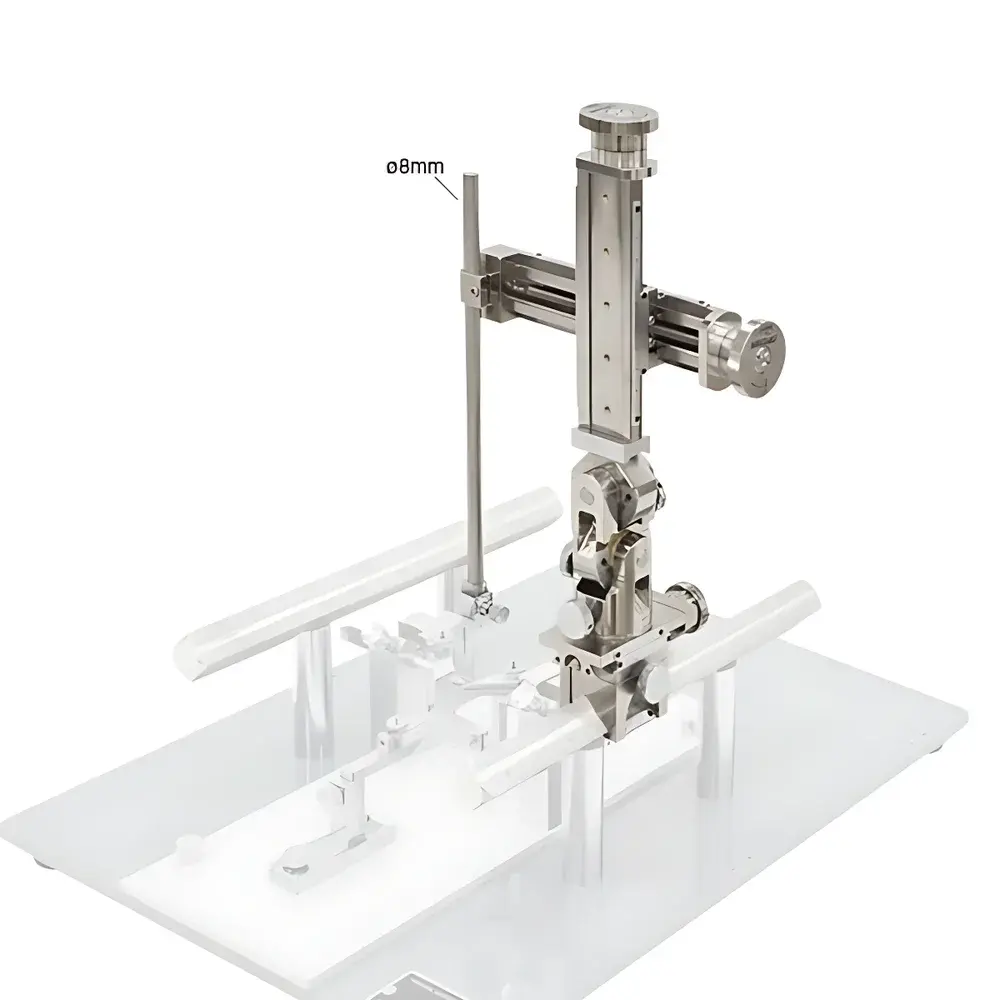
Narishige SMM-200 Stereotactic Micromanipulator
| Brand | Narishige |
|---|---|
| Origin | Japan |
| Model | SMM-200 |
| X Travel | 80 mm |
| Y Travel | 20 mm |
| Z Travel | 80 mm |
| Fine Adjustment Resolution | 10 µm per graduation |
| Full Knob Rotation | 1 mm |
| Tilt Capability | Dual-axis (AP and ML) |
| Dimensions (W×D×H) | 85 × 162 × 286 mm |
| Weight | 2.09 kg |
| Included Accessories | 2 mm & 2.5 mm hex keys, dedicated electrode holder with mounting hardware, grounding screw, Belleville washer, flat washer |
Overview
The Narishige SMM-200 Stereotactic Micromanipulator is a precision-engineered mechanical positioning system designed for high-fidelity neurophysiological and optogenetic experiments in vivo. Built upon Narishige’s decades-long legacy in micromanipulation for life science research, the SMM-200 integrates stereotactic rigidity with sub-micron repeatability in three orthogonal axes (X, Y, Z), enabling stable, drift-resistant placement of microelectrodes, optical fibers, silicon probes, and patch pipettes within defined brain coordinates. Its core operational principle relies on friction-locked lead-screw translation mechanisms coupled with calibrated vernier scales, ensuring deterministic displacement without backlash or thermal creep. Unlike motorized alternatives, the SMM-200 delivers passive mechanical stability essential for long-duration extracellular recordings, chronic implantation procedures, and simultaneous multi-modal interventions—such as concurrent electrophysiology and multi-site photostimulation—where electromagnetic interference must be minimized.
Key Features
- Three-axis manual translation (X: 80 mm, Y: 20 mm, Z: 80 mm) with tactile, gear-free micrometer knobs offering 10 µm minimum incremental resolution and 1 mm linear displacement per full 360° rotation.
- Dual-axis tilt adjustment: independent AP (anterior–posterior) and ML (medial–lateral) angular inclination of the upper manipulator body, facilitating oblique trajectory insertion while maintaining stereotactic alignment relative to the skull surface.
- Rigid aluminum alloy chassis with optimized mass distribution (2.09 kg) and low center of gravity to suppress vibration coupling during fine positioning—critical for single-unit recording fidelity and high-impedance patch-clamp stability.
- Integrated grounding interface: includes dedicated grounding screw, Belleville spring washer, and flat washer to ensure reliable electrical continuity between manipulator frame and Faraday cage or ground plane, reducing common-mode noise in sensitive electrophysiological measurements.
- Modular accessory compatibility: ships with Narishige-standard electrode holder (with set screws and mounting bracket), 2 mm and 2.5 mm hex keys, and standardized M3 and M4 threaded mounting interfaces for integration with stereotactic frames (e.g., Kopf, David Kopf Instruments models) and custom lab-built rigs.
Sample Compatibility & Compliance
The SMM-200 is validated for use across rodent (mouse, rat), avian, and small non-human primate preparations under standard institutional animal care protocols. Its mechanical design conforms to ISO 13485-aligned manufacturing practices observed by Narishige Co., Ltd., and supports compliance with GLP documentation requirements when paired with traceable calibration logs and maintenance records. While not an FDA-regulated device, its construction materials (anodized aluminum, stainless steel fasteners) meet USP Class VI biocompatibility thresholds for incidental tissue contact during surgical setup. The manipulator does not incorporate electronic components; therefore, it imposes no RF emission constraints and remains compatible with MRI-adjacent setups (excluding ferromagnetic accessories) and shielded electrophysiology suites operating under IEEE Std 1113-2017 EMC guidelines.
Software & Data Management
As a purely mechanical instrument, the SMM-200 operates independently of software control or digital interfacing. Position data are recorded manually via engraved scale readings and documented in experimental notebooks or LIMS-integrated electronic lab notebooks (ELNs) such as LabArchives or Benchling. For laboratories requiring audit trails under 21 CFR Part 11, position metadata (e.g., coordinate settings, tilt angles, date/time stamps) must be entered contemporaneously by the operator and co-signed by supervising personnel. Narishige provides a printed calibration certificate template (Form SMM-200-CAL-REV2) supporting metrological traceability to JIS B 7512-compliant length standards.
Applications
- Intracranial electrode placement for acute and chronic extracellular recording in awake or anesthetized rodents.
- Oblique insertion of high-density silicon probes (e.g., Neuropixels, NeuroPort) into layered cortical or hippocampal structures.
- Co-registered optrode deployment for combined optogenetic stimulation and calcium imaging or electrophysiological readout.
- Microinjection of viral vectors, tracers, or pharmacological agents using glass micropipettes or Hamilton syringes.
- Multi-electrode array (MEA) alignment during ex vivo slice recordings or in vitro organotypic culture experiments.
FAQ
Is the SMM-200 compatible with Kopf stereotactic frames?
Yes—the base plate features standardized ¼”-20 UNC threaded holes spaced at 25.4 mm intervals, matching the mounting pattern of Kopf Models 940, 1900, and 1430.
Can the Y-axis knob be locked during recording sessions?
Yes—a dedicated friction-lock collar adjacent to the Y-knob allows mechanical immobilization without altering zero-reference position.
What is the maximum recommended electrode diameter for the included holder?
The standard electrode holder accommodates glass micropipettes and metal electrodes with outer diameters from 0.8 mm to 1.5 mm; custom holders for larger shanks (e.g., 2.0 mm silicon probes) are available under Narishige part number EH-4.
Does Narishige offer calibration services for the SMM-200?
Yes—certified recalibration (including linearity verification per JIS B 7502) is available through Narishige’s Tokyo Service Center or authorized regional partners, with NIST-traceable reports issued upon completion.
Is the SMM-200 suitable for use inside a biosafety cabinet?
Yes—its all-metal construction and absence of polymers or lubricants susceptible to alcohol-based disinfectants make it appropriate for aseptic surgical workflows when cleaned per ISO 15883-1 guidelines.



