
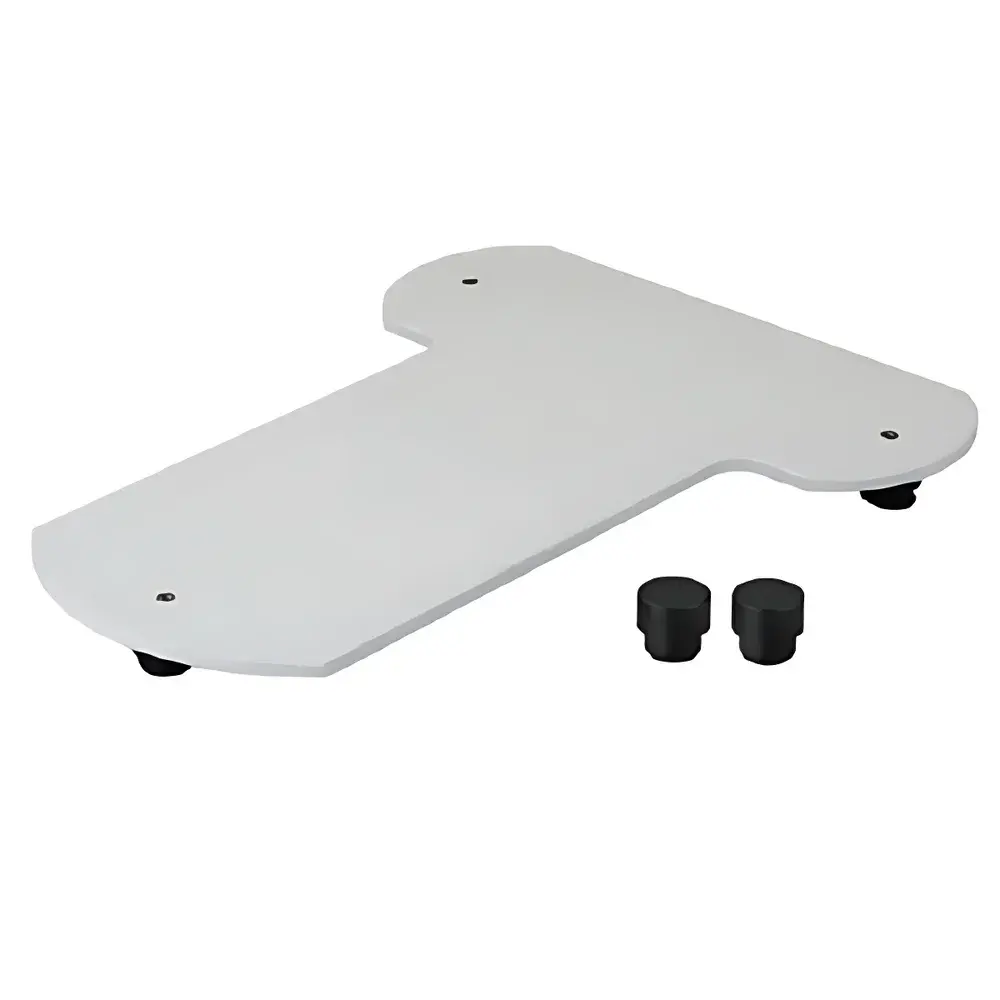
SBP-2 Vibration Isolation Base Plate by NARISHIGE
| Brand | NARISHIGE |
|---|---|
| Origin | Japan |
| Model | SBP-2 |
| Load Capacity | 45 kg per Spring Isolator (2 included) |
| Vertical Isolation Frequency | ~5.5 Hz |
| Horizontal Isolation Frequency | ~5 Hz |
| Dimensions (L×W×H) | 520 mm × 400 mm × 43 mm |
| Weight (empty) | ~10 kg |
Overview
The SBP-2 Vibration Isolation Base Plate is an engineered passive isolation solution designed specifically for high-sensitivity optical and micro-manipulation setups in life science and electrophysiology laboratories. Unlike active or pneumatic systems, the SBP-2 relies solely on mechanical spring isolation—eliminating dependency on compressed air, electrical power, or external control units. Its fundamental principle is low-frequency resonant mass-spring damping, optimized to attenuate ambient floor-borne vibrations (e.g., building HVAC, footfall, or nearby equipment) that would otherwise compromise image stability in upright or inverted microscopes, or induce positional drift during patch-clamp, intracellular injection, or micropipette positioning. The base plate’s rigid, flat top surface ensures direct, stable coupling with microscope frames—particularly advantageous for configurations requiring co-location of hydraulic micromanipulators, motorized injectors, or controller interfaces directly above or adjacent to the optical axis.
Key Features
- Passive spring-based isolation system—no air supply, electricity, or maintenance required
- Flat, rectangular top plate (520 × 400 mm) optimized for microscope footprint compatibility and unobstructed peripheral device placement
- Two integrated high-stiffness coil spring isolators, each rated for 45 kg static load, enabling total support capacity up to 90 kg
- Measured isolation performance: vertical resonance frequency ≈ 5.5 Hz; horizontal resonance frequency ≈ 5 Hz—effectively suppressing vibration transmission across typical laboratory disturbance spectra (1–20 Hz)
- Robust aluminum alloy construction with precision-machined mounting surfaces, ensuring long-term dimensional stability and minimal creep under sustained load
- Low-profile design (H = 43 mm) minimizes center-of-gravity elevation while maintaining sufficient stroke clearance for spring deflection
Sample Compatibility & Compliance
The SBP-2 is compatible with standard upright and inverted research-grade microscopes (e.g., Nikon Eclipse, Olympus BX/IX series, Zeiss Axio Observer), as well as modular electrophysiology rigs incorporating Narishige MO-202, MN-401, or IM-31 manipulators. Its flat, non-perforated surface avoids interference with microscope leveling feet, cable routing, or fluidic manifolds. While the SBP-2 itself does not carry formal certification, its mechanical isolation performance aligns with best-practice recommendations outlined in ISO 2631-2 (evaluation of human exposure to hand-arm vibration) and ASTM E1773 (standard guide for vibration testing of optical instruments). When deployed in GLP-compliant electrophysiology or imaging workflows, the SBP-2 contributes to environmental control traceability—particularly where vibration-induced artifact must be excluded from quantitative morphological or kinetic measurements.
Software & Data Management
As a purely mechanical isolation platform, the SBP-2 requires no embedded firmware, drivers, or software integration. It operates independently of data acquisition systems (e.g., Axon pCLAMP, Spike2, or NIS-Elements) and introduces zero latency, electromagnetic interference (EMI), or communication overhead. This independence simplifies validation protocols in regulated environments: no 21 CFR Part 11 compliance burden arises from the SBP-2 itself, and no audit trail, user access logs, or electronic signature functionality is applicable. Users retain full control over calibration documentation—vibration transmissibility curves and load-dependent resonance shifts may be empirically verified using laser Doppler vibrometry or triaxial accelerometers as part of lab-specific IQ/OQ protocols.
Applications
- Stabilization of upright/inverted microscopes during time-lapse fluorescence imaging or confocal Z-stack acquisition
- Vibration mitigation in whole-cell patch-clamp recordings, especially when using high-magnification water-immersion objectives
- Support platform for Narishige hydraulic and motorized micromanipulators in single-cell injection, oocyte enucleation, or CRISPR microinjection workflows
- Foundational isolation layer beneath optical tables or granite slabs in compact electrophysiology suites where space or infrastructure limits active systems
- Secondary isolation stage for sensitive interferometric or laser alignment setups where residual low-frequency motion must be minimized
FAQ
Does the SBP-2 require compressed air or electrical power?
No. It is a fully passive, spring-based mechanical isolator with zero utility dependencies.
Can the SBP-2 be stacked with other isolation platforms?
Stacking is not recommended. Coupling multiple resonant systems may introduce unpredictable modal interactions and degrade overall isolation performance. For enhanced attenuation, integrate the SBP-2 onto a dedicated inertial mass (e.g., concrete pier or steel-reinforced optical table) instead.
What is the maximum allowable payload for stable operation?
Each included spring isolator supports 45 kg statically. Total recommended load is ≤90 kg, evenly distributed. Exceeding this may reduce isolation efficiency and shift resonance frequencies upward.
Is recalibration needed after relocation or re-leveling?
No recalibration is required. However, ensure all four corner leveling feet are uniformly engaged and the top plate remains within ±0.1° level tolerance to maintain symmetric spring loading and optimal horizontal/vertical decoupling.
How does the SBP-2 compare to rubber or sorbothane pads?
Rubber isolators typically exhibit higher resonance frequencies (>10 Hz) and lower dynamic stiffness control. The SBP-2’s tuned coil springs provide superior low-frequency attenuation below 10 Hz—the dominant range of structural vibration—while maintaining precise geometric repeatability and load stability over time.



