
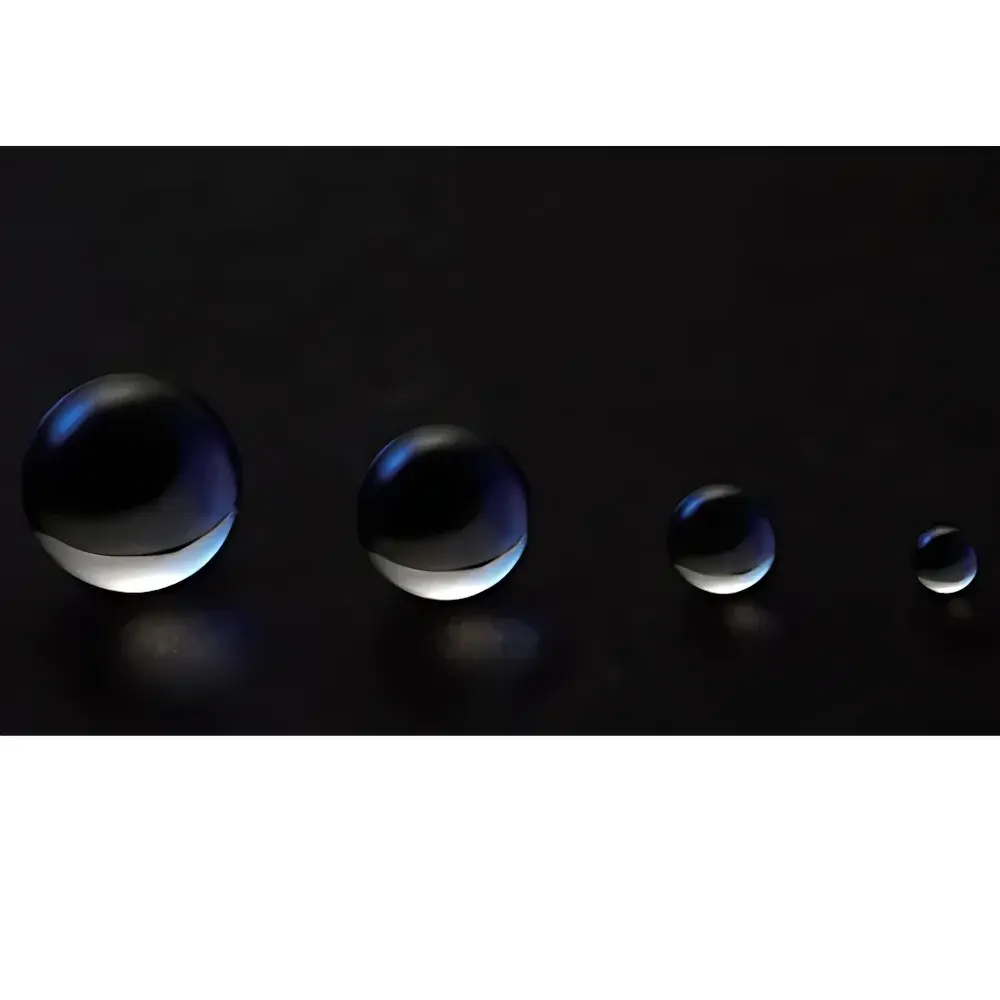
MiXran Meg1013 Spherical Lens
| Brand | MiXran |
|---|---|
| Model | Meg1013 |
| Type | Precision Optical Spherical Lens |
| Material | Optical Grade BK7 Glass (Standard) |
| Surface Quality | 40-20 Scratch-Dig |
| Coating | Optional AR Coating (VIS, 400–700 nm, R<0.5% per surface) |
| Diameter Tolerance | ±0.05 mm |
| Focal Length Tolerance | ±1% |
| Centration Error | ≤3 arcmin |
| Clear Aperture | ≥90% of Diameter |
| Compliance | ISO 10110-1, ISO 10110-2, ISO 10110-3 |
Overview
The MiXran Meg1013 Spherical Lens is a high-precision optical component engineered for demanding laboratory and industrial applications requiring accurate collimation, focusing, or beam manipulation in visible and near-visible spectral ranges. Designed and manufactured to international optical fabrication standards, the Meg1013 series comprises ten standard diameters (10 mm to 100 mm) with corresponding effective focal lengths (EFL) ranging from 30.2 mm to 734 mm — enabling systematic selection across common Gaussian optics configurations. Each lens is fabricated from homogenous, low-bubble, low-striae BK7 crown glass (Schott N-BK7 equivalent), offering excellent transmission (>91.5% uncoated, >99% with AR coating), minimal wavefront distortion, and thermal stability suitable for alignment-critical setups. The lenses adhere to ISO 10110 surface quality specifications (40–20 scratch-dig), with centration error controlled to ≤3 arcminutes and focal length tolerance maintained at ±1% — ensuring repeatability in multi-element systems such as laser cavities, interferometers, and imaging relay trains.
Key Features
- Precision-ground and polished spherical surfaces with RMS surface irregularity <λ/4 @ 633 nm (verified via interferometric testing)
- Consistent edge thickness control and chamfered mechanical edges (0.2 mm × 45°) to prevent chipping during mounting
- Standard uncoated finish; optional broadband anti-reflection (BBAR) coating optimized for 400–700 nm (average reflectance <0.5% per surface, maximum <1.0%)
- Traceable metrology documentation provided with each batch, including interferometric wavefront maps and focal length verification reports
- Mounting-ready geometry: plano-convex configuration with marked orientation (convex side indicated by engraved dot), facilitating rapid integration into kinematic lens holders and optomechanical breadboards
Sample Compatibility & Compliance
The Meg1013 lens series is compatible with standard optical mounts (e.g., SM1-threaded lens tubes, Ø1″ post holders) and supports both free-space and fiber-coupled configurations. All units comply with ISO 10110-1 (general requirements), ISO 10110-2 (surface form tolerances), and ISO 10110-3 (surface imperfection limits). For regulated environments — including ISO/IEC 17025-accredited calibration labs and GLP-compliant research facilities — full traceability to NIM (National Institute of Metrology, China) reference standards is available upon request. While not inherently FDA-regulated, the lenses meet material biocompatibility prerequisites (USP Class VI) when specified with certified lot documentation, supporting use in optical diagnostic instrumentation subject to IEC 60601-2-57 compliance pathways.
Software & Data Management
No embedded firmware or proprietary software is associated with the Meg1013 lens, as it functions as a passive optical element. However, comprehensive optical design support files are provided in standard industry formats: Zemax (.ZMX), Code V (.SEQ), and Synopsys LightTools (.LTS) — including exact surface sag tables, refractive index dispersion data (Sellmeier coefficients for BK7), and coating performance curves. All technical datasheets and test reports are delivered in PDF/A-1b format, compliant with long-term archival requirements under ISO 14721 (OAIS). Batch-specific metrology records are digitally signed and timestamped, satisfying audit trail requirements for GxP-aligned laboratories implementing electronic record management per ALCOA+ principles.
Applications
- Laser beam conditioning in DPSS and diode laser systems (collimation, spot size control, mode matching)
- Optical path folding and relay imaging in confocal microscopy, OCT sample arms, and structured light projection systems
- Calibration targets and reference elements in photonic sensor validation (e.g., PSDs, quadrant detectors, Shack-Hartmann sensors)
- Education and training platforms for undergraduate optics laboratories (thin-lens equation verification, aberration analysis, ABCD matrix modeling)
- Industrial machine vision illumination optics where cost-effective, high-reproducibility focusing is required without custom aspheric complexity
FAQ
What is the standard substrate material for the Meg1013 lens series?
Standard lenses are fabricated from optical-grade BK7 glass (Schott N-BK7 or equivalent), with fused silica (SiO₂) and CaF₂ variants available on special order.
Can I specify custom coatings beyond the standard VIS AR option?
Yes — custom single-layer or multilayer coatings (e.g., NIR AR, UV-enhanced, dichroic, or high-reflectivity mirrors) can be applied; lead time and MOQ apply.
Is focal length measured at the paraxial approximation or using ray-traced chief ray intersection?
All EFL values are experimentally verified using collimated HeNe laser (632.8 nm) and precision translation stage-based focus detection, per ISO 10110-2 Annex B.
Do you provide ISO/IEC 17025 calibration certificates?
Third-party accredited calibration certificates are available through partner metrology labs (NIST-traceable); internal verification reports meeting ISO 10110 requirements are included standard.
Are these lenses suitable for vacuum or high-humidity environments?
BK7 lenses are stable in ambient lab conditions (20–25°C, 30–60% RH); for vacuum or corrosive atmospheres, optional hydrophobic top-coats or fused silica substrates are recommended.




