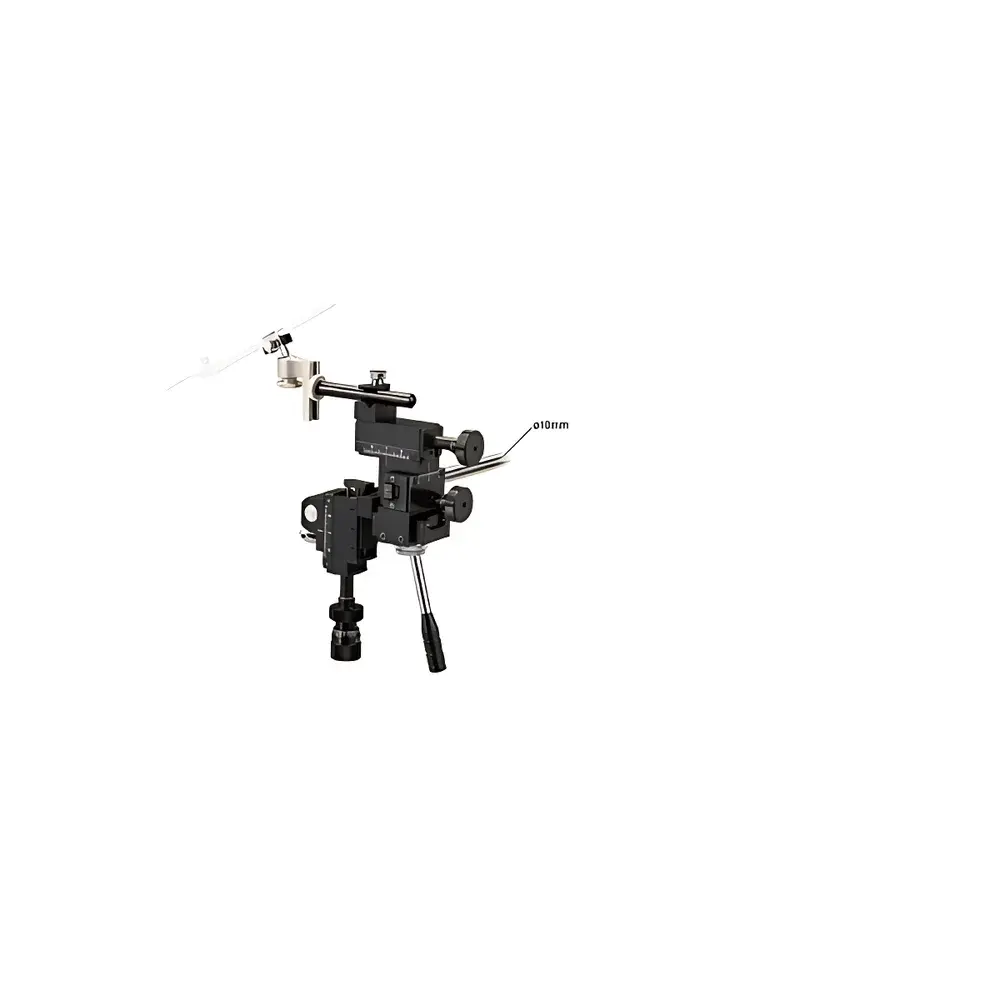
Sutter MN-151 Micromanipulator
| Brand | Sutter |
|---|---|
| Origin | USA |
| Manufacturer Type | Authorized Distributor |
| Origin Category | Imported |
| Model | MN-151 Micromanipulator |
| Pricing | Available Upon Request |
| Material | Lightweight Aluminum Alloy |
| Mounting | Side-mount compatible with standard microscope stages |
| Operation | Ambidextrous (left- or right-hand configurable) |
| Coarse Motion Range (X/Y/Z) | 25 mm / 20 mm / 25 mm |
| Fine Motion Range (X) | 8 mm (MN-152 adds X-axis fine adjustment) |
| Z-axis Fine Control | Linear push-button actuator with 250 µm full stroke, 5 µm minimum incremental displacement |
| Dimensions (W×D×H) | 121 × 36 × 145 mm |
| Weight | 330 g |
| Compatible Accessories | B-8B Ball Joint, P-1A Height Adjustment Plate, H-7 Pipette Holder, Allen Wrench Set |
Overview
The Sutter MN-151 Micromanipulator is a compact, three-axis coarse-adjustment micromanipulation system engineered for integration with stereo and compound microscopes in semiconductor process development, microprobe alignment, and microelectrode positioning applications. Unlike motorized or piezoelectric systems, the MN-151 employs a robust mechanical lever-and-gear architecture to deliver stable, backlash-free translational motion across X, Y, and Z axes—optimized for rapid repositioning of micropipettes, probe tips, or optical fibers during manual alignment tasks. Its core design principle centers on ergonomic, tactile control: X–Y positioning is achieved via dual-axis precision levers mounted on a single pivot arm, enabling intuitive, coordinated movement without requiring simultaneous hand coordination; Z-axis motion is decoupled and executed through a linear push-button mechanism offering high-resolution vertical displacement. Constructed from aerospace-grade aluminum alloy, the MN-151 balances structural rigidity with minimal mass (330 g), ensuring vibration damping and stage stability when side-mounted on inverted or upright microscope platforms. The device operates within ambient laboratory conditions and requires no external power, making it suitable for cleanroom-compatible workflows where electromagnetic interference or heat generation must be avoided.
Key Features
- Three-axis coarse positioning (X: ±12.5 mm, Y: ±10 mm, Z: ±12.5 mm) with smooth, low-friction mechanical transmission
- Dual-axis X–Y lever control enabling synchronized, single-hand manipulation with sub-10 µm repeatability under visual guidance
- Z-axis linear push-button actuator with 250 µm full stroke and 5 µm minimum step resolution—designed for controlled penetration and contact-force-sensitive operations
- Ambidextrous configuration: fully reversible mounting and lever orientation for left- or right-handed users without hardware modification
- Modular accessory interface supporting standardized Sutter components including B-8B ball joint (±15° tilt), P-1A height-adjustable base plate (±10 mm vertical offset), and H-7 universal pipette holder (accepts 1.0–1.5 mm OD glass capillaries)
- Cleanroom-ready construction: non-outgassing anodized aluminum housing, no lubricants exposed to optical paths or sample zones
Sample Compatibility & Compliance
The MN-151 is routinely deployed in semiconductor metrology labs for manual placement of microprobes during wafer-level parametric testing, alignment of fiber-coupled photonic devices, and positioning of atomic force microscopy (AFM) cantilevers prior to scanning. Its mechanical stability meets ISO 14644-1 Class 5 cleanroom requirements when used with appropriate mounting hardware. While not certified to IEC 61000-4 electromagnetic compatibility standards (as it contains no active electronics), its passive design inherently complies with SEMI S2/S8 safety guidelines for non-powered equipment in semiconductor fabrication environments. All accessories adhere to RoHS 2011/65/EU material restrictions. No FDA or ISO 13485 certification applies, as the device is classified as laboratory instrumentation—not medical device hardware.
Software & Data Management
The MN-151 operates entirely manually and does not incorporate embedded firmware, digital encoders, or software interfaces. Position data is not recorded or transmitted; all motion is analog and operator-dependent. This architecture ensures deterministic behavior in regulated environments where audit trails, electronic signatures, or 21 CFR Part 11 compliance are required—eliminating validation overhead associated with digital control systems. Users maintain full traceability through procedural documentation (e.g., SOPs referencing lever positions, calibrated scale readings, or video-recorded alignment sequences). When integrated with third-party imaging systems (e.g., Zeiss Axio Imager or Nikon Eclipse Ni-E), positional context may be annotated manually in acquisition metadata using standard TIFF or ND2 file headers.
Applications
- Manual alignment of tungsten microprobes on test structures during wafer-level reliability characterization
- Positioning of optical fibers for coupling into silicon photonics waveguides under 20–50× stereo magnification
- Mounting and coarse positioning of MEMS-based sensors prior to vacuum bonding
- Placement of ion milling masks or electron-beam lithography fiducials on TEM grid substrates
- Hand-guided manipulation of nanowires or 2D material flakes during transfer onto target substrates
- Adjustment of thermal probes in localized thermal conductivity mapping setups
FAQ
Is the MN-151 compatible with inverted microscopes?
Yes—the side-mount design and low profile (36 mm depth) allow secure attachment to most inverted microscope stage rails without obstructing objective clearance.
What is the maximum load capacity for the H-7 pipette holder?
The H-7 holder supports glass capillaries up to 1.5 mm outer diameter with a recommended tip mass ≤ 200 mg to maintain lever responsiveness and positional stability.
Can the Z-axis push-button be locked during extended experiments?
No—mechanical locking is not provided; however, the inherent friction of the lead-screw mechanism provides static hold without drift under typical lab temperatures (20–25°C).
Does Sutter offer calibration certificates for the MN-151?
No formal calibration certificate is issued, as the device lacks encoded position feedback; users perform verification using stage micrometers or interferometric reference standards per internal QA protocols.
How does the MN-151 differ from the MN-152 model?
The MN-152 adds a separate X-axis fine-adjustment knob (8 mm travel, 250 µm full range, 5 µm resolution), enabling subcellular targeting without lever repositioning—ideal for semiconductor device probing where nanoscale lateral accuracy is critical.