
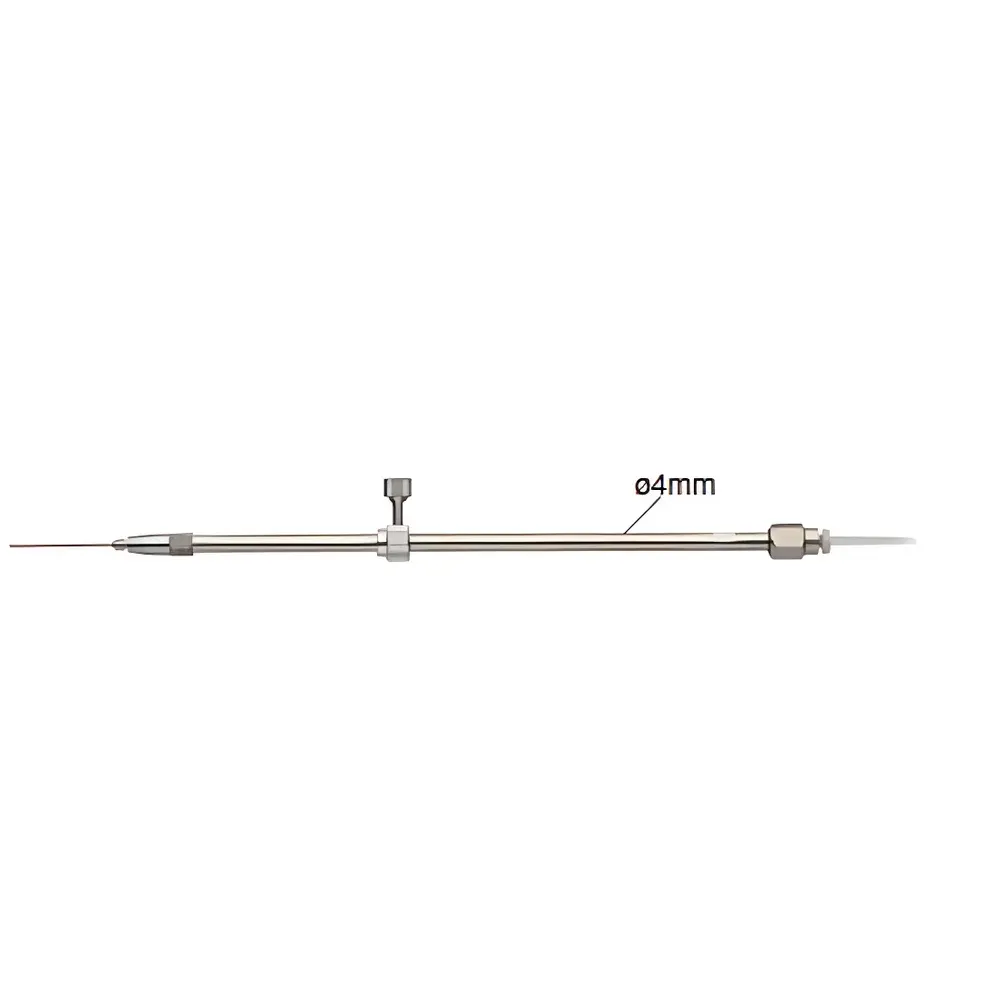
HI-9 Pneumatic Microinjector Handle by NARISHIGE
| Brand | NARISHIGE |
|---|---|
| Origin | Japan |
| Model | HI-9 |
| Compatible Capillary Outer Diameter | 1.0 mm |
| Weight | 18.6 g |
| Length | 155 mm |
| Includes | Silicone Rubber Gasket (HI01PK01), Cleaning Rod |
| Mounting Type | Standard Connector-Based Fixture with Rotatable HIR Clamp |
Overview
The HI-9 Pneumatic Microinjector Handle is a precision-engineered mechanical interface designed exclusively for integration with NARISHIGE’s pneumatic microinjection systems, including the IM-300 and IM-400 series injectors. It functions as a rigid, ergonomically optimized mounting platform that secures glass or fused-silica capillaries (OD = 1.0 mm) during high-accuracy intracellular, intranuclear, or cytoplasmic delivery procedures in live-cell manipulation workflows. Unlike manual or motorized injector handles, the HI-9 operates passively—transmitting pneumatic pressure pulses from the upstream controller to the capillary tip without introducing mechanical drift, thermal noise, or hysteresis. Its core design principle centers on mechanical stability, repeatable alignment, and torsional rigidity—critical parameters for maintaining consistent injection volume, timing, and positional fidelity across hundreds of sequential injections in single-cell experiments.
Key Features
- One-touch capillary insertion and ejection mechanism engineered to eliminate kinking, twisting, or lateral deflection of 1.0 mm OD micropipettes during loading and operation.
- HIR-series rotatable clamp assembly enabling ±180° continuous angular adjustment—essential for accommodating bent or angled capillaries used in oblique-angle microinjection (e.g., oocyte pronuclear injection or zebrafish embryo yolk sac access).
- Integrated standard connector interface compatible with NARISHIGE’s pneumatic tubing manifolds and pressure regulators (e.g., MF-9 or MP-2 units), ensuring leak-tight coupling and rapid system reconfiguration.
- Lightweight aluminum alloy housing (18.6 g) with anodized surface finish for corrosion resistance and electrostatic dissipation—optimized for use inside laminar flow hoods and inverted microscope stages.
- Includes silicone rubber gasket (part no. HI01PK01) for enhanced capillary grip and vibration damping, plus a dedicated cleaning rod for routine maintenance of the internal bore and sealing surfaces.
Sample Compatibility & Compliance
The HI-9 handle is validated for use with borosilicate and quartz capillaries meeting IEC 61000-4-2 ESD standards and ISO 8573-1 Class 4 compressed air purity requirements when paired with appropriate filtration. It supports capillary pull geometries commonly employed in embryology, neurophysiology, and CRISPR-Cas9 RNP delivery—including filamented, beveled, and laser-polished tips. While the device itself carries no active electronics or software, its mechanical architecture complies with GLP-aligned laboratory equipment documentation practices: full traceability via NARISHIGE serial-number engraving, RoHS-compliant material composition, and CE marking under Directive 2014/30/EU (EMC) and 2014/35/EU (LVD). No FDA 510(k) or IVDR classification applies, as it is classified as an ancillary mechanical component—not an IVD or therapeutic delivery device.
Software & Data Management
The HI-9 operates independently of software control; it is a purely mechanical transduction interface with no embedded firmware, sensors, or digital communication ports. All operational parameters—including injection pressure magnitude, duration, and pulse frequency—are managed externally via NARISHIGE’s pneumatic controllers (e.g., MP-2 with analog voltage input or MF-9 with TTL triggering). For laboratories requiring audit-ready records, integration with third-party acquisition platforms (e.g., MetaMorph, NIS-Elements, or custom LabVIEW applications) is achieved through hardware-triggered TTL signals synchronized to microscope stage coordinates and time-lapse imaging sequences. The absence of onboard data logging ensures deterministic latency and eliminates firmware-related validation overhead in regulated environments governed by 21 CFR Part 11 Annex 11 requirements.
Applications
- Microinjection into mammalian oocytes, zygotes, and blastocysts for transgenic model generation and assisted reproductive technology (ART) research.
- Precise cytoplasmic or nuclear delivery of dyes, antibodies, mRNA, sgRNA/Cas9 ribonucleoprotein complexes, or quantum dots in live-cell imaging and functional genomics assays.
- High-throughput single-cell perturbation studies requiring >200 repeatable injections per session under DIC or phase-contrast microscopy.
- Electrophysiology prep workflows where capillary integrity and tip alignment must remain invariant across patch-clamp and injection dual-modality configurations.
- Developmental biology experiments involving Xenopus laevis, Danio rerio, or Caenorhabditis elegans embryos, particularly where spatial constraints demand adjustable capillary orientation.
FAQ
Is the HI-9 compatible with non-NARISHIGE pneumatic controllers?
Yes—provided the controller delivers clean, regulated compressed air (0–100 psi) and uses standardized 1/8″ NPT or M5 threaded connectors. Adapter kits are available from authorized distributors.
Can the HI-9 be sterilized using autoclaving?
No. Autoclaving will degrade the silicone gasket and compromise aluminum anodization. Ethanol wipe-down or UV irradiation (254 nm, 30 min) is recommended for aseptic handling.
What capillary pullers are recommended for preparing 1.0 mm OD pipettes?
The PN-31 and PC-10 models from NARISHIGE are calibrated for optimal taper and tip geometry with this handle; Sutter P-1000 compatibility requires post-pull OD verification.
Does the HI-9 support pressure calibration traceability?
No—the handle itself does not measure pressure. Calibration must be performed at the controller level using NIST-traceable pressure transducers (e.g., Druck DPI 610).
Is replacement gasket HI01PK01 sold separately?
Yes—packaged as a 5-piece kit (HI01PK01) with batch-specific CoA; shelf life is 24 months when stored at 15–25°C in sealed packaging.




