
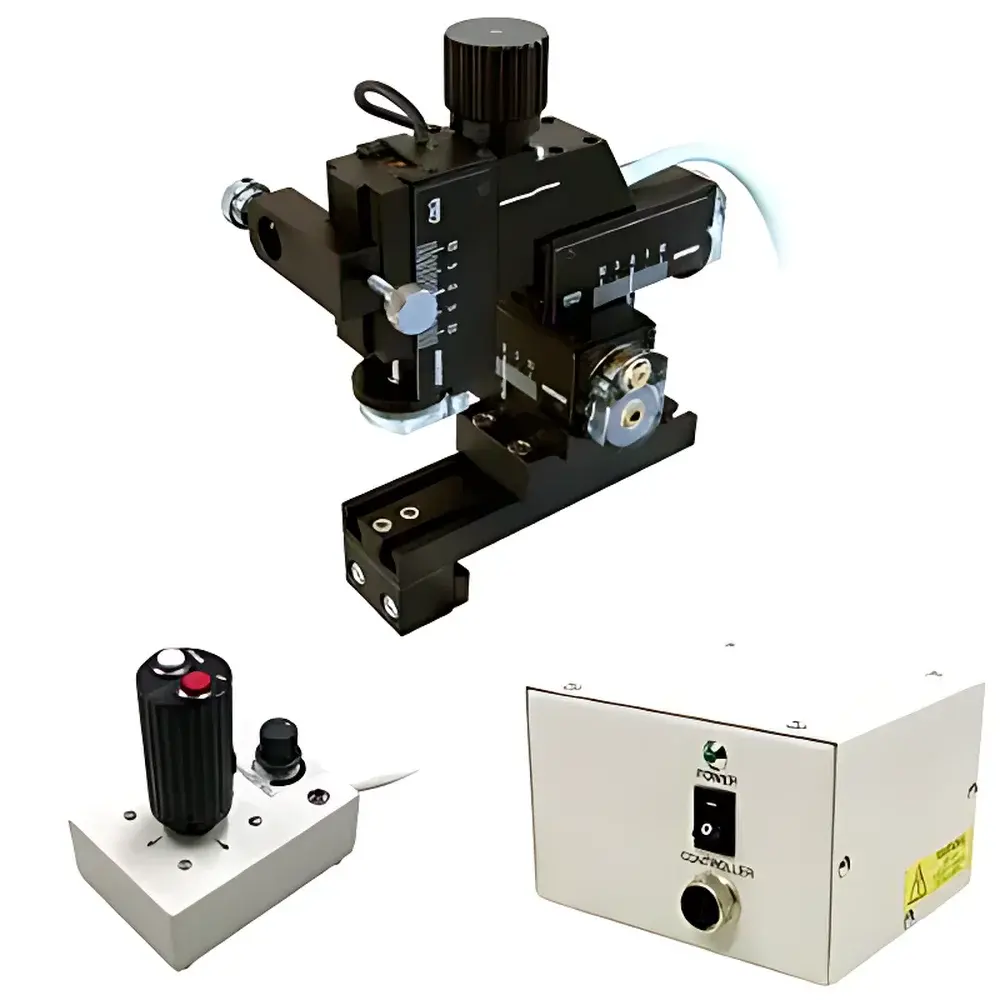
Narishige MM-89 Motorized Micromanipulator
| Brand | Narishige |
|---|---|
| Origin | Japan |
| Model | MM-89 |
| Drive Mechanism | Stepper Motor + Ball Screw |
| Resolution | 0.1 µm |
| Repeatability | ±0.5 µm |
| Travel Range (Coarse) | X/Y/Z = 22 mm × 22 mm × 22 mm |
| Driving Speed (Coarse Mode) | 1.4 mm/s |
| Speed Adjustment Range | 0.1–0.7 mm/s (X/Y), 0.2–2.8 mm/s (Z) |
| Interface | RS232 / USB |
| Power Input | AC 100–240 V (±5%), 50/60 Hz |
| Power Consumption | ~15 W |
| Noise Level | <40 dB(A) |
| Construction | 304 Stainless Steel & Anodized Aluminum |
| Overload Protection | Integrated Soft-Stop & Thermal Cut-off |
| Mounting | 10 mm Standard Rod + Magnetic Base |
| Accessories | AC Power Cord, Allen Wrench |
Overview
The Narishige MM-89 Motorized Micromanipulator is an electromechanically actuated precision positioning system engineered for high-fidelity manipulation of microtools—including glass micropipettes, patch-clamp electrodes, optical fibers, and AFM probes—within the focal plane of upright or inverted optical microscopes. It operates on the principle of closed-loop stepper motor control coupled with preloaded ball screw translation stages, delivering deterministic motion with sub-micrometer resolution and traceable repeatability. Designed specifically to address ergonomic limitations and positional drift associated with manual manipulators under high-magnification observation (≥40×), the MM-89 enables remote, vibration-isolated, and fatigue-free operation in demanding life science and materials characterization workflows. Its architecture adheres to fundamental metrological requirements for quantitative microscopy applications, supporting both real-time manual intervention and scripted automation via external host systems.
Key Features
- Three-axis independent motorized control (X, Y, Z) with coarse and fine speed modulation—enabling seamless transition between rapid repositioning (up to 1.4 mm/s) and nanoscale refinement (minimum step resolution: 0.1 µm)
- Proven mechanical repeatability of ±0.5 µm across full travel range (22 mm per axis), validated under ISO 230-2 test conditions for linear motion systems
- Dual-mode actuation interface: intuitive handheld controller with dual-axis joystick and tactile feedback switches, plus optional computer integration via RS232 or USB 2.0 for programmable trajectory execution
- Robust structural design using corrosion-resistant 304 stainless steel frame components and aerospace-grade anodized aluminum moving parts—compatible with common laboratory solvents and sterilization protocols
- Integrated electronic safeguards including current-limiting circuitry, thermal shutdown logic, and software-enforced soft-stop boundaries to prevent stage overtravel or motor stalling
- Low acoustic emission (<40 dB[A]) and minimal power draw (~15 W) ensure compatibility with electrophysiology rigs, cleanroom environments, and long-duration time-lapse experiments
Sample Compatibility & Compliance
The MM-89 is routinely deployed in GLP-compliant electrophysiology laboratories and ISO 17025-accredited materials testing facilities. Its mechanical stability and thermal inertia meet ASTM E2551-22 criteria for micropositioner performance in biological specimen handling. The device supports standard 10 mm diameter mounting rods and integrates seamlessly with Narishige’s full ecosystem of microscope adapters—including DIC-compatible side-entry holders, vibration-damped optical tables, and cryo-stage interfaces. All electrical subsystems conform to IEC 61000-6-3 (EMC emissions) and IEC 61010-1 (safety for laboratory equipment). Firmware logs include timestamped operational records suitable for FDA 21 CFR Part 11 audit trails when used with compliant data acquisition software.
Software & Data Management
While the MM-89 functions autonomously via its dedicated controller, it provides native command-line protocol support (ASCII-based SCPI-like syntax) for bidirectional communication with third-party platforms such as MATLAB, Python (PySerial), LabVIEW, or commercial electrophysiology suites (e.g., pCLAMP, PatchMaster). Positional coordinates, velocity states, and error flags are reportable in real time. Optional Narishige Control Software (v3.2+) adds path recording, multi-point coordinate registration, and G-code-style macro scripting—facilitating reproducible electrode approach sequences in patch-clamp or intracytoplasmic sperm injection (ICSI) protocols. All position data export in CSV or HDF5 format ensures compatibility with downstream statistical analysis pipelines.
Applications
- Electrophysiology: Precise alignment and advancement of patch pipettes during whole-cell or cell-attached recordings; automated “search-and-seal” routines for high-throughput ion channel screening
- Single-cell manipulation: CRISPR-Cas9 ribonucleoprotein delivery into nuclei; cytoplasmic injection of dyes or biosensors; organelle isolation via laser-assisted microdissection coupling
- Nanofabrication support: Positioning of conductive AFM tips for local oxidation lithography; graphene flake transfer onto TEM grids; quantum dot placement on photonic waveguides
- Industrial metrology: Non-contact alignment of fiber-optic couplers in semiconductor packaging; focal plane scanning for wafer-level lens inspection; stress-induced birefringence mapping in optical polymer films
- Crystallography & pharmaceutical QA: Immobilization and in situ monitoring of hydrate crystal growth kinetics; microinjection into protein crystallization droplets for seeding optimization
FAQ
What is the maximum load capacity supported by the MM-89 drive unit?
The MM-89 is rated for axial loads up to 1.2 kg without degradation in positional accuracy or mechanical hysteresis.
Can the MM-89 be synchronized with a motorized microscope stage or focus mechanism?
Yes—via TTL trigger input/output ports and serial command coordination, enabling coordinated XYZ motion between manipulator and stage for correlative imaging workflows.
Is firmware upgrade capability available, and how is it performed?
Firmware updates are delivered via USB connection using Narishige’s official utility; version history and release notes comply with ISO 13485 medical device software update standards.
Does the system support backlash compensation or homing routines?
The MM-89 does not perform automatic homing but includes mechanical zero-reference marks and supports user-defined origin offsets through software configuration.
Are calibration certificates traceable to NIST or JCSS standards available upon request?
Calibration reports—including linearity, repeatability, and thermal drift measurements—are available as optional add-ons, issued by Narishige’s Tokyo Metrology Center accredited to JCSS Class A standards.



