
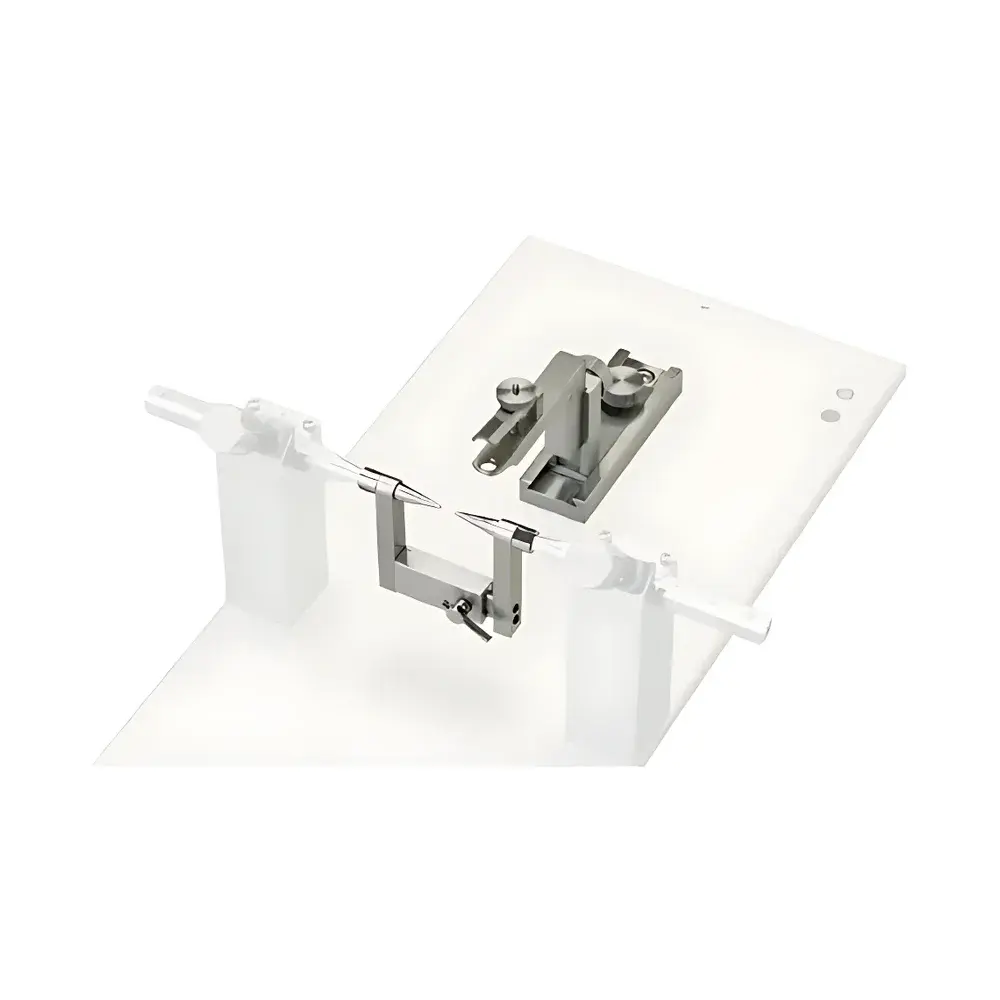
Narishige MA-6N Mouse Head Holder Adapter
| Brand | Narishige |
|---|---|
| Origin | Japan |
| Model | MA-6N |
| Ear Rod Adjustment Range | 0–40 mm (X-axis, graduated) |
| Rostral Mandibular Bar Adjustment Range | 0–30 mm (Y-axis) |
| Vertical Height Adjustment Range | 0–15 mm (Z-axis) |
| Positioning Resolution | 0.1 mm |
| Dimensions (W×D×H) | 20 × 98 × 50–70 mm |
| Weight | 132 g |
| Included Accessory | EB-5N Auxiliary Ear Bars |
Overview
The Narishige MA-6N Mouse Head Holder Adapter is a precision-engineered stereotactic accessory designed for stable, reproducible immobilization of murine subjects during neurophysiological, optogenetic, electrophysiological, and microinjection procedures. Built upon the foundational principles of stereotactic alignment—where anatomical landmarks (bregma, lambda, and interaural line) serve as fiducial references—the MA-6N enables three-dimensional positional control of the mouse skull relative to a fixed coordinate system. Its mechanical architecture follows the standard interface protocol compatible with Narishige’s MO series micromanipulators and STS series stereotactic frames, ensuring seamless integration into established neuroscience workflows. Unlike generic clamping systems, the MA-6N implements calibrated, micrometer-driven adjustments along orthogonal axes (X, Y, Z), directly supporting standardized atlas-based targeting (e.g., Paxinos & Franklin, 5th ed.) and minimizing inter-subject variability in craniotomy placement or electrode trajectory planning.
Key Features
- Precision-calibrated ear rods with engraved 0.1 mm graduations, adjustable across a 0–40 mm lateral range to accommodate variable interaural distances across C57BL/6, BALB/c, and transgenic strains.
- Rostral mandibular bar with 0–30 mm anterior-posterior travel, coupled with a spring-loaded incisor clamp that applies consistent, non-traumatic force (≤ 0.8 N) to the upper incisors without dental deformation.
- Independent vertical height adjustment (0–15 mm) for each ear rod and the mandibular bar, enabling precise leveling of the skull surface to the horizontal zero plane—critical for accurate bregma-lambda alignment per stereotactic coordinate protocols.
- Modular design featuring standardized M4 threaded mounting interfaces, allowing direct attachment to Narishige STS-1, STS-2, or third-party stereotactic frames with ISO 15380-compliant base plates.
- Includes EB-5N auxiliary ear bars (tapered stainless steel, Ø1.0 mm tip diameter) optimized for juvenile mice (P21–P35) or low-body-weight models (<20 g), extending experimental flexibility without compromising rigidity.
Sample Compatibility & Compliance
The MA-6N is validated for use with adult and adolescent mice (weight range: 18–35 g), including common inbred, outbred, and genetically modified lines. Its mechanical tolerances comply with ISO 13485-aligned manufacturing controls under Narishige’s quality management system. While not a medical device, the adapter supports GLP-compliant preclinical studies when used within SOPs referencing ASTM F2623-22 (Standard Guide for Stereotactic Neurosurgical Procedures in Rodents) and NIH OLAW-approved animal protocols. All contact surfaces are passivated 316L stainless steel, autoclavable at 121°C for ≥20 min, and certified free of endotoxins (<0.03 EU/mL) per USP .
Software & Data Management
As a purely mechanical positioning system, the MA-6N requires no embedded firmware, drivers, or proprietary software. Its operation is fully manual and deterministic—eliminating latency, calibration drift, or cybersecurity concerns associated with motorized alternatives. All positional settings are recorded manually in lab notebooks or digital ELN systems (e.g., LabArchives, Benchling) using standardized templates aligned with MIAME/MINSEQE metadata conventions. When integrated with Narishige’s MX series motorized manipulators (via optional MA-6N-MK mounting kit), position logs can be exported as CSV timestamps synchronized with electrophysiology acquisition platforms (e.g., Spike2, Open Ephys) for traceable experiment reconstruction.
Applications
- Intracranial electrode implantation for chronic LFP/MEA recording in hippocampal CA1, prefrontal cortex, or thalamic nuclei.
- Stereotactic viral vector delivery (AAV, lentivirus) with sub-100 µm injection site accuracy in Cre-driver lines.
- Two-photon imaging through cranial windows, where minimal skull movement (<1 µm RMS displacement over 2 hr) is essential for longitudinal dendritic spine tracking.
- Optrode-based photostimulation experiments requiring co-registered light delivery and electrical readout.
- Ex vivo brain slice preparation, where precise skull orientation ensures consistent coronal/horizontal sectioning angles across cohorts.
FAQ
Is the MA-6N compatible with non-Narishige stereotactic frames?
Yes—when mounted via ISO 15380-compatible base adapters (e.g., Leica Biosystems STS-Adapter Kit or Stoelting 51900 Frame Interface Plate). Mechanical fitment must be verified prior to use.
Can the EB-5N ear bars be sterilized repeatedly without degradation?
Yes—EB-5N bars withstand ≥50 cycles of steam autoclaving (121°C, 15 psi, 20 min) without measurable dimensional change or surface pitting, per Narishige QC test report #MA-6N-EB5N-2023-087.
What is the maximum recommended torque for tightening the ear rod locking screws?
0.25–0.35 N·m. Exceeding 0.4 N·m risks thread deformation and compromises repeatable repositioning accuracy.
Does the MA-6N support head tilt adjustment (pitch/roll)?
No—it maintains strict horizontal plane alignment only. For pitch/roll control, Narishige recommends pairing with the STS-2A Adjustable Angle Base or custom-machined angled base plates.
How often should the micrometer scales be recalibrated?
No periodic recalibration is required; the scales are factory-laser-engraved onto hardened stainless steel and retain metrological stability under normal laboratory environmental conditions (20–25°C, RH <60%).



