
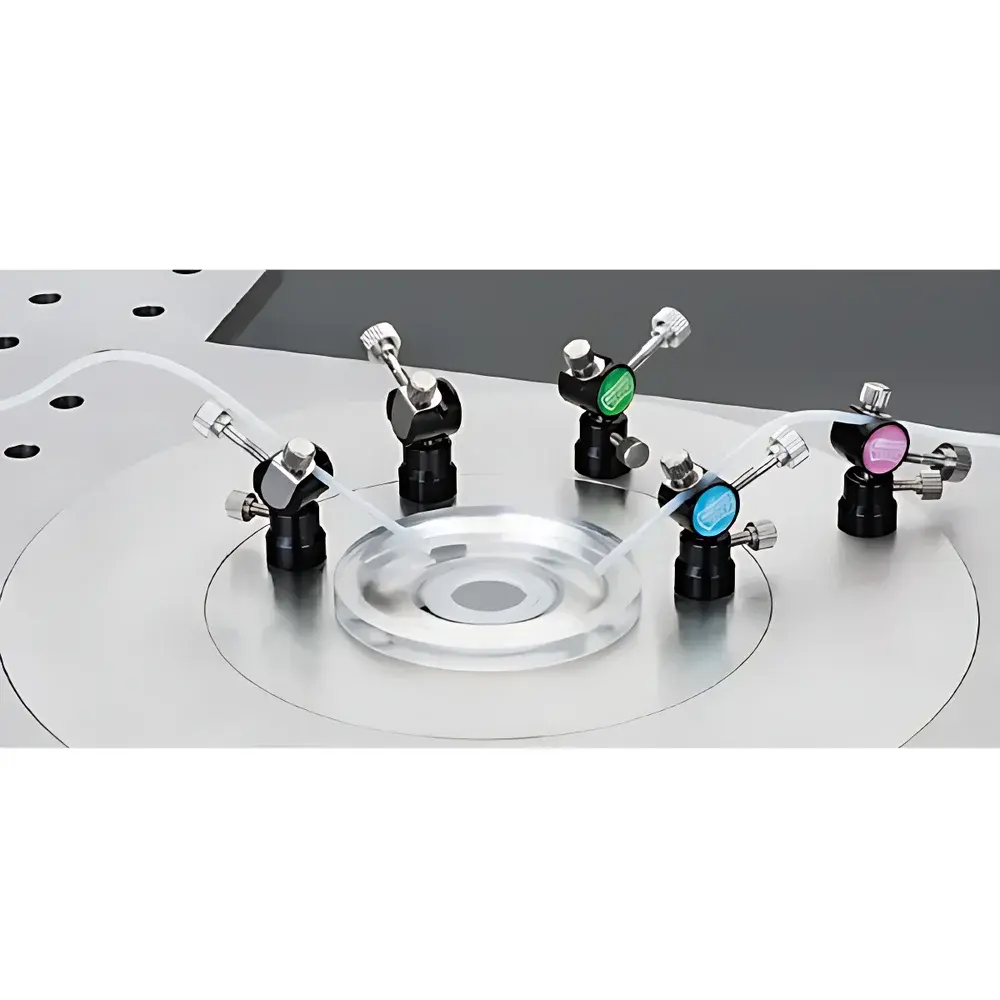
Narishige NAC-1O Perfusion Chamber System for ITS/Olympus Microscopes
| Brand | Narishige |
|---|---|
| Origin | Japan |
| Model | NAC-1O |
| Compatibility | Olympus IX73/IX83 inverted microscopes |
| Chamber Material | Medical-grade stainless steel & polycarbonate (PC) |
| Temperature Control Range | 20–40 °C (±0.5 °C) |
| Gas Input | CO₂ (5–10%) and O₂ (5–20%) |
| Flow Rate Range | 0.1–100 µL/min |
| Sterilization | Autoclavable at 121 °C for 20 min |
| Observation Window Thickness | 1 mm |
| Mounting Diameter | φ60 mm |
| Sealing | Silicone gasket + quick-connect fittings |
| Waste Collection | Integrated drain channel + collection reservoir |
Overview
The Narishige NAC-1O Perfusion Chamber System is an engineered solution for live-cell and tissue-level experimentation under precisely controlled physiological conditions. Designed specifically for integration with inverted microscope platforms—particularly the Olympus IX73 and IX83 series—and compatible with the Narishige ITS (Inverted Temperature System), the NAC-1O enables dynamic, long-term observation of biological specimens while maintaining native microenvironmental parameters. Its operational principle centers on laminar, low-shear perfusion through a biocompatible chamber architecture, where fluid exchange, thermal regulation, and gas equilibration occur simultaneously without mechanical or thermal disturbance to the sample. This system adheres to fundamental requirements for GLP-compliant cell-based assays and supports experimental rigor in applications demanding high spatiotemporal resolution—such as patch-clamp electrophysiology, time-lapse fluorescence imaging, and real-time pharmacological challenge studies.
Key Features
- Multi-channel perfusion capability with independent control of up to three fluid lines, enabling sequential or simultaneous delivery of culture medium, pharmacological agents, and buffering solutions.
- Integrated precision peristaltic pump module delivering stable flow rates from 0.1 to 100 µL/min, calibrated for reproducible shear stress profiles across microfluidic channels.
- Active temperature regulation via embedded Peltier-based heating element (20–40 °C range, ±0.5 °C stability), synchronized with Narishige ITS controllers for closed-loop thermal management.
- Dual-gas inlet ports supporting regulated CO₂ (5–10%) and O₂ (5–20%) supply, facilitating pH stabilization and hypoxic/normoxic condition modeling in vitro.
- Autoclavable modular construction: chamber body, lid, and fluid manifolds fabricated from medical-grade 316 stainless steel and USP Class VI-certified polycarbonate; all surfaces undergo hydrophilic surface treatment to minimize non-specific cell adhesion.
- Vibration-damped base with elastomeric isolation feet, reducing transmission of ambient mechanical noise to sub-micron optical paths during high-magnification imaging.
- EMI-shielded electronics housing, ensuring signal integrity during concurrent whole-cell patch-clamp recording and confocal microscopy.
Sample Compatibility & Compliance
The NAC-1O accommodates a broad spectrum of specimen formats including primary neuronal cultures, acute brain slices (200–400 µm), organoids, 3D hydrogel-embedded tumor spheroids, and endothelial monolayers. Its φ60 mm mounting interface conforms to standard inverted microscope stage specifications, while the 1 mm-thick optical-grade quartz observation window ensures compatibility with high-NA oil-immersion objectives (up to 100×). All wetted materials comply with ISO 10993-5 (cytotoxicity) and USP extractables testing protocols. The system supports adherence to ASTM E2912-22 (standard guide for in vitro cytotoxicity assays) and facilitates audit-ready documentation when paired with compliant data acquisition software.
Software & Data Management
While the NAC-1O operates as a hardware-integrated platform without proprietary firmware, it is fully compatible with third-party control environments including LabVIEW, MATLAB Data Acquisition Toolbox, and Python-based instrument drivers (PyVISA, PySerial). When used alongside Narishige’s ITS-3 temperature controller or external gas mixers (e.g., Cytotherm C-200), digital I/O signals enable synchronized logging of temperature, flow rate, and gas concentration metadata. All configuration parameters—including sterilization cycle logs, calibration timestamps, and user-defined perfusion sequences—are exportable in CSV or HDF5 format, supporting 21 CFR Part 11–compliant electronic records when deployed within validated laboratory information management systems (LIMS).
Applications
- Electrophysiology: Sustained viability of hippocampal brain slices during extracellular field potential or whole-cell patch-clamp recordings, with continuous artificial cerebrospinal fluid (aCSF) perfusion and CO₂/HCO₃⁻ buffering.
- Neurodegenerative disease modeling: Real-time monitoring of Aβ-induced synaptic dysfunction in human iPSC-derived neurons under physiologically relevant interstitial flow conditions.
- 3D cancer biology: Perfusion-driven invasion assays using collagen I/Matrigel matrices, coupled with time-resolved confocal tracking of fluorescently labeled tumor cells.
- Biomaterial testing: Dynamic corrosion assessment of titanium alloy implants immersed in simulated body fluid (SBF), with inline pH and ion concentration monitoring.
- Drug discovery: High-content screening of compound libraries via automated multi-step perfusion protocols—wash-in/wash-out kinetics, dose escalation, and recovery phase analysis.
FAQ
Is the NAC-1O compatible with upright microscopes?
No—the NAC-1O is mechanically and optically optimized for inverted configurations only, due to its bottom-access fluid routing and stage-mounted thermal interface.
Can the chamber be used for long-term (>24 h) live imaging?
Yes, provided that perfusion media are supplemented with appropriate nutrients and osmotic stabilizers; users must validate sterility maintenance through routine endotoxin testing of recirculated lines.
Does Narishige provide validation documentation for GMP environments?
Narishige supplies material traceability certificates and biocompatibility test summaries; full IQ/OQ/PQ protocol development requires collaboration with qualified third-party validation partners.
What is the maximum recommended pressure for fluid input lines?
Maximum inlet pressure is 100 kPa (14.5 psi); exceeding this threshold may compromise silicone gasket integrity and induce laminar-to-turbulent transition in microchannels.
Are replacement seals and tubing available as consumables?
Yes—Narishige offers OEM-certified silicone gaskets (Part No. NAC-GSKT), Tygon® LFL-400 tubing (ID 0.5 mm), and quick-connect ferrules (Part No. QCN-10) through authorized distribution channels.



