
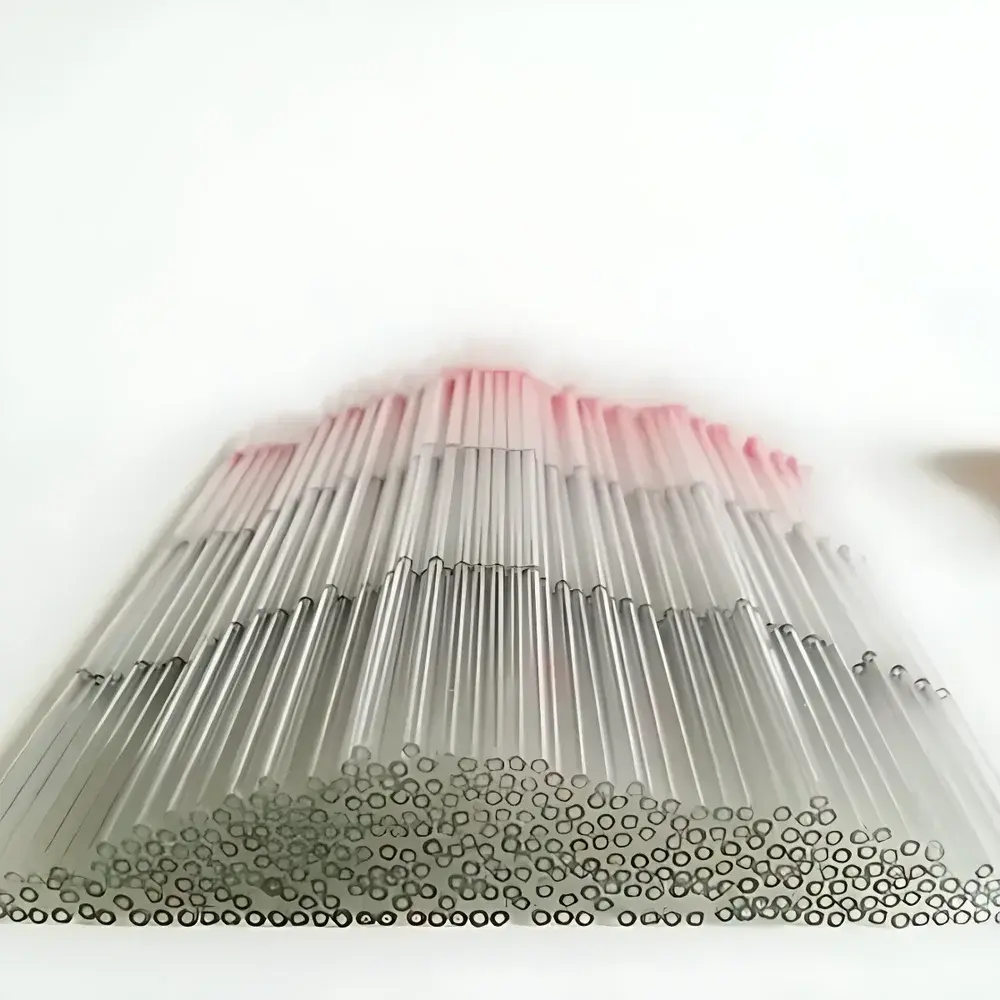
GD-1 Double-Tube Glass Capillary Tube by NARISHIGE
| Brand | NARISHIGE |
|---|---|
| Origin | Japan |
| Model | GD-1 |
| Type | Double-Bore Borosilicate Glass Capillary Tube |
| Material | High-Purity Borosilicate Glass (e.g., SCHOTT 8330 or equivalent) |
| Outer Diameter | 1.5 mm |
| Inner Diameter (each lumen) | 0.75 mm |
| Wall Thickness | 0.375 mm |
| Length | 100 mm |
| Sterilization Compatibility | Autoclavable (121°C, 20 min), Ethylene Oxide, and Gamma Irradiation |
| Packaging | Individually wrapped in sterile blister packs or bulk in Class 100 cleanroom bags |
| Compliance | ISO 13485–certified manufacturing, USP <381> compliant glass composition |
Overview
The GD-1 Double-Tube Glass Capillary Tube is a precision-engineered microfluidic component designed for rigorous life science applications requiring dual-channel fluid handling under controlled experimental conditions. Manufactured by NARISHIGE—a globally recognized Japanese provider of micromanipulation and microinjection instrumentation—the GD-1 is fabricated from medical-grade borosilicate glass conforming to USP specifications for extractables and biocompatibility. Its coaxial double-lumen architecture enables simultaneous delivery and aspiration, differential pressure control, or counter-flow configurations—critical for intracellular injection, patch-clamp electrode filling, microperfusion in slice electrophysiology, and in vivo microdialysis probe assembly. Unlike polymer-based alternatives, the GD-1 exhibits negligible adsorption, chemical inertness toward organic solvents and aqueous buffers (pH 1–14), and thermal stability up to 500°C short-term exposure, making it suitable for high-temperature sterilization cycles and laser-assisted fabrication processes.
Key Features
- Coaxial dual-bore geometry with precisely matched inner diameters (0.75 mm each) and concentric wall symmetry—ensuring laminar flow consistency and minimal cross-talk between channels.
- Borosilicate glass composition certified to ISO 13485 quality management standards, with traceable batch documentation supporting GLP and GMP-aligned workflows.
- Dimensional tolerance maintained within ±5 µm across outer diameter and lumen uniformity—validated via optical interferometry and scanning electron microscopy (SEM) metrology.
- Autoclavable at 121°C for 20 minutes without deformation or leaching; compatible with ethylene oxide (EtO) and gamma irradiation (25 kGy) sterilization protocols per ISO 11135 and ISO 11137.
- Surface treatment options available upon request—including silanization (e.g., with (3-aminopropyl)triethoxysilane) for covalent biomolecule immobilization or hydrophobic/hydrophilic modulation.
Sample Compatibility & Compliance
The GD-1 capillary demonstrates broad compatibility with biological samples including primary neurons, oocytes, zebrafish embryos, and organotypic brain slices. Its inert surface minimizes non-specific protein binding, preserving native conformation during microinjection of CRISPR-Cas9 ribonucleoprotein complexes, fluorescent dyes (e.g., Alexa Fluor 488–dextran), or viscous cytoplasmic extracts. The device complies with ASTM F2459-21 (Standard Guide for Evaluation of Extractables from Medical Devices) and supports regulatory submissions requiring material biocompatibility data per ISO 10993-5 and ISO 10993-12. Batch-specific certificates of analysis (CoA) include heavy metal content (Pb, As, Cd < 1 ppm), particulate count (<10 particles ≥5 µm per tube), and endotoxin levels (<0.03 EU/mL after saline rinse).
Software & Data Management
While the GD-1 is a passive consumable, its integration into automated platforms—such as NARISHIGE’s MO-202U micromanipulator or Sutter Instrument’s MPC-200 microdrive—is supported via standardized mounting interfaces (M6 thread, 10 mm hex base). When used with pressure-controlled microinjection systems (e.g., ALA Scientific BV-10 or CellMicroSystems MicroXact), the GD-1’s consistent hydraulic resistance enables reproducible pulse duration calibration and real-time flow rate modeling using Poiseuille’s law. Digital asset management is facilitated through NARISHIGE’s TraceLink™ system, which assigns unique QR-coded identifiers to each tube lot, linking to raw QC data, sterilization validation reports, and shelf-life tracking (36 months from manufacture when stored at 15–25°C, <60% RH).
Applications
- Intracytoplasmic sperm injection (ICSI) and pronuclear transfer in assisted reproductive technology (ART) laboratories.
- Dual-barrel recording electrodes for iontophoretic drug application combined with extracellular neural signal acquisition.
- Microfluidic interconnects in organ-on-chip devices requiring gas-permeable yet chemically resistant tubing segments.
- Reference capillaries in capillary electrophoresis (CE) system validation and electroosmotic flow (EOF) calibration.
- Custom puller templates for fabricating tapered dual-patch pipettes in subcellular electrophysiology.
FAQ
Is the GD-1 suitable for use with organic solvents such as chloroform or DMSO?
Yes—the borosilicate glass matrix is chemically resistant to halogenated hydrocarbons, dimethyl sulfoxide, ethanol, and most common laboratory solvents per ISO 8504-2 corrosion testing protocols.
Can the GD-1 be flame-polished without compromising lumen integrity?
Yes—controlled microtorch annealing (using H₂/O₂ or butane/air flame) yields smooth, rounded tips with minimal taper distortion; optimal tip diameter reduction is 10–15% per polishing cycle.
Does NARISHIGE provide custom length or diameter variants?
Yes—custom OD/ID combinations (e.g., 1.0 mm OD × 0.3 mm ID dual bore) and lengths (50–200 mm) are available under NARISHIGE’s OEM service program (lead time: 8–12 weeks).
What documentation accompanies each shipment?
Each box includes a Certificate of Conformance (CoC), sterilization validation report (if applicable), and a copy of the ISO 13485 certificate for the manufacturing facility.
How should unused GD-1 capillaries be stored long-term?
Store upright in original packaging at 15–25°C and relative humidity <60%; avoid exposure to UV light or acidic vapors to prevent surface hydration layer formation.



