
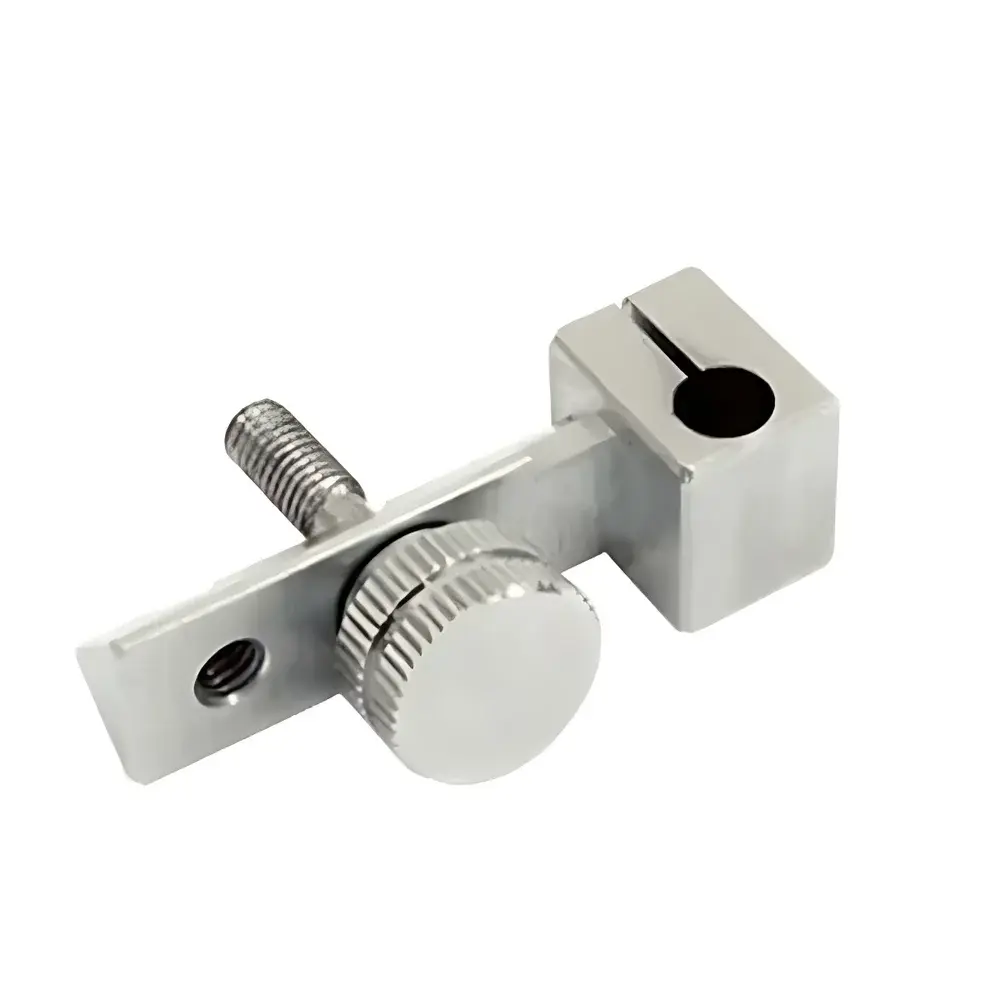
NARISHIGE SM-15C Coupling Adapter
| Brand | NARISHIGE |
|---|---|
| Origin | Japan |
| Manufacturer Type | Authorized Distributor |
| Origin Category | Imported |
| Model | SM-15C |
| Pricing | Available Upon Request |
| Compatible Shaft Diameter | Ø5 mm |
| Dimensions (W×D×H) | 38 × 13 × 12 mm |
| Weight | 24 g |
| Included Tool | Hex Key Wrench |
Overview
The NARISHIGE SM-15C Coupling Adapter is a precision-engineered mechanical interface component designed for high-fidelity, low-profile integration between micro-manipulation and optical instrumentation in life science laboratories. It operates on the principle of rigid coaxial coupling—mechanically securing two rotating or static shafts with nominal Ø5 mm outer diameter to maintain angular alignment and axial repeatability within micrometer-scale tolerances. Unlike generic adapters, the SM-15C is purpose-built for compatibility with NARISHIGE’s SM-15 series of motorized and manual micromanipulators (e.g., SM-15, SM-15A) and auxiliary devices such as the SHC-1 hydraulic micromanipulator head. Its function is not merely transitional but operational: it preserves positional integrity during fine adjustments, minimizes torque-induced wobble, and ensures zero backlash under repeated engagement cycles—critical for applications demanding sub-micron positional fidelity over extended experimental durations.
Key Features
- Precision-machined from high-strength, anodized aluminum alloy—offering optimal strength-to-weight ratio while resisting oxidation and organic solvent exposure common in cell culture and electrophysiology environments.
- Compact form factor (38 × 13 × 12 mm) and ultra-lightweight design (24 g) ensure minimal inertial loading on delicate manipulator arms and microscope stages—preserving dynamic stability during real-time positioning tasks.
- Integrated clamping mechanism with dual-point radial compression enables uniform grip force distribution across the Ø5 mm shaft surface, eliminating localized deformation or slippage even under intermittent vibrational loads.
- Hex-key-driven tightening system (included 1.5 mm hex wrench) provides calibrated torque application—ensuring repeatable fastening without risk of thread stripping or shaft marring.
- Zero-play interface geometry validated per NARISHIGE’s internal mechanical alignment protocol, supporting ≤ ±0.5° angular deviation after 100+ mating/unmating cycles.
Sample Compatibility & Compliance
The SM-15C is certified for use with all NARISHIGE instruments specifying Ø5 mm output shafts—including but not limited to the SM-15, SM-15A, SHC-1, and MN-4 micromanipulator heads. It complies with ISO 9001-certified manufacturing practices at NARISHIGE’s Tokyo facility and meets RoHS Directive 2011/65/EU requirements for hazardous substance restriction. While not a standalone measurement device, its mechanical interface performance supports GLP-compliant workflows where traceability of instrument interconnectivity is required—for instance, in FDA-regulated neurophysiology assay setups where manipulator calibration logs must reference coupling integrity. No electrical or optical functionality is embedded; therefore, no IEC 61000-4 electromagnetic compatibility testing applies.
Software & Data Management
As a passive mechanical adapter, the SM-15C does not incorporate firmware, sensors, or digital communication interfaces. Its role in data integrity is indirect but essential: by ensuring mechanical continuity between position-controlled hardware (e.g., SM-15 micromanipulator) and imaging systems (e.g., upright or inverted microscopes), it eliminates positional drift artifacts that could otherwise corrupt coordinate mapping in software platforms such as NARISHIGE’s MMS-10 control suite, MetaMorph, or MicroManager. Users are advised to document SM-15C installation events—including date, operator ID, and torque value applied—in their electronic lab notebook (ELN) to satisfy audit requirements under 21 CFR Part 11 when used in regulated preclinical research environments.
Applications
- Cellular electrophysiology: Securing patch-clamp pipette holders to micromanipulators while maintaining stable electrode trajectory during whole-cell recording.
- Live-cell imaging: Coupling motorized focus drives to microscope nosepieces to enable synchronized Z-stack acquisition without mechanical hysteresis.
- Optogenetics setup integration: Interfacing laser delivery collimators with XYZ translation stages for precise light targeting in brain slice preparations.
- Microinjection workflows: Linking pneumatic injectors to SM-15-based positioning arms in zebrafish or C. elegans embryo injection rigs.
- Custom rig assembly: Serving as a modular node in multi-instrument platforms where space-constrained, high-rigidity shaft coupling is non-negotiable.
FAQ
Is the SM-15C compatible with non-NARISHIGE equipment featuring Ø5 mm shafts?
Yes—provided the mating shaft exhibits standard cylindrical geometry, smooth surface finish (Ra ≤ 0.8 µm), and sufficient concentricity tolerance (< 0.02 mm runout). However, full functional validation is the user’s responsibility.
Does the SM-15C require periodic recalibration?
No. As a passive mechanical component without adjustable metrological elements, it requires only visual inspection for wear or deformation prior to critical experiments.
Can the SM-15C be sterilized for use in sterile tissue culture environments?
It is compatible with 70% ethanol wipe disinfection and UV-C irradiation (254 nm, ≤30 min). Autoclaving, ethylene oxide, or hydrogen peroxide plasma sterilization is not recommended due to thermal and chemical sensitivity of the anodized surface.
What is the maximum permissible torque for tightening the clamping screw?
The integrated M2.5 × 0.45 thread is rated for a maximum tightening torque of 0.15 N·m—exceeding this may compromise clamping consistency or damage the shaft interface.



