
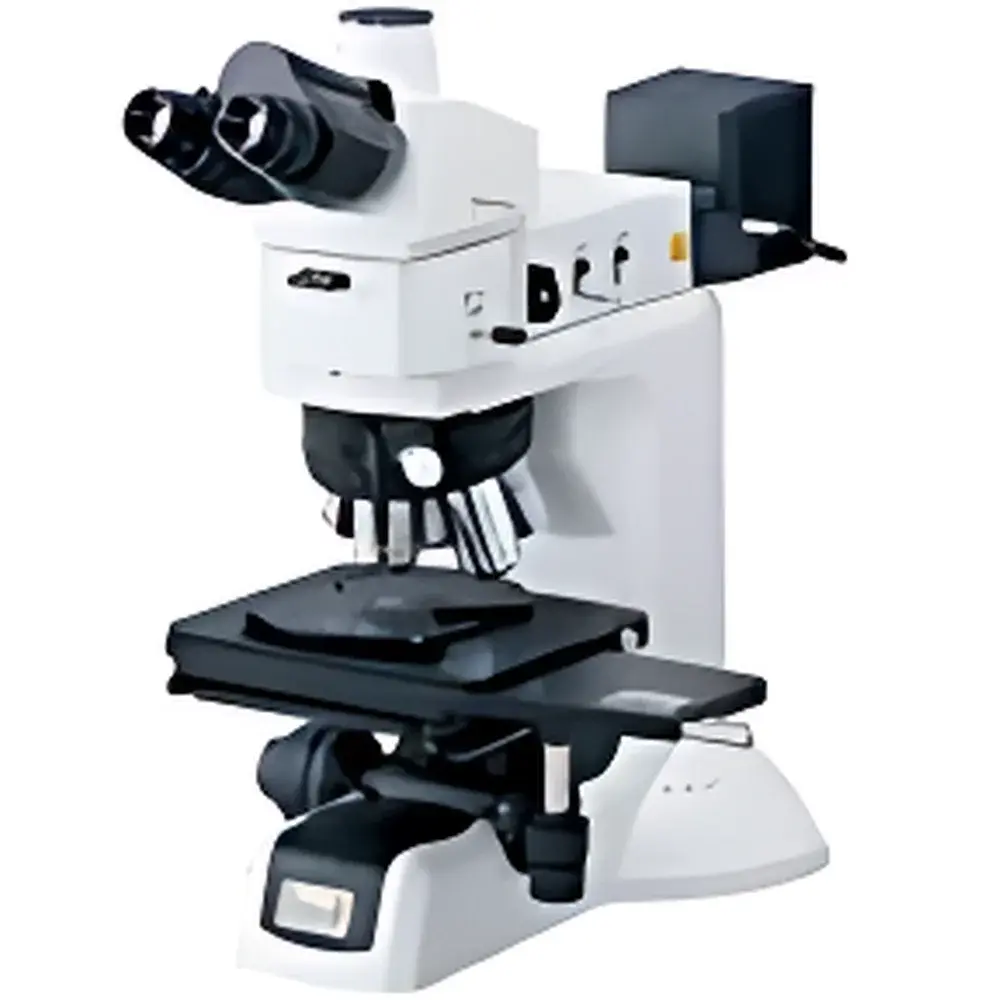
Nikon Ci-POL Polarizing Microscope
| Brand | Nikon |
|---|---|
| Origin | Japan |
| Model | Ci-POL |
| Optical System | CFI60 Infinity-Corrected |
| Objective Type | CFI P Achromat Polarizing (4X–100X Oil) |
| Illumination | 12 V, 50 W Halogen (equivalent to 12 V, 100 W output) |
| Analyzer | 360° Rotatable, 0.1° Graduation |
| Bertrand Lens | Focusing Type |
| Compensation Plates | Standard λ/4 Plate & Quartz Wedge |
| Stage | 360° Rotatable Mechanical Stage (1° Accuracy), 35 × 25 mm Travel |
| Focusing Range | 30 mm Vertical Travel |
| Max. Specimen Height | 82 mm (with LV-CR Spacer 35) |
| Observation Modes | Brightfield, Darkfield, Simple Polarization, DIC, Reflected Fluorescence (Visible/UV), Two-Beam Interference, Senarmont & Conoscopy |
| Compliance | RoHS-compliant optical glass (Pb/As-free) |
| Software Integration | NIS-Elements compatible |
| Weight | ~14 kg |
Overview
The Nikon Ci-POL Polarizing Microscope is an engineered solution for quantitative birefringence analysis and crystallographic characterization in research, education, and industrial quality assurance environments. Built upon Nikon’s CFI60 infinity-corrected optical architecture, the Ci-POL implements rigorous polarized light microscopy (PLM) principles grounded in Maltese cross extinction, conoscopic interference pattern generation, and retardation measurement via compensator-based phase shift analysis. Its dual-path illumination system—supporting both transmitted and reflected light modalities—enables consistent evaluation of anisotropic structures across diverse specimen types: geological thin sections, polymer films, liquid crystals, pharmaceutical crystals, biological fibrils, and semiconductor wafers. The instrument adheres to foundational metrological requirements defined in ASTM D4123 (Standard Test Method for Determining Birefringence of Plastics), ISO 10110-5 (Optics and photonics — Specification of optical components — Part 5: Surface form tolerances), and USP (Microscopic Identification of Pharmaceutical Crystals), ensuring traceable, repeatable data acquisition under GLP-aligned workflows.
Key Features
- CFI60 infinity-corrected polarizing optics with CFI P Achromat objectives (4X–100X oil immersion), delivering flat-field, apochromatically corrected imaging free from chromatic and spherical aberrations.
- Dual-mode illumination: Transmitted Köhler illumination and reflected LV-UEPI-N universal epi-illuminator (50 W halogen, luminous output equivalent to 100 W standard source), enabling simultaneous brightfield, darkfield, and polarization contrast on opaque or semi-transparent samples.
- Precision polarization train: Motor-assisted or manual 360° rotatable analyzer with 0.1° angular resolution; focusing Bertrand lens for high-fidelity conoscopy; integrated λ/4 plate and quartz wedge for quantitative retardation measurement (Δn·d) and sign-of-elongation determination.
- High-stability mechanical stage: 360° rotation with ±1° positional repeatability and 35 × 25 mm XY travel; detachable configuration supports third-party stages (e.g., Suruga Seiki B23-60CR) for extended vertical working distance (up to 116.5 mm).
- Ergonomic focusing mechanism: 30 mm coarse/fine focusing range with clutch-controlled upper-stage locking—optimized for safe handling of tall specimens such as petrographic rock slabs or packaged optical components.
- RoHS-compliant optical design: All CFI PLAN FLUOR and CFI L PLAN EPI CR objectives fabricated using lead- and arsenic-free eco-glass, meeting EU Directive 2011/65/EU environmental safety thresholds.
Sample Compatibility & Compliance
The Ci-POL accommodates a broad spectrum of specimen geometries and optical properties—from 30 µm-thick geological thin sections to 82 mm-tall mounted industrial components. Its modular stage interface permits integration with motorized XYZ translation units, heating/cooling stages (−20°C to +200°C), and environmental chambers for in situ thermal birefringence mapping. Regulatory alignment includes full support for FDA 21 CFR Part 11 audit trails when paired with NIS-Elements BR software (electronic signature, user access control, and immutable metadata logging). Instrument validation documentation complies with ISO/IEC 17025:2017 clause 6.4.10 (measurement equipment verification) and satisfies internal QA protocols for GMP-regulated pharmaceutical crystallinity assessment per ICH Q5A(R2).
Software & Data Management
NIS-Elements software provides native driver-level integration for real-time image capture, multi-channel polarization series acquisition (e.g., analyzer rotation stacks), and automated birefringence quantification. Key analytical modules include: (i) Retardation calibration using standard quartz reference slides; (ii) Orientation mapping via fast Fourier transform (FFT)-based director angle extraction; (iii) Interference figure annotation with isogyre/isochromatic overlay tools; (iv) Batch export of TIFF/OME-TIFF files with embedded EXIF metadata (objective magnification, analyzer angle, exposure time, lamp intensity). All measurement logs are timestamped and linked to user credentials, fulfilling ALCOA+ data integrity criteria (Attributable, Legible, Contemporaneous, Original, Accurate, Complete, Consistent, Enduring, Available).
Applications
- Materials Science: Quantitative assessment of polymer chain orientation in extruded films, stress-induced birefringence in injection-molded lenses, and domain alignment in ferroelectric liquid crystals.
- Geosciences: Mineral identification in thin sections using optic sign, extinction angle, and interference color charts per Deer, Howie & Zussman nomenclature; twinning analysis in feldspars and micas.
- Pharmaceutical Development: Polymorph discrimination in active pharmaceutical ingredients (APIs), crystallinity grading of lyophilized formulations, and detection of amorphous content in tablet matrices.
- Life Sciences: Visualization of collagen fiber anisotropy in connective tissues, microtubule alignment in mitotic spindles, and amyloid β-fibril birefringence under Congo red staining.
- Industrial Metrology: Stress mapping in tempered glass, residual strain evaluation in optical adhesives, and uniformity inspection of stretched polyethylene terephthalate (PET) films.
FAQ
What polarization observation methods does the Ci-POL support?
Brightfield, darkfield, simple polarization, differential interference contrast (DIC), reflected fluorescence (visible and UV excitation), two-beam interference, Senarmont compensation, and conoscopic observation.
Can the Ci-POL be used for quantitative birefringence measurement?
Yes—using the built-in λ/4 plate, quartz wedge, and rotating analyzer, users can determine retardation values (nm) and optical sign with sub-degree angular precision.
Is the microscope compliant with regulatory data integrity standards?
When operated with NIS-Elements BR v5.0+, the system supports 21 CFR Part 11 compliance through electronic signatures, role-based access control, and immutable audit trails.
What is the maximum specimen height supported without modifications?
82 mm when used with the LV-CR spacer 35; up to 116.5 mm when combined with LV-SUB Stage 2 and compatible third-party mechanical stages.
Are replacement objectives available with enhanced numerical aperture or correction for specific wavelengths?
Yes—Nikon offers CFI P Fluor and CFI P Apo objectives optimized for UV transmission and higher NA performance, all maintaining CFI60 mechanical and optical compatibility.




