
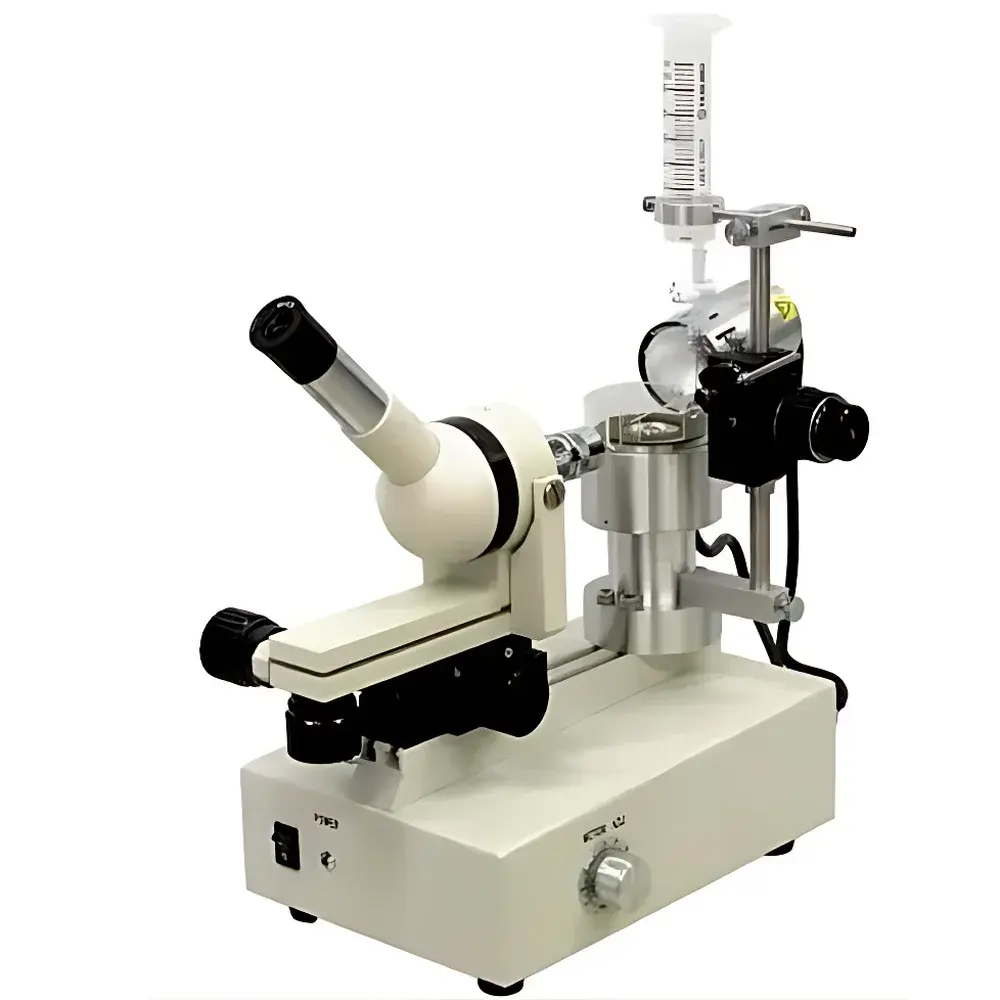
NARISHIGE EG-402 Microelectrode Puller & Grinder with Integrated Stereo Microscope
| Brand | NARISHIGE |
|---|---|
| Origin | Japan |
| Model | EG-402 |
| Accessories | Vertical Grinding Adapter, Diamond Wheel, Pipette Holder, Allen Wrench, Spare Lamp, AC Power Cord |
| Movement Range (Up–Down Manipulator) | ~47 mm |
| Microscope Travel (X/Y/Z) | ~7 mm / ~30 mm / ~8 mm |
| Magnification | 30× (10× Eyepiece × 3× Objective) |
| Compatible Capillary OD | 1.0–1.5 mm |
| Motor Speed | 50–2,000 rpm |
| Power Input | AC 100–240 V (±5%), 50/60 Hz |
| Power Consumption | ~50 W |
| Dimensions (W×D×H) | 250 × 450 × 400 mm |
| Weight | 6.6 kg |
| Water Supply/Drain System | Integrated for debris mitigation |
| Angle Measurement | Equipped with calibrated protractor on pipette holder |
Overview
The NARISHIGE EG-402 is a precision-engineered microelectrode fabrication system designed for the reproducible preparation of sharp, geometry-controlled glass micropipettes used in electrophysiology, microinjection, and microfluidic interfacing. Unlike conventional pullers or standalone grinders, the EG-402 integrates a high-stability rotational grinding mechanism with an optically coupled stereo microscope (30× total magnification), enabling real-time visual feedback during tip shaping. Its core principle relies on controlled abrasive contact between a diamond-coated grinding wheel and a vertically or angularly positioned capillary—driven by a low-vibration DC motor operating across a wide speed range (50–2,000 rpm). This architecture ensures minimal thermal distortion and mechanical chatter, critical for achieving sub-micron tip consistency in patch-clamp electrodes, injection needles, and aspiration probes. The system is not a thermal puller; it is a mechanical grinder optimized for post-pull sharpening, beveling, and angle-specific tip conditioning—making it indispensable where tip geometry, edge integrity, and reproducibility outweigh pure taper length.
Key Features
- Integrated stereo microscope with 10× eyepiece and 3× objective lens (30× total magnification), mounted on a three-axis mechanical stage (X: ~7 mm, Y: ~30 mm, Z: ~8 mm) for precise optical alignment and focal tracking during grinding.
- Coaxial coarse/fine focus manipulator with ~47 mm vertical travel range, enabling stable, vibration-damped positioning of capillaries relative to the grinding wheel.
- Calibrated protractor mounted directly on the pipette holder, allowing direct readout and repeatable setup of grinding angles from 0° (vertical) to >45°—critical for optimizing access geometry in confined tissue preparations or microfluidic channels.
- Dedicated vertical grinding adapter included as standard, ensuring orthogonal tip formation without manual reorientation or alignment drift.
- Integrated water supply and drainage manifold that delivers continuous coolant flow to the grinding interface while evacuating glass debris—preventing wheel clogging, thermal buildup, and tip contamination.
- Universal AC power compatibility (100–240 V, 50/60 Hz) and low power draw (~50 W) support deployment in multi-instrument labs without dedicated circuits.
Sample Compatibility & Compliance
The EG-402 accepts borosilicate or quartz glass capillaries with outer diameters of 1.0–1.5 mm—standard dimensions for patch-clamp, intracellular recording, and microinjection applications. Its mechanical grinding approach avoids thermal stress-induced crystallinity changes or surface devitrification common in laser or filament-based systems. While the instrument itself does not carry CE or FDA 510(k) certification as a medical device, its design adheres to general laboratory equipment safety standards (IEC 61010-1) and supports GLP-compliant documentation when integrated into validated electrophysiology workflows. All accessories—including diamond wheel, pipette holder, and vertical adapter—are manufactured to NARISHIGE’s ISO 9001-certified quality control specifications, ensuring interchangeability and long-term dimensional stability.
Software & Data Management
The EG-402 operates as a hardware-only platform with no embedded firmware or digital control interface. All operational parameters—including motor speed, grinding duration, and angle setting—are manually configured and recorded externally. This analog architecture eliminates software validation overhead and ensures deterministic behavior under ISO/IEC 17025 or FDA 21 CFR Part 11 environments where audit trails must originate from user logs or LIMS entries—not proprietary firmware. Users commonly pair the EG-402 with calibrated digital calipers, SEM imaging, and resistance measurement systems (e.g., using Axon Instruments amplifiers) to generate traceable tip geometry and electrical characterization datasets.
Applications
- Electrophysiology: Fabrication of low-resistance, low-noise patch pipettes for whole-cell, cell-attached, and perforated patch configurations; beveled electrodes for improved seal formation in brain slice or retinal preparations.
- Microinjection & Transgenesis: Production of rigid, non-clogging injection needles for pronuclear injection, CRISPR ribonucleoprotein delivery, and oocyte enucleation in developmental biology.
- Single-Cell Manipulation: Custom sharpening of aspiration pipettes for gentle cell capture, organelle isolation, or microalgae sorting in flow-through microfluidic traps.
- Microfluidics Integration: Tip angling and diameter reduction to match inlet geometries of PDMS or glass microchannels, minimizing dead volume and improving laminar flow coupling.
- Materials Science Probing: Preparation of conductive or insulated probe tips for localized electrochemical scanning or nanoscale mechanical indentation.
FAQ
Is the EG-402 compatible with quartz capillaries?
Yes—it accommodates fused silica and borosilicate capillaries within the specified 1.0–1.5 mm outer diameter range, though grinding time and wheel wear rate increase with quartz hardness.
Does the system include calibration documentation for the protractor or manipulator scales?
No factory calibration certificate is supplied; users are advised to verify angular accuracy using optical goniometry and linear travel via certified gauge blocks prior to GxP-critical use.
Can the diamond wheel be reconditioned or replaced in-house?
Yes—the wheel mounts via standardized M6 threads and may be replaced using the included Allen wrench; NARISHIGE supplies OEM-replacement wheels (Part No. EG-WHEEL-DIA) with documented grit uniformity and concentricity.
What maintenance intervals are recommended for the water circulation system?
Daily visual inspection of inlet/outlet lines and weekly flushing with deionized water are advised; the integrated drain valve allows full system evacuation to prevent biofilm accumulation in humid lab environments.
Is the microscope parfocal and parcentral across magnification changes?
The fixed 3× objective and 10× eyepiece provide a single, non-zoom optical path—eliminating parfocal shift concerns but requiring manual refocusing after stage repositioning.
Related Products



