
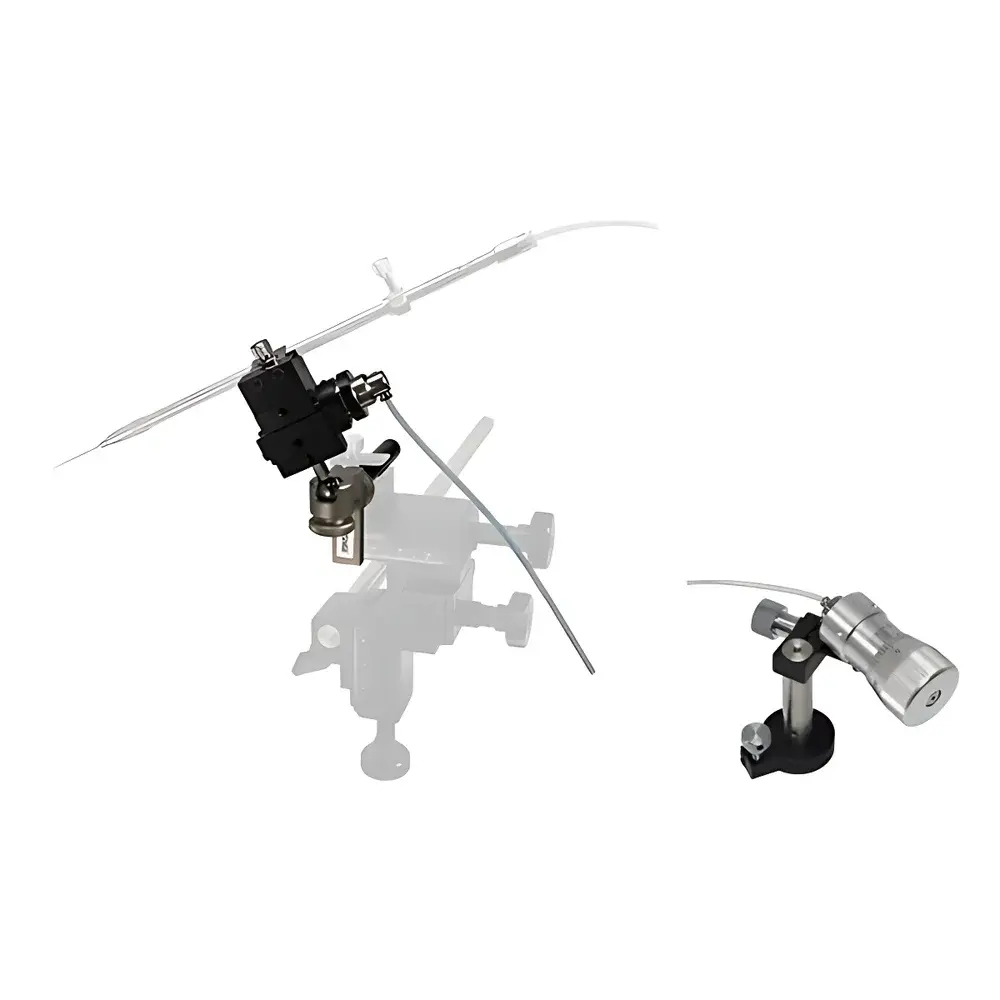
NARISHIGE MMO-220C One-Axis Oil-Hydraulic Micromanipulator
| Brand | NARISHIGE |
|---|---|
| Origin | Japan |
| Model | MMO-220C |
| Coarse Travel Range | 10 mm |
| Full Knob Rotation Displacement | 1 mm |
| Minimum Scale Division | 20 µm |
| Controller Dimensions (W×D×H) | 55 × 45 × 80 mm, 140 g |
| Drive Unit Dimensions (W×D×H) | 45 × 20 × 35 mm, 90 g |
| Hydraulic Tubing Length | 0.9 m |
Overview
The NARISHIGE MMO-220C One-Axis Oil-Hydraulic Micromanipulator is a precision mechanical positioning instrument engineered for stable, low-drift, and vibration-insensitive manual micromanipulation in life science and electrophysiology laboratories. Operating on the principle of incompressible oil transmission, the device converts fine rotational input at the control knob into smooth, backlash-free linear displacement of the drive unit via hydraulic coupling—eliminating gear play, friction-induced hysteresis, and thermal drift common in screw-driven or piezoelectric alternatives. Its 10 mm coarse travel range supports initial probe placement, while the calibrated 1 mm per full-turn ratio and 20 µm minimum scale division enable reproducible sub-micron estimation during coarse positioning tasks. Designed for integration with upright and inverted microscopes, patch-clamp rigs, and microinjection setups, the MMO-220C serves as a foundational tool for applications requiring deterministic, tactile feedback–based manipulation without electronic actuation.
Key Features
- Oil-hydraulic transmission mechanism ensures zero mechanical backlash, minimal hysteresis, and long-term positional stability under static load.
- High-resolution mechanical scale with 20 µm graduation allows visual estimation of displacement increments without external readout systems.
- Modular architecture separates the compact controller (55 × 45 × 80 mm, 140 g) from the lightweight drive unit (45 × 20 × 35 mm, 90 g), facilitating flexible mounting on microscope stages, manipulator arms, or custom optical tables.
- 0.9 m length of reinforced hydraulic tubing provides sufficient working distance while maintaining pressure integrity and minimizing compliance-related lag.
- Knob torque profile optimized for dexterous single-finger operation—ideal for extended-duration procedures such as intracellular electrode penetration or embryo microinjection.
- No electrical power, batteries, or firmware required; fully compatible with Faraday cages, high-voltage electrophysiology environments, and MRI-adjacent labs.
Sample Compatibility & Compliance
The MMO-220C is routinely deployed in GLP-aligned neurophysiology and developmental biology workflows where regulatory traceability of manual intervention is essential. While the device itself carries no active sensing or data logging capability, its mechanical repeatability supports documentation protocols compliant with ISO/IEC 17025 (General requirements for the competence of testing and calibration laboratories) when used within validated experimental SOPs. The stainless steel and anodized aluminum construction resists corrosion from ethanol, 70% isopropanol, and standard saline buffers. It meets RoHS Directive 2011/65/EU for hazardous substance restrictions and bears CE marking for conformity with EU health, safety, and environmental protection standards. No FDA 21 CFR Part 11 requirements apply, as the unit performs no electronic record generation or user authentication.
Software & Data Management
The MMO-220C operates independently of software and does not interface with digital acquisition systems. Positional data must be manually recorded in lab notebooks or electronic lab notebooks (ELNs) as part of procedural metadata. Users integrating the manipulator into automated workflows typically pair it with third-party motorized stages or vision-based tracking systems (e.g., using OpenCV or Micro-Manager) for hybrid semi-automated protocols. NARISHIGE provides no proprietary drivers, SDKs, or API documentation for this model—consistent with its design intent as a purely mechanical, human-in-the-loop positioning aid.
Applications
- Manual patch-clamp electrode positioning during whole-cell or cell-attached recordings.
- Microinjection of zygotes, oocytes, or early-stage embryos in transgenic model organism studies (e.g., mouse, zebrafish, C. elegans).
- Placement and alignment of glass micropipettes in single-cell electroporation or iontophoresis experiments.
- Adjustment of microelectrode arrays or silicon probes during acute brain slice recordings.
- Positioning of optical fibers or photostimulation waveguides in optogenetics preparations.
- Alignment of microneedles or microfluidic probes in organ-on-chip interface experiments.
FAQ
Is the MMO-220C compatible with vibration-isolation tables?
Yes—the absence of motors, solenoids, or switching electronics eliminates electromagnetic and mechanical noise sources, making it suitable for use on passive and active vibration-damping platforms.
Can the hydraulic tubing be replaced or extended?
NARISHIGE specifies 0.9 m as the factory-calibrated length; extension beyond this requires recalibration of the displacement-to-rotation ratio due to fluid compressibility and line compliance effects. Replacement tubing must match inner diameter (ID = 0.5 mm), wall thickness (0.3 mm), and material compatibility (medical-grade polyurethane or nylon).
Does the device support fine adjustment below 20 µm?
No—the 20 µm scale represents the smallest visually resolvable increment. Sub-20 µm adjustments rely on operator tactile perception and are not quantitatively verifiable without external metrology (e.g., laser interferometry or high-magnification video tracking).
What maintenance is required?
Annual inspection of hydraulic seals and tubing for microcracks or leakage; cleaning of the control knob and drive unit surfaces with lint-free cloth and isopropanol. No lubrication of internal components is permitted—oil volume is sealed and pre-charged at manufacture.



