
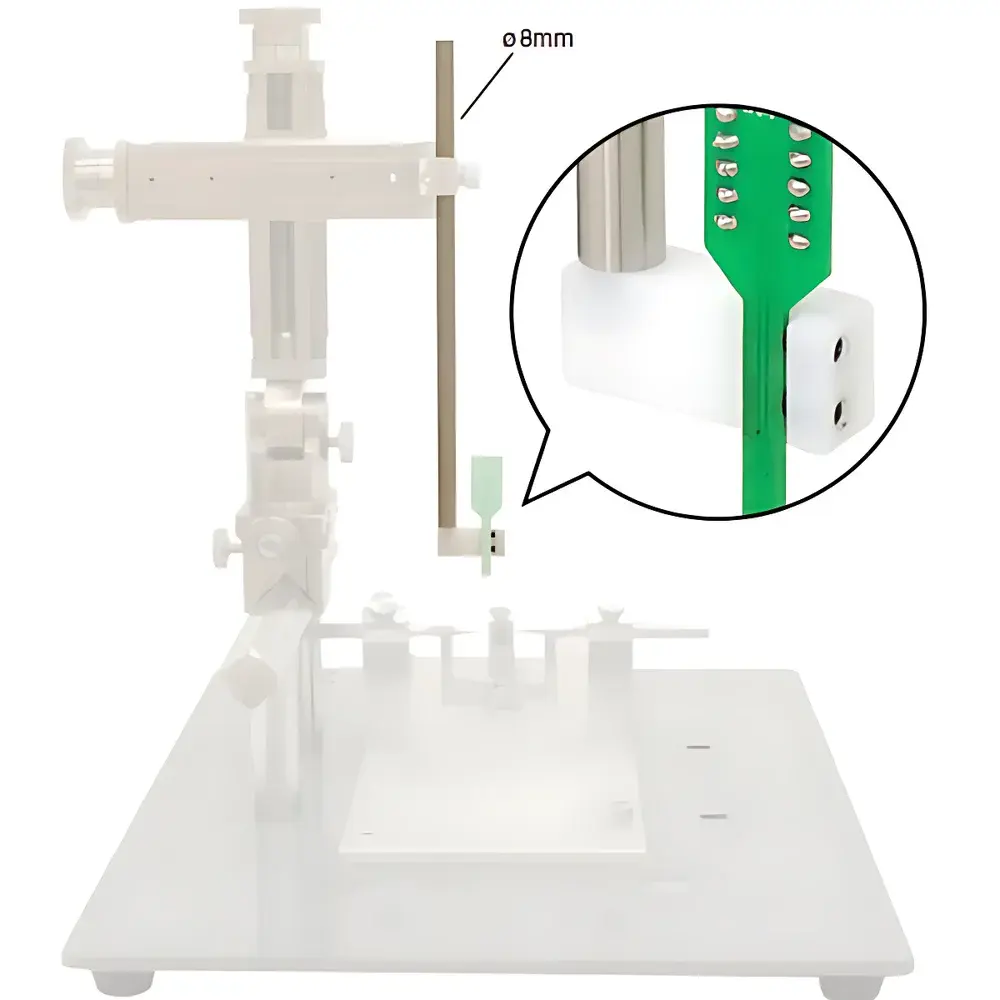
Narishige SMM-HB Silicon Probe Holder
| Brand | Narishige |
|---|---|
| Origin | Japan |
| Model | SMM-HB |
| Dimensions | 28 mm (W) × 8 mm (D) × 212 mm (H) |
| Weight | 85 g |
| Compatible Probe Thickness | ≤ 2 mm |
| Compatible Probe Width | 2.5–5 mm |
| Compatible Probe Length | ≥ 12 mm |
| Material | Non-conductive resin block |
| Mounting Interface | SMM-series micromanipulators |
| Adjustability | Rotatable support segment (left/right orientation), detachable from main shaft |
| Included Accessories | Hex wrench, fixing knob, set screws ×2 |
Overview
The Narishige SMM-HB Silicon Probe Holder is a precision mechanical mounting accessory engineered for electrophysiological and optogenetic experiments requiring high spatial fidelity and electrical isolation. Designed exclusively for integration with Narishige’s SMM-series motorized or manual micromanipulators, the SMM-HB provides secure, repeatable fixation of rigid silicon-based neural probes—commonly used in acute and chronic in vivo recordings, closed-loop stimulation paradigms, and high-density neural interfacing. Unlike the SMM-HA variant—which positions probes in close proximity to the manipulator axis—the SMM-HB enables lateral offset mounting, allowing optimal probe trajectory alignment relative to cranial landmarks, dura surface geometry, or implanted guide cannulae. Its non-conductive resin mounting block eliminates parasitic coupling between the probe substrate and manipulator body, preserving signal integrity in low-noise extracellular recording applications (e.g., single-unit spike sorting, local field potential acquisition). The holder’s modular architecture supports rapid reconfiguration without recalibration, making it suitable for multi-probe insertion protocols and stereotaxic workflows compliant with standard rodent and non-human primate neurosurgical coordinates.
Key Features
- Lateral Offset Capability: Positions silicon probes at a defined radial distance from the manipulator axis—enabling oblique or parallel insertion angles that minimize tissue displacement and vascular damage during deep-brain targeting.
- Electrically Isolated Mounting Block: Precision-machined resin block ensures galvanic separation between probe shank and manipulator chassis, critical for minimizing common-mode noise in high-impedance (>1 MΩ) recording configurations.
- Rotatable & Detachable Support Segment: The probe-holding arm can be decoupled from the central shaft and rotated ±90° left or right, facilitating ergonomic probe loading and alignment under microscope visualization without disturbing base-stage positioning.
- Micron-Level Positional Reproducibility: Rigid aluminum housing and dual-set-screw clamping system maintain probe orientation stability across repeated insertions, supporting longitudinal studies requiring consistent electrode placement across sessions.
- Standardized SMM Interface Compatibility: Direct mechanical and kinematic integration with SMM-1, SMM-2, and SMM-3 series manipulators ensures seamless coordinate mapping between manipulator encoder feedback and stereotaxic atlas coordinates (e.g., Paxinos & Watson).
Sample Compatibility & Compliance
The SMM-HB accommodates silicon probes with thickness ≤2 mm, width 2.5–5 mm, and length ≥12 mm—covering industry-standard geometries including NeuroPort (Blackrock Microsystems), Neuropixels 1.0/2.0 shanks, and custom CMOS-integrated probes. Its non-metallic contact surfaces meet ISO 13485-relevant biocompatibility prerequisites for preclinical instrumentation. While not a medical device itself, the holder supports GLP-compliant experimental setups when used in conjunction with FDA-cleared or CE-marked recording systems. It contributes to audit-ready documentation by enabling traceable probe positioning metadata via synchronized manipulator encoder logs.
Software & Data Management
No embedded firmware or proprietary software is included; the SMM-HB operates as a passive mechanical interface. However, its compatibility with Narishige’s optional digital control units (e.g., SMM-1000 controller) allows full integration into automated acquisition pipelines. Encoder position data (X/Y/Z/θ) can be streamed via RS-232 or USB-C to third-party platforms such as SpikeGLX, Open Ephys, or MATLAB-based acquisition suites. All positional parameters are exportable in CSV format for correlation with electrophysiological timestamps, histological reconstruction, or computational modeling workflows.
Applications
- In Vivo Electrophysiology: Stable fixation of multi-shank silicon probes during long-duration cortical or subcortical recordings in awake, behaving rodents and primates—supporting studies on sensory coding, decision-making, and network oscillations.
- Optogenetic + Electrophysiology Integration: Precise co-localization of optical fibers and silicon probes within the same craniotomy window, enabling simultaneous all-optical interrogation and readout of defined neuronal populations.
- Chronic Implantation Studies: Used during initial surgical placement of chronically implanted probes, ensuring accurate depth registration and minimizing post-operative drift due to mechanical relaxation.
- Ex Vivo Slice Electrophysiology: Adaptable for fixed-angle mounting in upright microscopes during patch-clamp or multi-electrode array (MEA) experiments on brain slices, particularly where probe orientation must avoid meningeal layers.
FAQ
Is the SMM-HB compatible with non-Narishige micromanipulators?
No—mechanical and kinematic interoperability is guaranteed only with Narishige SMM-series manipulators due to proprietary mounting flange geometry and torque transmission design.
Can the resin block be replaced if damaged?
Yes—Narishige offers replacement blocks (Part No. SMM-HB-BLK) as a service component; users should avoid solvent-based cleaning agents to preserve dielectric integrity.
Does the SMM-HB support thermal regulation for temperature-sensitive probes?
It does not include active cooling/heating elements; however, its low-mass construction minimizes thermal bridging, and external Peltier stages may be integrated beneath the manipulator base without interference.
What is the maximum recommended insertion force for silicon probes mounted on the SMM-HB?
Narishige specifies ≤50 mN axial load during insertion to prevent micro-fracture of brittle silicon substrates; force feedback is best monitored via integrated piezoresistive sensors in compatible manipulators (e.g., SMM-3000).
Are calibration certificates available for the SMM-HB?
As a passive mechanical fixture, it does not require NIST-traceable calibration; dimensional conformity to published specifications is verified during final assembly per JIS B 7451 metrological standards.



