
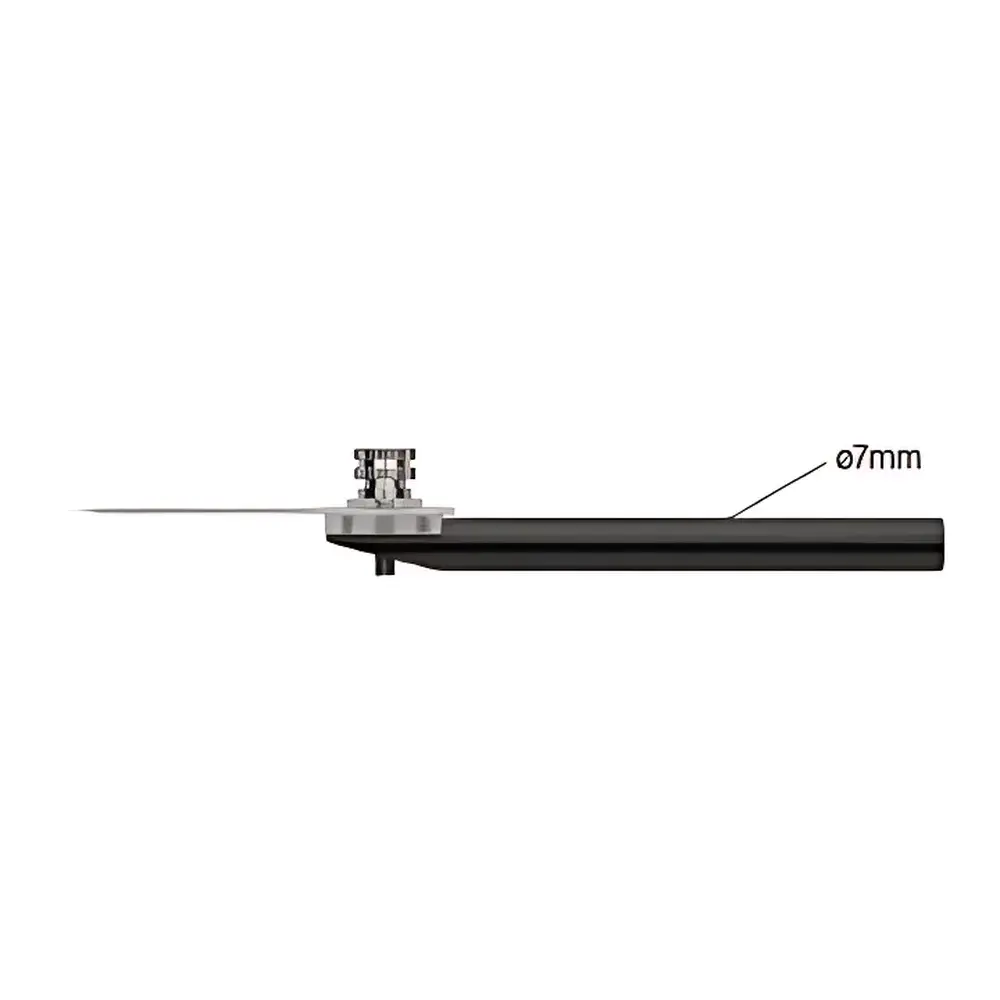
Narishige H-12 Electrode Holder
| Brand | Narishige |
|---|---|
| Origin | Japan |
| Model | H-12 |
| Weight | 8 g |
| Overall Length | 80 mm |
| Heating Rod Diameter | 7 mm |
| Heating Rod Length | 65 mm |
| Material | High-grade stainless steel and heat-resistant polymer |
| Mounting Type | Standard 3-axis micromanipulator compatible (e.g., MO-10, MN-151) |
| Operating Temperature Range | Ambient to 120 °C (with optional external controller) |
| Compliance | CE-marked for laboratory use |
Overview
The Narishige H-12 Electrode Holder is a precision-engineered mechanical fixture designed for stable, repeatable positioning of glass or metal microelectrodes during electrophysiological, patch-clamp, and intracellular recording experiments. Its compact design integrates seamlessly with standard Narishige micromanipulators (e.g., MO-10, MN-151, and NT-81) and third-party XYZ translation stages equipped with 3/8″-32 threaded mounting interfaces. Unlike generic clamps, the H-12 employs a dual-screw coaxial tightening mechanism that applies uniform radial pressure to the electrode shaft—minimizing slippage, torsional deformation, and axial drift under prolonged thermal or mechanical load. The device operates passively but is fully compatible with externally regulated heating systems via its integrated 7 mm diameter × 65 mm long stainless-steel heating rod, enabling precise local temperature control near the electrode tip when paired with a PID-controlled heater unit (e.g., Narishige TH-10 or equivalent).
Key Features
- Ultra-lightweight construction (8 g total mass) reduces inertial loading on fine-positioning manipulators, preserving resolution and stability during sub-micron adjustments
- Optimized 80 mm overall length balances reach and rigidity—ideal for confined recording chambers and multi-electrode configurations
- Corrosion-resistant 304 stainless-steel heating rod (ø7 mm × L65 mm) provides uniform thermal conduction and withstands repeated autoclaving and chemical exposure
- Knurled aluminum body with laser-etched scale markers enables tactile, tool-free repositioning and rapid setup reproducibility
- Interchangeable electrode sleeves (sold separately) support glass capillaries (1.0–1.5 mm OD), tungsten wires (0.1–0.3 mm), and insulated platinum-iridium electrodes
- Mechanically decoupled clamping interface prevents torque transfer from manipulator motion to electrode tip—critical for high-impedance (>100 MΩ) recordings
Sample Compatibility & Compliance
The H-12 accommodates a broad range of electrode geometries used in neuroscience, oocyte voltage-clamp, and single-cell electrophysiology. It maintains secure grip across glass pipettes with wall thicknesses from 0.5 to 1.2 mm and metallic electrodes up to 0.3 mm in diameter. All materials comply with ISO 10993-5 (biological evaluation of medical devices — cytotoxicity) and RoHS Directive 2011/65/EU. The device carries CE marking per Directive 2014/30/EU (EMC) and 2014/35/EU (LVD), confirming conformity with essential health and safety requirements for laboratory instrumentation. No internal electronics or power supply are present—thus, no IEC 61010-1 certification is required; however, integration with external heating controllers must adhere to their respective regulatory documentation.
Software & Data Management
As a purely mechanical positioning component, the H-12 does not incorporate embedded firmware, digital interfaces, or software dependencies. Its operation requires no driver installation, calibration routines, or data logging functionality. However, it is routinely deployed in GLP- and GMP-aligned workflows where traceability is enforced: users log H-12 serial numbers (engraved on base flange), mounting orientation, and associated electrode lot numbers within electronic lab notebooks (ELNs) compliant with 21 CFR Part 11 (e.g., LabArchives, Benchling). When used with Narishige’s TH-10 temperature controller, full audit trails—including setpoint history, ramp profiles, and real-time thermocouple feedback—are retained per FDA-compliant data integrity standards.
Applications
- Intracellular sharp-electrode recordings in invertebrate ganglia and vertebrate brain slices
- Two-electrode voltage clamp (TEVC) of Xenopus laevis oocytes expressing ion channels or transporters
- Extracellular field potential mapping using multi-barrel glass electrodes
- Combined optogenetic stimulation and electrophysiological readout where thermal stability minimizes photoelectric artifact
- Long-duration (>6 h) patch-clamp experiments requiring minimal drift and consistent seal formation
- Microinjection setups where electrode alignment must remain invariant across multiple injection cycles
FAQ
Is the H-12 compatible with non-Narishige micromanipulators?
Yes—the H-12 features a standardized 3/8″-32 threaded base mount, enabling direct attachment to Sutter MP-285, Scientifica PatchStar, and other manipulators with matching female threads.
Can the heating rod be replaced or modified?
No—its dimensions and material composition are integral to thermal performance and mechanical fit. Narishige does not offer aftermarket rods; replacement units must be ordered as complete H-12 assemblies.
What is the maximum recommended operating temperature at the electrode tip?
While the rod itself tolerates up to 120 °C, tip temperature depends on immersion depth, bath conductivity, and ambient convection. For physiological recordings, sustained tip temperatures above 40 °C are discouraged to prevent membrane damage.
Does the H-12 include an integrated temperature sensor?
No—it lacks built-in thermocouples or RTDs. Accurate tip temperature monitoring requires external fiber-optic probes (e.g., Neoptix FT-10) placed adjacent to the electrode shaft.
How is positional repeatability verified during system qualification?
Users perform three-point repeatability tests: after clamping a reference electrode, they record XYZ coordinates via manipulator encoders before and after five full-tighten/release cycles—deviation must remain ≤0.5 µm in all axes per ISO/IEC 17025 guidelines.



