
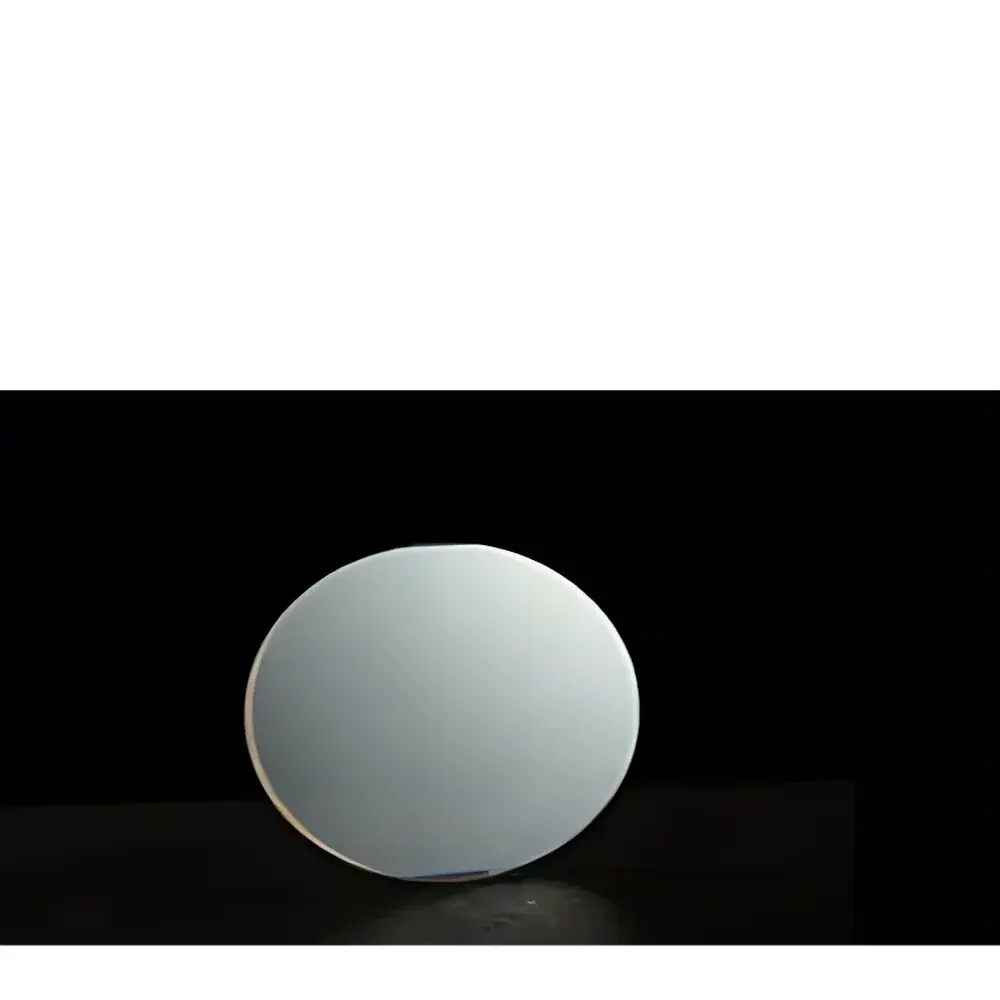
MiXran Meg1093 Elliptical Broadband Beamsplitter Plate
| Brand | MiXran |
|---|---|
| Model | Meg1093 |
| Component Type | Optical Element |
| Coating Specifications | S1 – 50R/50T ±10% average within designated bandwidth |
| Available spectral bands | VIS (350–700 nm), NIR (700–1100 nm), SWIR (900–1700 nm) |
| Available diameters | Φ12.5 mm, Φ25.0 mm, Φ50.0 mm |
| Substrate material | Fused silica or BK7 (standard) |
| Surface quality | 20–10 scratch-dig |
| Flatness | λ/4 @ 633 nm |
| Clear aperture | ≥90% of diameter |
| Wedge | <3 arcsec |
| Damage threshold | >5 J/cm² @ 1064 nm, 10 ns, 10 Hz (typ.) |
Overview
The MiXran Meg1093 Elliptical Broadband Beamsplitter Plate is a precision optical component engineered for high-stability beam division in demanding spectroscopic, interferometric, and multi-channel imaging systems. Unlike conventional circular beamsplitters, the Meg1093 features an elliptical geometry optimized to accommodate oblique incidence configurations—particularly in compact folded-path optical layouts where spatial constraints limit component footprint while preserving beam clearance. Its operational principle relies on controlled thin-film interference at the S1 surface, delivering a nominal 50:50 reflectance-to-transmittance (R/T) ratio across broad spectral bands. The S2 surface is coated with a multi-layer anti-reflection (AR) stack tailored to minimize residual reflection (<1% average) in one of three standardized wavelength regimes: visible (350–700 nm), near-infrared (700–1100 nm), or short-wave infrared (900–1700 nm). This design enables minimal ghosting, low wavefront distortion, and high polarization insensitivity under typical non-normal incidence angles (up to 45°), making it suitable for both polarized and unpolarized light applications.
Key Features
- Elliptical form factor (short-axis dimension optimized per model) for enhanced mechanical integration in constrained optical benches and OEM instrumentation
- S1 surface: Dielectric broadband beamsplitter coating with 50R/50T ±10% tolerance averaged over full designated band; optimized for low angular sensitivity
- S2 surface: Ion-assisted e-beam deposited AR coating—spectrally matched to VIS, NIR, or SWIR bands—with Ravg <1% and <0.3% peak reflectance
- High laser damage threshold (>5 J/cm² @ 1064 nm, 10 ns, 10 Hz) validated per ISO 21254-1, supporting pulsed laser alignment and diagnostic setups
- λ/4 surface flatness (measured at 633 nm) and 20–10 scratch-dig surface quality ensure compatibility with diffraction-limited systems
- Low wedge (<3 arcsec) minimizes beam deviation and facilitates precise collimation in multi-pass cavities and Michelson-type interferometers
Sample Compatibility & Compliance
The Meg1093 is fabricated using optically homogeneous fused silica (Grade UV-Grade or IR-Grade) or Schott BK7 substrates, selected based on spectral transmission requirements and thermal stability needs. All coatings are deposited via ion-beam sputtering (IBS) to ensure dense, stable film architecture with negligible hygroscopic drift. Each plate undergoes spectral verification using calibrated UV-VIS-NIR spectrophotometry (PerkinElmer Lambda 1050+ with integrating sphere) and surface inspection per MIL-PRF-13830B. Documentation includes full spectral reflectance/transmittance curves (350–1700 nm), surface flatness interferograms (Zygo GPI), and coating adhesion testing (ASTM D3359 Tape Test, Class 5A). Units comply with ISO 9001 manufacturing controls and are traceable to NIST-calibrated reference standards.
Software & Data Management
While the Meg1093 is a passive optical element requiring no embedded firmware or drivers, its performance data is fully integrated into standard optical design workflows. Spectral coating files (.cof, .dat) and Zemax-compatible surface property models (including complex refractive index dispersion data) are provided with each shipment. These files support accurate modeling in Zemax OpticStudio, CODE V, and FRED environments—enabling realistic stray-light analysis, polarization ray tracing, and thermal deformation simulation. All spectral datasets conform to the ISO 15382 metadata schema and include uncertainty quantification per GUM (Guide to the Expression of Uncertainty in Measurement). Raw measurement logs and calibration certificates are archived for 10 years and available upon audit request for GLP/GMP-aligned laboratories.
Applications
- Beam combining/splitting in dual-wavelength fluorescence microscopes (e.g., simultaneous 488 nm/640 nm excitation pathways)
- Reference arm conditioning in fiber-optic OCT systems operating in 850 nm or 1300 nm windows
- Multi-spectral illumination modules for machine vision inspection systems covering VIS–SWIR bands
- Alignment fiducial elements in ultrafast laser pump-probe setups requiring minimal group delay dispersion
- Compact interferometer cores for environmental gas sensing platforms (e.g., TDLAS-based CO2/CH4 detection)
- OEM integration into portable Raman spectrometers where elliptical footprint reduces module depth without sacrificing clear aperture
FAQ
What is the maximum recommended angle of incidence for optimal 50R/50T performance?
For minimal deviation from nominal split ratio, use ≤45° AOI in air; performance degrades gradually beyond this due to polarization splitting—consult included polarization-dependent reflectance curves for exact s/p ratios.
Can the Meg1093 be used in vacuum or high-humidity environments?
Yes—IBS-coated plates meet outgassing requirements per ASTM E595 (CVCM <0.1%, TML <1.0%) and pass 95% RH / 40°C soak testing per MIL-STD-810G Method 507.4.
Is custom spectral band optimization available?
Yes—custom AR or beamsplitter bands (e.g., 1064 nm + 1550 nm dual-band) can be quoted with 8–12 week lead time; minimum order quantity applies.
Do you provide mounting kinematic solutions compatible with the elliptical geometry?
Standard SM1-threaded elliptical lens tubes and kinematic mounts (e.g., Thorlabs KM100E) are mechanically compatible; CAD models available upon request.
How is coating durability validated for long-term deployment?
Accelerated lifetime testing includes 1000-hour damp heat (85°C/85% RH), 500-cycle thermal cycling (−40°C to +85°C), and abrasion resistance per ISO 9211-4, with post-test spectral verification.




