
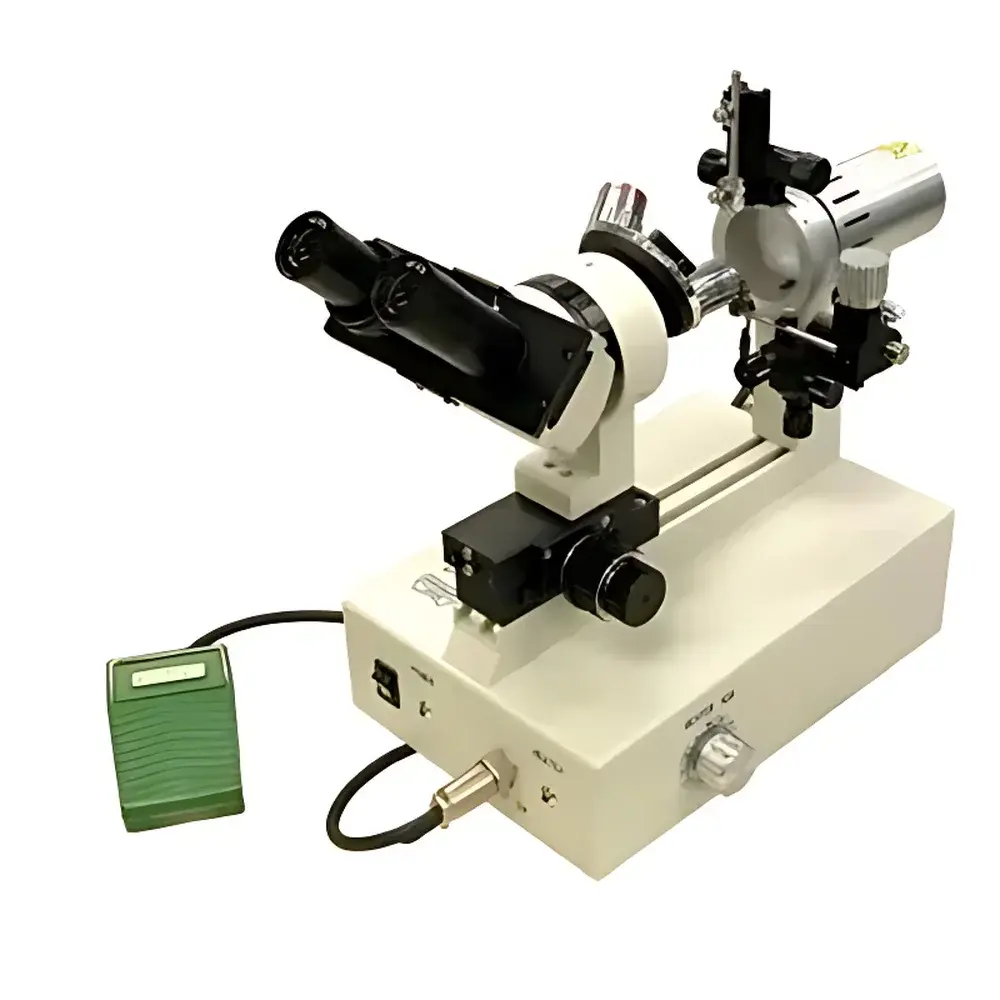
Narishige MF-900 Microelectrode Puller and Needle Forge System
| Brand | Narishige |
|---|---|
| Model | MF-900 |
| Origin | Japan |
| Power Input | AC 100–240 V (±5%), 50/60 Hz |
| Power Consumption | ~35 W |
| Microscope Magnification | 50× / 100× (10× eyepiece, 5× & 10× objectives) |
| Capillary Diameter | Ø1 mm |
| Manipulator Travel Range (Heater) | X/Y/Z ±14 mm |
| Manipulator Travel Range (Pipette) | X ±12 mm, Z ±28 mm |
| Microscope Stage Travel | X ≈7 mm, Y 30 mm, Z ≈8 mm |
| Accessories | Foot switch, dedicated pipette holder, Allen wrench, spare heater, spare lamp, silicone rubber gasket |
Overview
The Narishige MF-900 Microelectrode Puller and Needle Forge System is a precision-engineered benchtop instrument designed for the fabrication and thermal shaping of glass micropipettes and microelectrodes used in electrophysiology, microinjection, patch-clamp recording, and single-cell manipulation. Unlike conventional pullers that rely solely on filament-based heating and linear tension control, the MF-900 integrates a dual-axis manipulator-driven forging architecture with real-time visual feedback via an integrated stereomicroscope. Its operational principle centers on localized resistive heating of borosilicate or quartz capillaries (Ø1 mm), followed by controlled mechanical deformation—either axial drawing (for tip tapering) or lateral bending and tip sculpting (for angled or fire-polished electrodes). This hybrid approach enables reproducible fabrication of custom geometries—including bent, beveled, coated, or multi-barrel configurations—without requiring post-fabrication grinding or polishing.
Key Features
- Independent XYZ manipulators for both heater assembly and pipette holder, enabling precise angular alignment (e.g., 0°–90° tip orientation) and spatial positioning under direct microscopic observation.
- Dual-magnification optical system (50×/100×) with coaxial illumination, calibrated stage movement, and reticle-equipped eyepieces for in-situ angle measurement during tip forging.
- Foot-operated heater activation for hands-free thermal control, minimizing vibration-induced drift during delicate shaping operations.
- Modular heater cartridge design with rapid thermal response (<2 s to reach operating temperature) and replaceable heating elements for long-term calibration stability.
- Universal AC power compatibility (100–240 V, 50/60 Hz) ensures deployment across global laboratory environments without voltage conversion hardware.
- Ergonomic layout with all controls—including heater on/off, focus adjustment, and manipulator fine-tuning—positioned within immediate reach of the operator’s dominant hand.
Sample Compatibility & Compliance
The MF-900 accommodates standard borosilicate (e.g., GC150F-10) and quartz capillaries (Ø1 mm OD) with wall thicknesses ranging from 0.15 to 0.25 mm. It supports fabrication of intracellular microelectrodes (tip diameters <0.5 µm), patch pipettes (2–5 MΩ), and injection needles for embryology or C. elegans microinjection. All mechanical adjustments conform to ISO 9283:1998 (manipulator repeatability standards), while electrical safety complies with IEC 61010-1:2010 for laboratory equipment. The system is routinely validated in GLP-compliant neurophysiology labs where traceable electrode geometry documentation is required per SOPs aligned with NIH-funded electrophysiology core facility guidelines.
Software & Data Management
The MF-900 operates as a standalone analog-digital hybrid system with no embedded firmware or proprietary software. All parameter settings—including heating duration, manipulator displacement increments, and microscope focus position—are manually recorded in lab notebooks or LIMS-integrated electronic logs. For audit readiness, users may integrate digital microscope cameras (e.g., Thorlabs DCU223M) with third-party image annotation tools supporting FDA 21 CFR Part 11–compliant metadata tagging (timestamp, operator ID, capillary lot number). Calibration records for heater output and stage linearity are maintained per ISO/IEC 17025:2017 requirements for accredited testing laboratories.
Applications
- Preparation of sharp intracellular recording electrodes for hippocampal slice or cultured neuron studies.
- Fabrication of fire-polished patch-clamp pipettes with optimized tip geometry for high-resistance seals (>1 GΩ) in whole-cell configuration.
- Custom bending of injection needles for zebrafish or Drosophila embryo microinjection protocols.
- Thermal reshaping of broken or contaminated electrodes in situ, reducing consumable waste and experimental downtime.
- Teaching applications in graduate-level neuroscience and biophysics courses where hands-on electrode fabrication reinforces principles of capillary physics and thermal deformation mechanics.
FAQ
What types of capillaries are compatible with the MF-900?
Standard 1.0 mm outer diameter borosilicate (e.g., Sutter BF100-78-10) and fused silica capillaries; wall thickness must be ≥0.15 mm to sustain structural integrity during heating.
Is the microscope parfocal across magnifications?
Yes—the 5× and 10× objective lenses are factory-aligned for parfocality, minimizing refocusing when switching between 50× and 100× observation modes.
Can the MF-900 produce double-barrel or theta-style pipettes?
No—this system is optimized for single-capillary forging and pulling; multi-barrel fabrication requires dedicated laser-based pullers (e.g., Sutter P-1000) or microforge-puller hybrids.
How often should the heater element be replaced?
Under typical usage (≤20 fabrications/day), the spare heater cartridge maintains stable thermal output for ≥12 months; replacement is indicated when observed tip asymmetry exceeds ±5° at fixed manipulator settings.
Does Narishige provide calibration certificates for the MF-900?
Narishige supplies a factory verification report confirming manipulator travel accuracy (±0.02 mm) and microscope magnification tolerance (±2.5%) at time of shipment; full metrological calibration is performed by authorized service partners per ISO/IEC 17025.



