
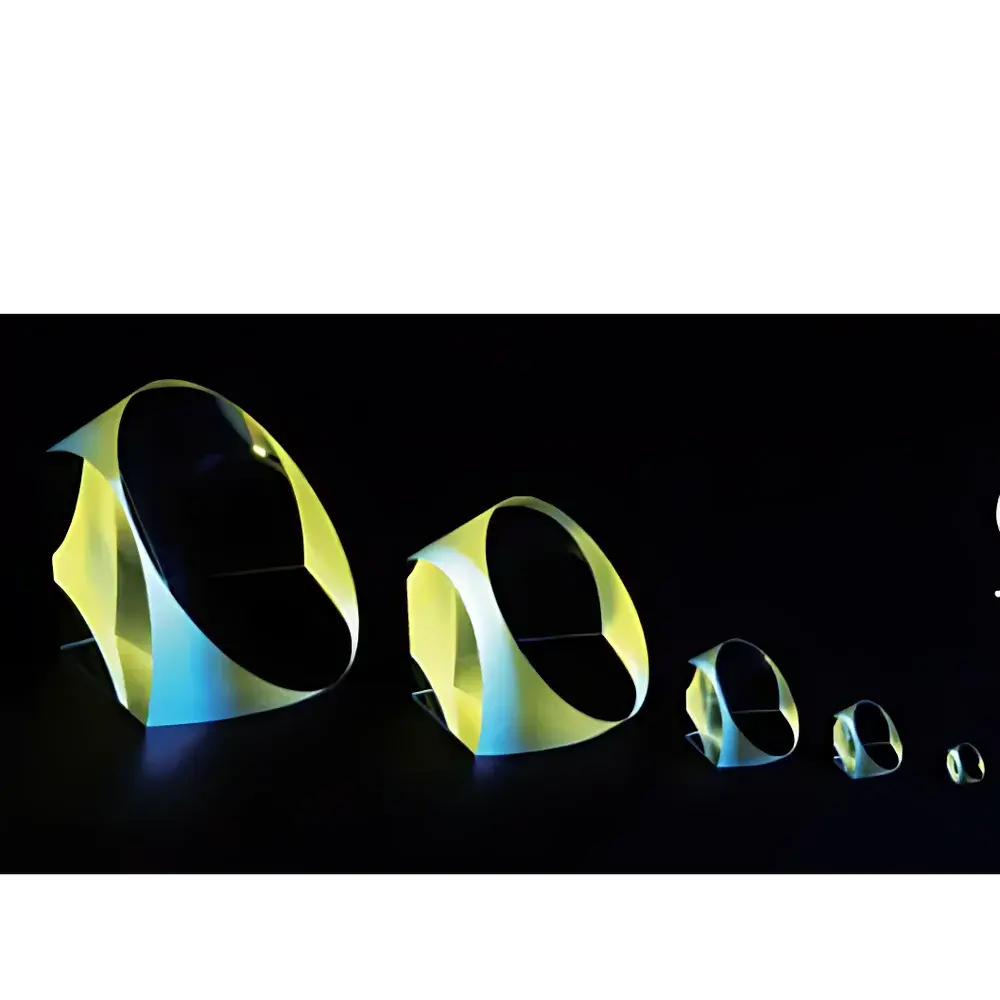
MiXran Meg1045 Corner Cube Retroreflector
| Brand | MiXran |
|---|---|
| Model | Meg1045 |
| Optical Component Type | Corner Cube Retroreflector |
| Material | N-BK7 or Fused Silica (standard) |
| Surface Quality | 20–10 scratch-dig |
| Surface Flatness | λ/10 @ 633 nm |
| Coating Options | Uncoated, Protected Silver (Ag) + VIS AR (400–700 nm), or Protected Silver + NIR AR (700–1100 nm) |
| Beam Deviation | ≤ 3 arcsec |
| Clear Aperture | ≥ 90% of diameter |
| Dimensional Tolerance | ±0.1 mm (diameter), ±0.2 mm (height) |
| Environmental Compliance | RoHS-compliant substrate and coatings |
Overview
The MiXran Meg1045 Corner Cube Retroreflector is a precision optical component engineered for high-fidelity beam return in interferometric metrology, laser alignment systems, satellite laser ranging (SLR), and industrial LIDAR calibration. Based on the principle of total internal reflection within a trihedral prism geometry, the Meg1045 ensures near-zero angular deviation between incident and retroreflected beams—regardless of input angle—within its specified acceptance cone. Its monolithic fused silica or N-BK7 construction provides exceptional thermal stability (dn/dT ≈ 1.2 × 10⁻⁶ /°C for N-BK7; < 0.5 × 10⁻⁶ /°C for fused silica), low wavefront distortion ( 500 MW/cm² for 10 ns pulses at 1064 nm). Designed to meet ISO 10110-7 surface quality standards and calibrated per ISO 10110-5 for orientation tolerance, the Meg1045 serves as a passive, alignment-insensitive reference element in applications demanding long-term repeatability and minimal path-length drift.
Key Features
- Precision trihedral geometry with vertex error < 1 arcsec, ensuring angular reproducibility across temperature cycling (−40 °C to +80 °C)
- Multiple substrate options: standard N-BK7 for visible/NIR broadband use; optional fused silica for UV-VIS-NIR extended transmission and superior thermal homogeneity
- Three coating configurations: uncoated (for UV applications requiring minimal absorption); protected silver (Ag) with VIS-optimized anti-reflection (AR) coating (R < 0.25% avg. 400–700 nm); or protected silver with NIR-optimized AR coating (R < 0.3% avg. 700–1100 nm)
- Surface flatness certified to λ/10 @ 633 nm (peak-to-valley), verified via phase-shifting interferometry traceable to NIST standards
- Robust mechanical mounting interface: cylindrical outer profile with optional kinematic base flange (M4 or M6 tapped holes) for stable integration into optomechanical breadboards and vacuum-compatible housings
- Compliance with MIL-PRF-13830B surface quality specification (20–10 scratch-dig) and ISO 9022 environmental testing protocols (vibration, shock, humidity)
Sample Compatibility & Compliance
The Meg1045 is compatible with collimated beams up to 25 mm diameter (depending on model variant) and supports incident angles from 0° to ±5° off normal incidence without measurable degradation in retroreflection fidelity. All variants undergo 100% inspection for coating adhesion (per ASTM D3359), spectral reflectance (via calibrated spectrophotometry 250–1600 nm), and angular deviation (using autocollimator-based metrology). The device conforms to ISO 10110 optical drawing standards and is supplied with individual test reports including interferometric surface map, spectral reflectance curve, and beam deviation measurement. For regulated environments—including FDA-regulated analytical instrumentation and aerospace-grade optical assemblies—the Meg1045 meets traceability requirements under ISO/IEC 17025-accredited calibration procedures and supports GLP/GMP documentation packages upon request.
Software & Data Management
While the Meg1045 is a passive optical element and requires no embedded firmware or drivers, MiXran provides comprehensive digital support resources: downloadable Zemax OpticStudio and CODE V prescription files (including full coating stack models), MATLAB-compatible spectral reflectance datasets (.csv), and STEP/IGES mechanical models for CAD-integrated optical system design. Each unit ships with a unique serial-numbered Certificate of Conformance that includes measured surface flatness, coating performance data, and environmental test summaries. For enterprise customers implementing automated inventory or calibration management systems, MiXran supports CSV/XML export of full product metadata—including coating batch IDs, interferogram timestamps, and metrology lab accreditation details—compatible with LabVantage, STARLIMS, and TrackWise LIMS platforms.
Applications
- Laser interferometry: used as fixed reference retroreflector in heterodyne and homodyne displacement measurement systems (e.g., HP/Keysight 5529A calibration chains)
- Satellite laser ranging (SLR): deployed in ground-station corner cube arrays (e.g., MOBLAS, ILRS network) due to high return signal integrity and thermal stability
- Industrial LIDAR calibration: serves as primary target in time-of-flight (ToF) and phase-shift LIDAR verification setups per ISO 19377:2021
- Optical encoder feedback loops: integrated into high-resolution rotary and linear encoders where zero-phase error and insensitivity to lateral misalignment are critical
- Quantum optics experiments: employed in cavity ring-down spectroscopy (CRDS) and optical lattice setups requiring ultra-low-loss, polarization-preserving retroreflection
- Defense and aerospace: qualified for use in gimbal-mounted tracking systems and inertial navigation alignment references per MIL-STD-810H environmental categories
FAQ
What is the maximum incident beam diameter supported by the Meg1045-025-1 variant?
The Meg1045-025-1 (25.4 mm diameter, 19 mm height) supports a clear aperture of ≥ 22.9 mm, enabling full transmission of collimated beams up to 22 mm in diameter without vignetting.
Can the Meg1045 be used in vacuum environments?
Yes—fused silica variants with protected silver + NIR AR coatings are routinely qualified for UHV applications (≤ 10⁻⁷ Torr) when mounted using low-outgassing adhesives or kinematic mounts; outgassing rates comply with ECSS-Q-ST-70-02C.
Is there a difference in wavefront error between VIS-AR and NIR-AR coated versions?
No—coating-induced wavefront distortion is negligible (< λ/100 PV) in both configurations; the primary distinction lies in residual reflectance minima and bandwidth optimization.
Do you offer custom apex angles or non-standard substrates?
Yes—MiXran supports custom designs including CaF₂ substrates for deep-UV applications, apex angle adjustments (±0.5 arcsec), and hybrid coating stacks (e.g., Ag + dual-band AR); lead time and MOQ apply.
How is angular deviation measured and reported?
Angular deviation is measured using a high-resolution autocollimator (resolution 0.01 arcsec) aligned to the retroreflected beam centroid; results are reported as RMS deviation over five independent orientations and included in the CoC.




