
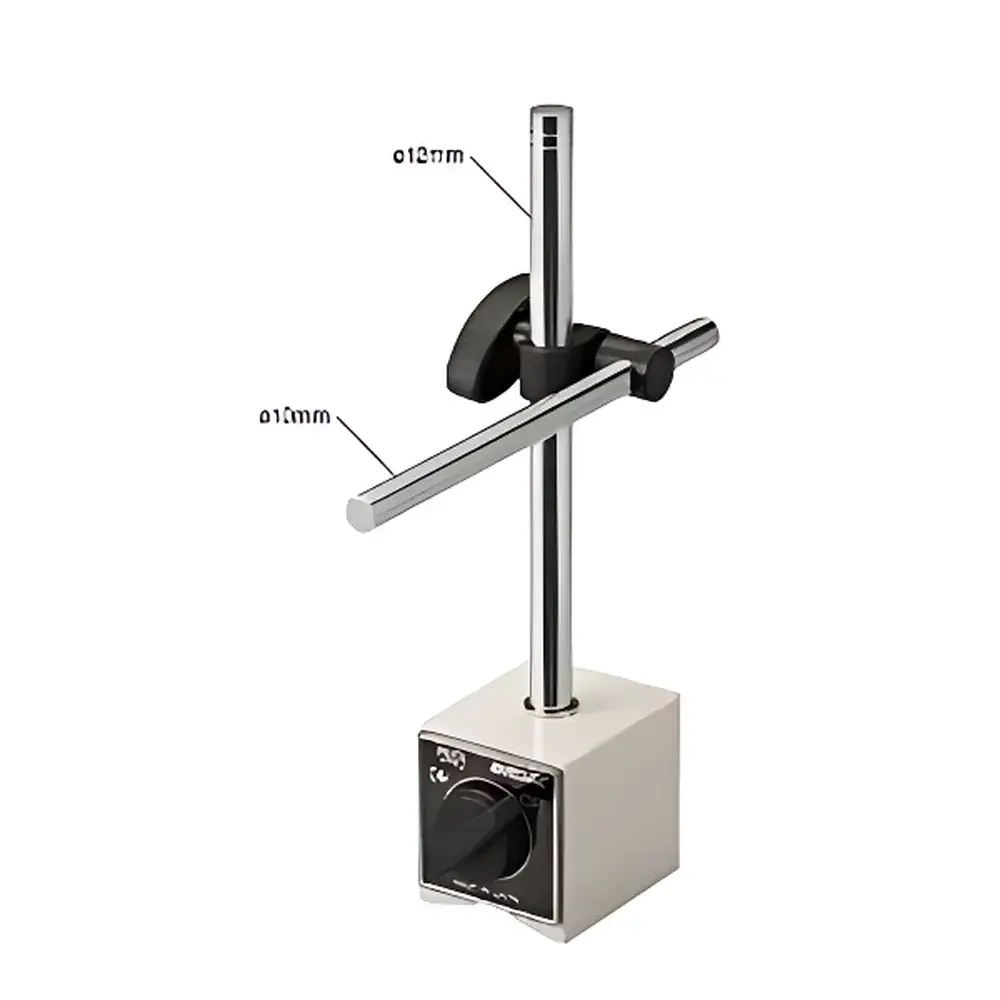
NARISHIGE GJ-1 Magnetic Stand
| Brand | NARISHIGE |
|---|---|
| Origin | Japan |
| Model | GJ-1 |
| Magnet Type | NdFeB (Grade N52) |
| Max Holding Force | >50 N |
| Base Compatibility | Ferromagnetic Iron Plate (IP-series, sold separately) |
| Rotation | 360° continuous |
| Mounting Rod Diameter | Ø10 mm |
| Stand Dimensions (W×D×H) | 50 × 65 × 55 mm |
| Weight | 1.5 kg |
| Material | 304 Stainless Steel housing with Ni-plated magnet surface |
| Operating Environment | Lab-grade humid/corrosive conditions |
Overview
The NARISHIGE GJ-1 Magnetic Stand is an engineered mechanical support solution designed for high-precision optical and micro-manipulation applications in life science and materials research laboratories. It operates on the principle of controlled ferromagnetic coupling—utilizing a high-grade sintered NdFeB (N52) permanent magnet embedded within a corrosion-resistant 304 stainless steel housing—to provide stable, non-threaded, and repositionable fixation of micromanipulators, patch-clamp electrodes, microinjection needles, fiber-optic probes, and other Ø10 mm cylindrical instruments. Unlike clamped or threaded mounts, the GJ-1 enables rapid, tool-free placement and reorientation on standardized iron plates (e.g., NARISHIGE IP-series base plates), making it especially suitable for dynamic experimental workflows requiring iterative spatial adjustment without mechanical loosening or drift. Its compact footprint (50 × 65 × 55 mm) and low center of gravity ensure minimal interference with microscope objectives, stage clearance, and multi-axis manipulator kinematics.
Key Features
- High-strength magnetic coupling: Delivers >50 N holding force on standard IP-series ferromagnetic base plates, sufficient to secure instruments under typical vibration and thermal drift conditions encountered in electrophysiology rigs or AFM setups.
- 360° continuous rotational freedom: Precision-machined bearing interface allows smooth, backlash-free angular repositioning—critical for aligning pipette trajectories relative to cell membranes or optical axes.
- Modular mounting compatibility: Accepts standard Ø10 mm mounting rods (e.g., NARISHIGE MN-153 series manipulators) and interfaces seamlessly with optional height-adjustment accessories such as the P-1A vertical lift plate.
- Chemically inert construction: 304 stainless steel housing resists degradation from common lab solvents (e.g., ethanol, acetone, PBS buffers); nickel-plated magnet surface inhibits oxidation, maintaining magnetic performance with <5% flux loss over 10 years under ambient storage.
- Single-hand release mechanism: Integrated mechanical lock lever disengages magnetic adhesion instantly—eliminating manual prying or twisting, reducing operator fatigue during repeated setup cycles.
Sample Compatibility & Compliance
The GJ-1 is compatible with all commercially available Ø10 mm rod-mounted instrumentation, including but not limited to NARISHIGE MN-151/MN-153 manipulators, Sutter MP-285 controllers, and custom-built micro-positioning stages. It requires a ferromagnetic base plate (e.g., NARISHIGE IP-1 or IP-2) for optimal performance; direct mounting onto non-ferrous surfaces (aluminum, plastic, granite) is not supported. The device complies with EU Directive 2011/65/EU (RoHS 2), confirming absence of lead, cadmium, mercury, hexavalent chromium, PBB, and PBDE. While not certified for medical device use per ISO 13485, its material traceability and surface finish meet GLP-aligned laboratory equipment requirements for documentation of hardware provenance and environmental stability.
Software & Data Management
As a passive mechanical component, the GJ-1 does not incorporate electronics, firmware, or software interfaces. Its integration into automated workflows occurs at the system level—e.g., when paired with motorized manipulators (e.g., NARISHIGE MMO-202E) or microscope stages equipped with digital position encoders. No proprietary drivers or configuration files are required. All mechanical specifications—including dimensional tolerances (±0.05 mm), magnetic field uniformity across the pole face, and torque vs. rotation angle profiles—are documented in the manufacturer’s technical datasheet (Rev. D, 2023), supporting audit-ready instrument qualification under ISO/IEC 17025 or FDA 21 CFR Part 11–aligned validation protocols where traceable mechanical anchoring is essential.
Applications
- Electrophysiology: Secure fixation of patch-clamp pipettes and recording electrodes during whole-cell or perforated-patch configurations, minimizing positional drift during long-duration recordings (>2 hrs).
- Single-cell microinjection: Stabilization of injection needles in CRISPR-Cas9 delivery, mRNA transfection, or organelle transplantation experiments—enabling sub-micron targeting accuracy in live-cell imaging chambers.
- Nanoscale characterization: Mounting of AFM cantilever holders or STM probe arms on vibration-isolated optical tables, ensuring static alignment integrity during force spectroscopy or topographic scanning.
- Optical metrology: Rigid positioning of collimated laser diodes or fiber-coupled spectrometers in interferometric or ellipsometric setups where beam path stability directly impacts measurement repeatability.
- Materials processing: Anchoring of thermal probes or nanoindenter tips during in-situ heating/cooling experiments on hot stages, preserving alignment across thermal expansion gradients (−20 °C to +150 °C).
FAQ
Can the GJ-1 be used on non-magnetic surfaces such as aluminum or glass?
No. It requires a ferromagnetic base plate (e.g., NARISHIGE IP-1) for effective magnetic coupling. Direct adhesion to paramagnetic or diamagnetic substrates is insufficient for reliable load-bearing.
Is the magnetic field strength affected by temperature?
Yes—NdFeB magnets exhibit reversible flux loss above 80 °C. Continuous operation above this threshold is not recommended; maximum safe ambient temperature is 60 °C.
Does the GJ-1 support vertical load only, or can it resist lateral shear forces?
It provides optimal resistance to axial (pull-off) loads. Shear resistance depends on surface flatness and contact area; for lateral-force-intensive applications, pairing with a secondary mechanical stop or guide rail is advised.
What is the expected service life under daily laboratory use?
With proper handling and avoidance of mechanical impact or demagnetizing fields, the magnet retains ≥95% of initial flux after 10 years of continuous use in controlled environments.
Are replacement magnets available from NARISHIGE?
No—the magnet is permanently potted and sealed within the housing. Units exhibiting significant field decay should be returned to authorized service centers for evaluation and replacement.



