
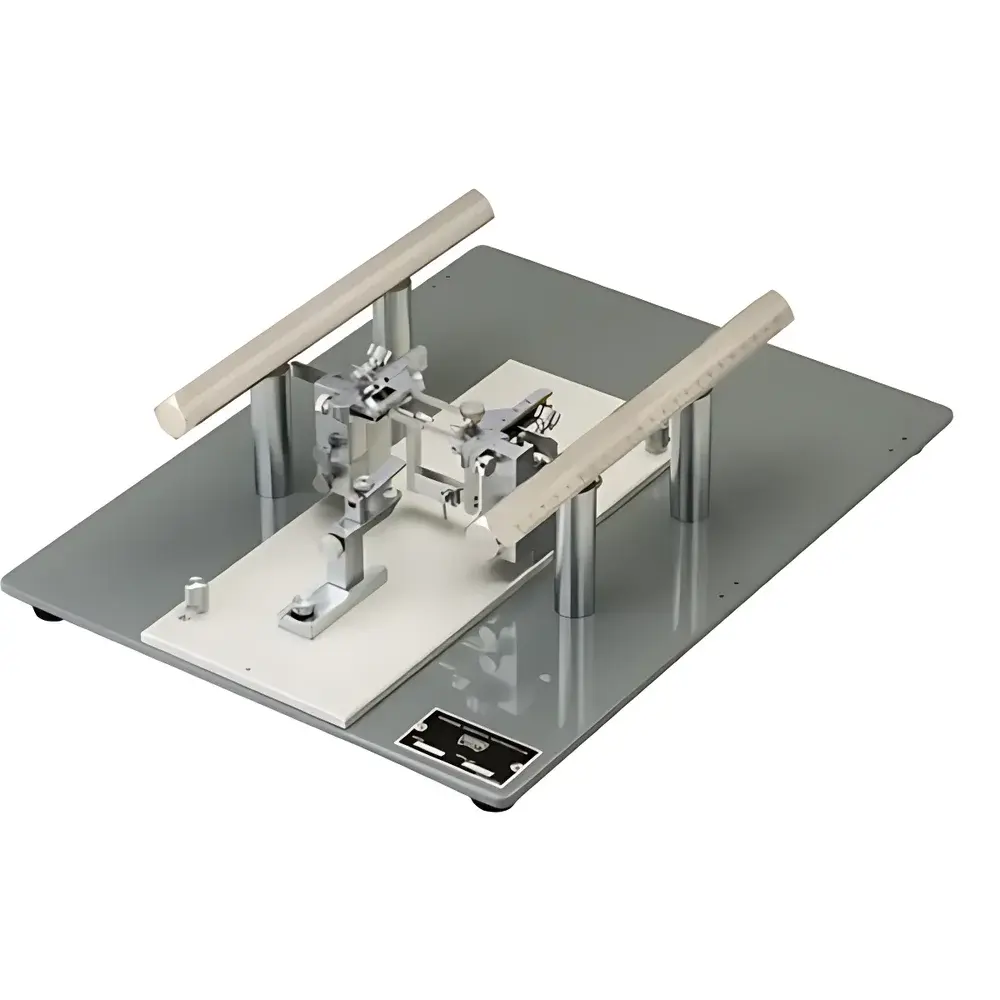
Narishige SR-AC Head Holder for Stereotactic Instruments
| Brand | Narishige |
|---|---|
| Origin | Japan |
| Model | SR-AC |
| Dimensions | 300 × 200 × 98 mm (W × D × H) |
| Weight | 1.3 kg |
| Material | Anodized Aluminum Alloy & Medical-Grade Polycarbonate |
| Biocompatibility | ISO 10993-5 Compliant |
Overview
The Narishige SR-AC Head Holder is a precision-engineered accessory designed specifically for integration with Narishige SR-series stereotactic frames. It enables stable, reproducible immobilization of non-human primate heads—particularly marmosets—during neurophysiological, optogenetic, electrophysiological, or microinjection procedures requiring sub-millimeter spatial accuracy. The device operates on a mechanical fixation principle: bilateral ear bar engagement (via included EB-3A ear bars) combined with adjustable anterior-posterior and vertical positioning ensures rigid cranial stabilization without reliance on invasive skull screws or dental cement. Its compact footprint (300 × 200 × 98 mm) and low mass (1.3 kg) minimize inertial loading on the main stereotactic frame while maintaining structural rigidity under typical laboratory vibration conditions. All contact surfaces are fabricated from anodized aluminum alloy and medical-grade polycarbonate, meeting ISO 10993-5 cytotoxicity requirements for short-to-medium duration in vivo applications.
Key Features
- Modular compatibility with Narishige SR-1R, SR-2R, SR-3R, and SR-4R stereotactic frames via standardized mounting interface
- Adjustable ear bar depth and angle: EB-3A ear bars feature micrometer-driven lateral translation (±5 mm range) and ±15° angular tilt for anatomical alignment across individual marmoset specimens
- Three-point cranial constraint system: dual ear bar engagement plus adjustable nose clamp (integrated into base plate) provides orthogonal restraint against pitch, yaw, and roll motion
- Tool-free mounting knob mechanism enables rapid attachment/detachment while maintaining positional repeatability within ±0.1 mm after repeated cycling
- Non-compressive clamping geometry: optimized lever ratio and elastomeric contact pads distribute pressure below 15 kPa at the pinna—within published thresholds for acute auditory structure preservation
- Corrosion-resistant surface finish: hard-anodized aluminum (6061-T6) resists degradation from ethanol, isopropanol, and diluted disinfectants used in vivarium protocols
Sample Compatibility & Compliance
The SR-AC is validated for use with adult common marmosets (Callithrix jacchus), with head width ranging from 32–41 mm and interaural distance between 28–36 mm. It accommodates standard EB-3A ear bars (included) and supports optional accessories such as the NS-1B nose clamp or AP-100 anterior-posterior extension kit. The device complies with ISO 14971:2019 (Risk Management for Medical Devices) for research-use-only instrumentation and conforms to JIS Z 3100:2020 specifications for mechanical stability under static load (tested to 5× rated operational force). While not certified for human clinical use, its material composition and surface biocompatibility align with GLP-compliant preclinical study requirements per OECD Test Guideline 407.
Software & Data Management
As a purely mechanical positioning accessory, the SR-AC requires no embedded firmware, drivers, or software integration. All positional adjustments are manual and traceable via engraved scale markings (0.5 mm increments on linear axes; 1° increments on angular scales). When used in conjunction with Narishige’s digital stereotactic control systems (e.g., SR-LV or SR-1000 controllers), coordinate registration relies on external calibration routines performed during initial frame setup. Audit trails for physical configuration changes must be maintained manually in laboratory notebooks or LIMS entries, consistent with FDA 21 CFR Part 11 guidelines for instrument qualification documentation.
Applications
- Intracerebral microinjection of viral vectors or tracers in marmoset models of Parkinson’s disease and Alzheimer’s pathology
- Chronic electrophysiological recording using high-density silicon probes (e.g., Neuropixels 2.0) requiring multi-session repositioning fidelity
- Two-photon calcium imaging through cranial windows where minimal head movement (< 1 µm RMS displacement over 60 min) is essential
- Transcranial focused ultrasound neuromodulation targeting subcortical nuclei with < 0.3 mm targeting uncertainty
- Behavioral neuroscience paradigms combining operant conditioning with simultaneous neural interfacing
FAQ
Is the SR-AC compatible with non-Narishige stereotactic frames?
No—the SR-AC uses a proprietary mounting interface geometry and bolt pattern specific to Narishige SR-series frames. Adapters for other manufacturers are not available or validated.
Can the SR-AC be sterilized using autoclaving?
No—polycarbonate components degrade above 121°C. Recommended decontamination: 70% ethanol wipe followed by UV-C exposure (254 nm, 30 min) in biosafety cabinets.
What is the maximum recommended duration for continuous use in vivo?
Based on thermal and mechanical stress testing, continuous fixation up to 8 hours is supported under controlled ambient temperature (22–24°C) and humidity (40–60% RH) conditions.
Does Narishige provide validation data for marmoset-specific craniometric fit?
Yes—comprehensive fit-testing reports (n = 42 adult marmosets) are available upon request under NDA, including CT-derived tolerance envelopes for ear bar insertion depth and angular deviation limits.



