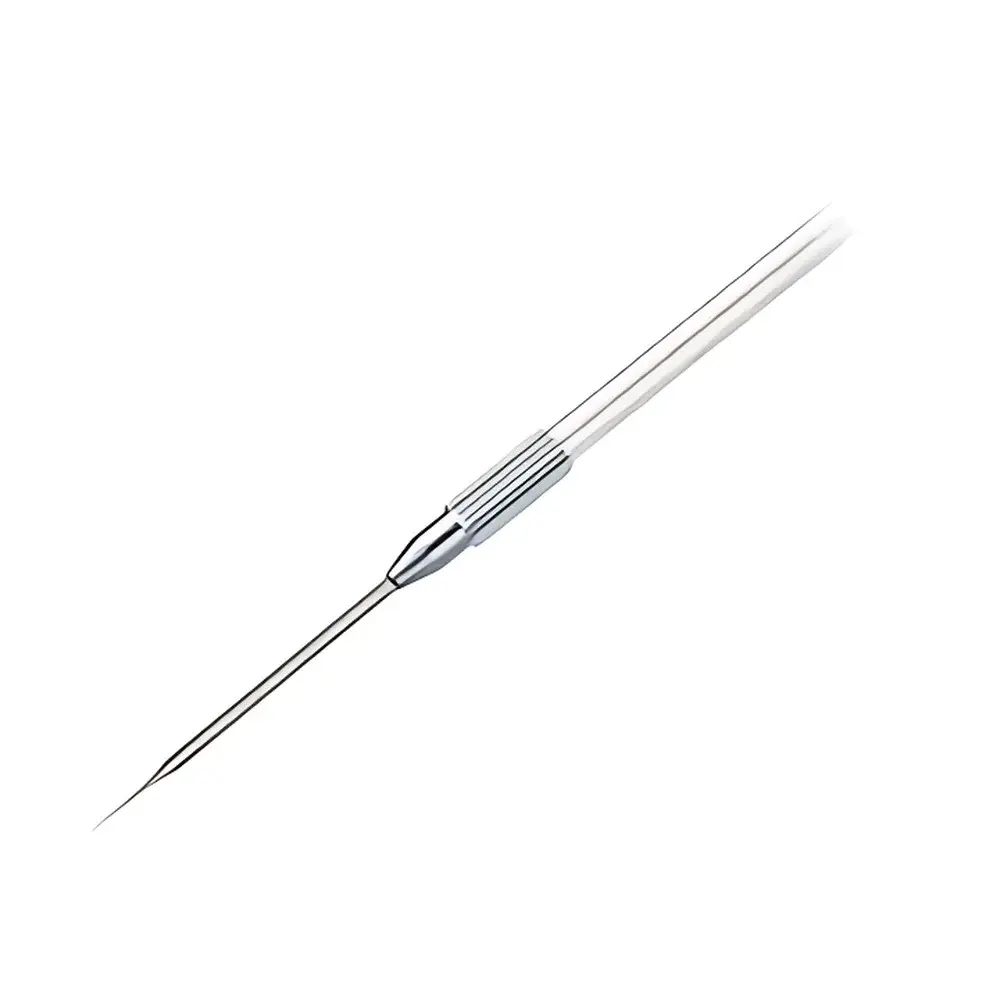
HIC-1.5 Cap for 1.5 mm OD Pipettes (NARISHIGE)
| Brand | NARISHIGE |
|---|---|
| Origin | Japan |
| Model | HIC-1.5 |
| Compatible Instruments | HI-7, HI-9 Micromanipulators |
| Cap Outer Diameter | 1.5 mm |
| Silicone Gasket Included | HI01PK04 (20 × 5 × 5 mm, 1 g) |
Overview
The HIC-1.5 Cap is a precision-engineered consumable component designed exclusively for use with NARISHIGE’s HI-7 and HI-9 hydraulic micromanipulators. It functions as a sealing and mounting interface for glass or fused-silica capillary pipettes with an outer diameter of 1.5 mm. Unlike generic caps, the HIC-1.5 integrates mechanical compatibility, thermal stability, and consistent axial alignment—critical requirements in microinjection, patch-clamp electrophysiology, and single-cell aspiration workflows. Its design adheres to NARISHIGE’s proprietary coupling geometry, ensuring zero slippage under hydraulic pressure (up to 1.0 MPa typical operating range) and maintaining tip-to-stage positional fidelity during fine positional adjustments. The cap does not perform active measurement or signal transduction; rather, it serves as a passive, high-reliability mechanical interface that preserves the integrity of delicate pipette assemblies in vibration-sensitive and temperature-controlled environments.
Key Features
- Exact-fit threading and taper geometry for seamless integration with HI-7 and HI-9 manipulator heads—no adapter or torque calibration required.
- Incorporates a pre-assembled, sterilizable silicone rubber gasket (HI01PK04), dimensionally specified at 20 mm (W) × 5 mm (D) × 5 mm (H), mass 1.0 g, providing uniform radial compression and leak-tight sealing without over-tightening.
- Manufactured from medical-grade polyether ether ketone (PEEK) housing material, offering chemical resistance to ethanol, chloroform, and standard cell culture reagents, as well as dimensional stability across ambient to 40 °C operational ranges.
- Surface-finished to ISO 13485-compliant tolerances (±0.02 mm on critical diameters), minimizing runout and enabling reproducible pipette centering—essential for sub-micron electrode positioning accuracy.
- Designed for rapid exchange: full installation or removal achievable in <8 seconds using standard 2.0 mm hex key, supporting high-throughput experimental setups requiring frequent pipette changes.
Sample Compatibility & Compliance
The HIC-1.5 Cap supports glass and quartz pipettes with nominal outer diameters of 1.50 ± 0.03 mm and wall thicknesses between 0.15–0.30 mm—commonly used in intracellular recording, CRISPR-Cas9 microinjection, and oocyte enucleation protocols. It is compatible with both pulled and laser-polished pipettes. While the cap itself carries no CE marking or FDA 510(k) clearance (as a Class I non-invasive accessory), its materials and manufacturing process conform to ISO 10993-5 (cytotoxicity) and ISO 10993-10 (irritation/sensitization) testing standards. When used within validated NARISHIGE HI-series systems, the assembly meets GLP documentation requirements for traceability (batch-coded gaskets, serialized cap housings) and supports audit-ready records per 21 CFR Part 11 when paired with compliant data acquisition software.
Software & Data Management
As a passive mechanical component, the HIC-1.5 Cap does not interface directly with software or generate digital outputs. However, its consistent mechanical performance contributes directly to data integrity in automated workflows: when used with HI-7/9 manipulators connected to NARISHIGE’s MN-400 control unit or third-party platforms (e.g., Sutter MP-285 via TTL synchronization), positional repeatability remains within ±0.15 µm over 1,000 insertion cycles—enabling reliable correlation between physical actuation and recorded electrophysiological or imaging datasets. Lab managers may log cap batch numbers alongside experimental metadata in LIMS systems (e.g., LabVantage, Thermo Fisher SampleManager) to support root-cause analysis during protocol deviation investigations.
Applications
- Microinjection of zygotes, embryos, or cultured mammalian cells using HI-7/9-driven pressure or hydraulic actuation.
- Whole-cell patch-clamp recordings where pipette seal formation depends on stable, vibration-damped mounting.
- Single-cell isolation and transfer in stem cell or iPSC line derivation workflows.
- High-resolution intracellular dye loading (e.g., Ca²⁺ indicators) requiring precise depth control and minimal pipette drift.
- Combined optical-electrophysiological experiments (e.g., optogenetics + patch clamp) where mechanical decoupling between manipulator and microscope stage is essential.
FAQ
Is the HIC-1.5 Cap compatible with HI-10 or HI-12 manipulators?
No. The HIC-1.5 is mechanically specific to HI-7 and HI-9 head units. HI-10 and HI-12 require HIC-2.0 or HIC-2.5 caps due to differences in thread pitch and internal taper angle.
Can the HI01PK04 gasket be replaced independently?
Yes. HI01PK04 is sold separately as a consumable kit (10-pk), allowing scheduled replacement without discarding the PEEK cap body.
Does this cap support autoclaving?
The PEEK housing withstands steam autoclaving at 121 °C for 20 minutes; however, the silicone gasket (HI01PK04) must be removed prior to autoclaving and replaced post-sterilization.
What is the recommended torque for installation?
Tighten to 0.35–0.45 N·m using a calibrated torque screwdriver—exceeding 0.5 N·m risks gasket extrusion and loss of sealing integrity.
How often should the cap be inspected for wear?
Inspect visually before each experiment for gasket compression set, housing microcracks, or thread deformation; replace after 200 hours of cumulative hydraulic operation or following any accidental over-pressurization event.