
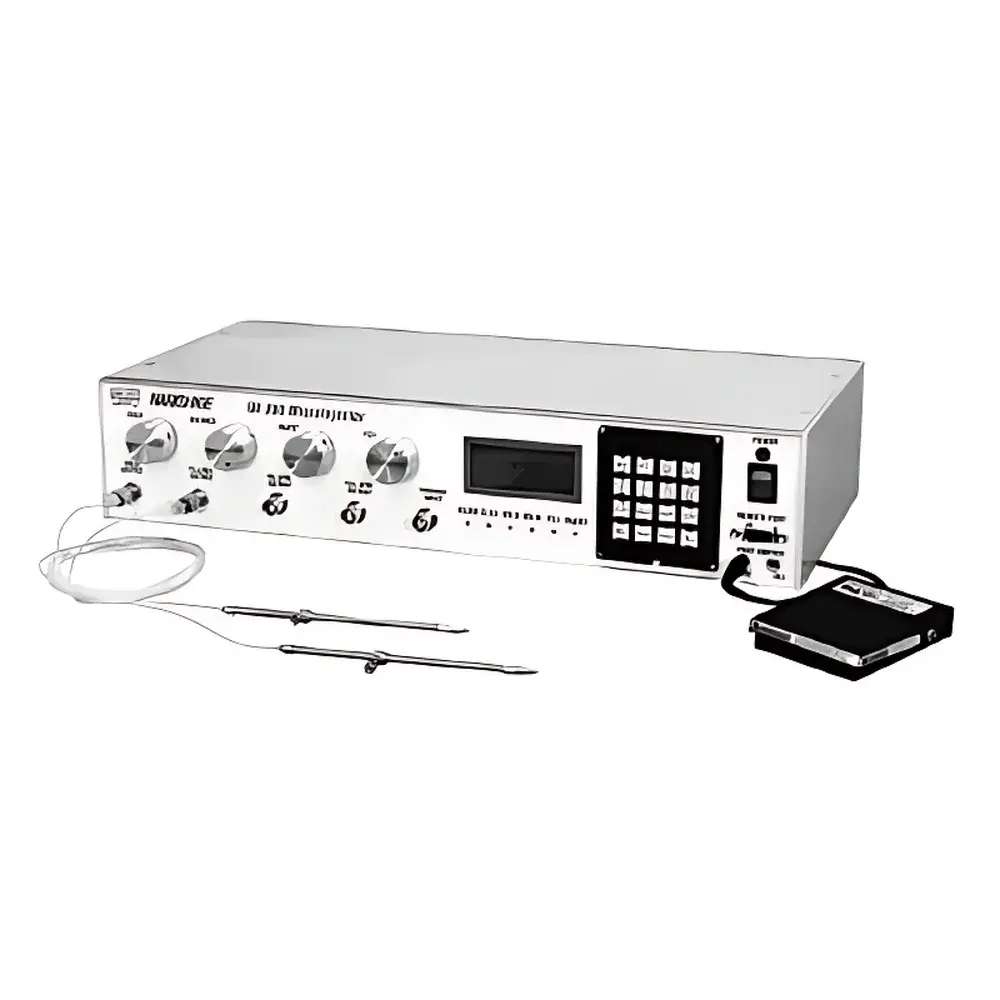
Microinjector IM-300 by NARISHIGE
| Brand | NARISHIGE |
|---|---|
| Model | IM-300 |
| Origin | Japan |
| Operating Pressure Range | Up to 7 kgf/cm² (≈686 kPa) |
| Power Consumption | ~35 W |
| Dimensions | 425 × 205 × 90 mm (W × D × H) |
| Weight | 3.7 kg |
| Includes | Inlet/Outlet Tubing, Foot Switch, Silicone Gasket, Power Cord, HI-7 Microinjector Holder |
Overview
The NARISHIGE IM-300 Microinjector is a precision pneumatic microinjection system engineered for reproducible, time- and pressure-controlled delivery of nanoliter- to microliter-scale volumes into biological specimens. Unlike syringe pump-based or electrokinetic systems, the IM-300 operates on regulated compressed air or nitrogen supplied externally—enabling rapid, stepwise actuation with high temporal resolution and minimal mechanical drift. Its core function relies on controlled gas pressure applied to the rear of a standard glass capillary or syringe plunger, translating calibrated pressure pulses into precise fluid displacement. Designed specifically for intracellular injection, oocyte microinjection, embryonic manipulation, patch-clamp pipette filling, and microfluidic device priming, the IM-300 integrates seamlessly into electrophysiology rigs, inverted microscope workstations, and developmental biology labs where spatial confinement and vibration isolation are critical.
Key Features
- Pneumatically actuated injection with programmable pressure and duration settings—enabling repeatable volume delivery across multiple trials.
- Dual-mode operation: manual (via foot switch) and automated (via TTL-triggered input), supporting synchronization with imaging acquisition or electrophysiological recording systems.
- Adjustable pressure range up to 7 kgf/cm² (686 kPa), compatible with standard borosilicate or quartz capillaries (e.g., Sutter BF150-86-10, World Precision Instruments TW100F-4) mounted on the HI-7 holder.
- Compact benchtop footprint (425 × 205 × 90 mm) and low power draw (~35 W) minimize thermal load and electrical interference in sensitive optical or electrophysiological setups.
- Modular accessory interface: inlet/outlet tubing ports support integration with vacuum-assisted aspiration or backfilling circuits; silicone gasket ensures stable mounting on vibration-damped platforms.
- No internal compressor—eliminates acoustic noise and heat generation, preserving specimen viability during prolonged microinjection protocols.
Sample Compatibility & Compliance
The IM-300 is routinely deployed in applications requiring compliance with GLP-aligned experimental documentation practices. While the device itself does not carry FDA 21 CFR Part 11 certification (as it is a non-data-logging hardware controller), its deterministic pressure-timing behavior supports audit-ready workflows when paired with validated recording software (e.g., Axon pCLAMP, NIS-Elements, or custom LabVIEW VI). It is compatible with ISO 8573-1 Class 4 compressed air standards when used with appropriate filtration and regulators. The system meets IEC 61000-6-2 (immunity) and IEC 61000-6-3 (emission) requirements for laboratory environments. No hazardous materials are employed in construction; all wetted parts are chemically inert (glass, stainless steel, PTFE, silicone), ensuring compatibility with aqueous buffers, enzyme solutions, fluorescent dyes, and low-concentration nucleic acid or protein suspensions.
Software & Data Management
The IM-300 operates as a standalone analog/digital hybrid controller—no proprietary software installation is required. Pressure and timing parameters are set via front-panel rotary dials and push-button interface. For traceable protocol execution, users may integrate the unit’s TTL input/output ports with external data acquisition systems (e.g., National Instruments DAQ, HEKA EPC10) to log trigger events, synchronize with camera frame timestamps, or embed injection markers into electrophysiology recordings. Audit trails can be maintained manually or through third-party experiment management platforms (e.g., MetaMorph, Micromanager) that support hardware triggering metadata capture. Firmware updates are not applicable—the device contains no embedded microprocessor firmware.
Applications
- Intracytoplasmic sperm injection (ICSI) and pronuclear injection in mammalian zygotes.
- Delivery of CRISPR-Cas9 ribonucleoprotein complexes, morpholinos, or mRNA into Xenopus oocytes and zebrafish embryos.
- Filling patch-clamp electrodes with internal solution prior to gigaseal formation.
- Controlled loading of microfluidic channels or organ-on-chip devices with gradient-forming reagents.
- Calibration of nanoliter dispensers using gravimetric or fluorometric endpoint verification.
- Reproducible introduction of tracer dyes (e.g., Alexa Fluor–conjugated dextrans) into single neurons or glial cells.
FAQ
What external pressure source is recommended for optimal performance?
A clean, oil-free, regulated compressed air or nitrogen supply (0–7 kgf/cm² range) with particulate and moisture filtration (ISO 8573-1 Class 4) is required. A laboratory-grade pressure regulator with fine adjustment (e.g., SMC ITV2050) ensures stable output under variable flow conditions.
Can the IM-300 be used for reverse-mode aspiration (withdrawal)?
Yes—by reversing inlet/outlet tubing orientation and applying negative pressure via an external vacuum source (not included), the system supports controlled aspiration for cell content extraction or pipette cleaning.
Is the HI-7 holder compatible with pulled glass capillaries?
Yes—the HI-7 accommodates capillaries with outer diameters from 1.0 to 1.5 mm and lengths up to 100 mm, including laser-pulled or microforge-shaped tips commonly used in single-cell injection.
Does the unit include pressure calibration documentation?
NARISHIGE provides factory calibration certificates upon request (traceable to JIS Z 8001); end-user recalibration is not field-serviceable but may be performed by authorized service centers using dead-weight testers.
How is maintenance performed on the IM-300?
Routine maintenance consists of periodic inspection of O-rings and tubing connections; no internal lubrication or alignment is required. The solenoid valve and pressure sensor are sealed units with >10⁶ cycle lifetime per manufacturer specification.



