
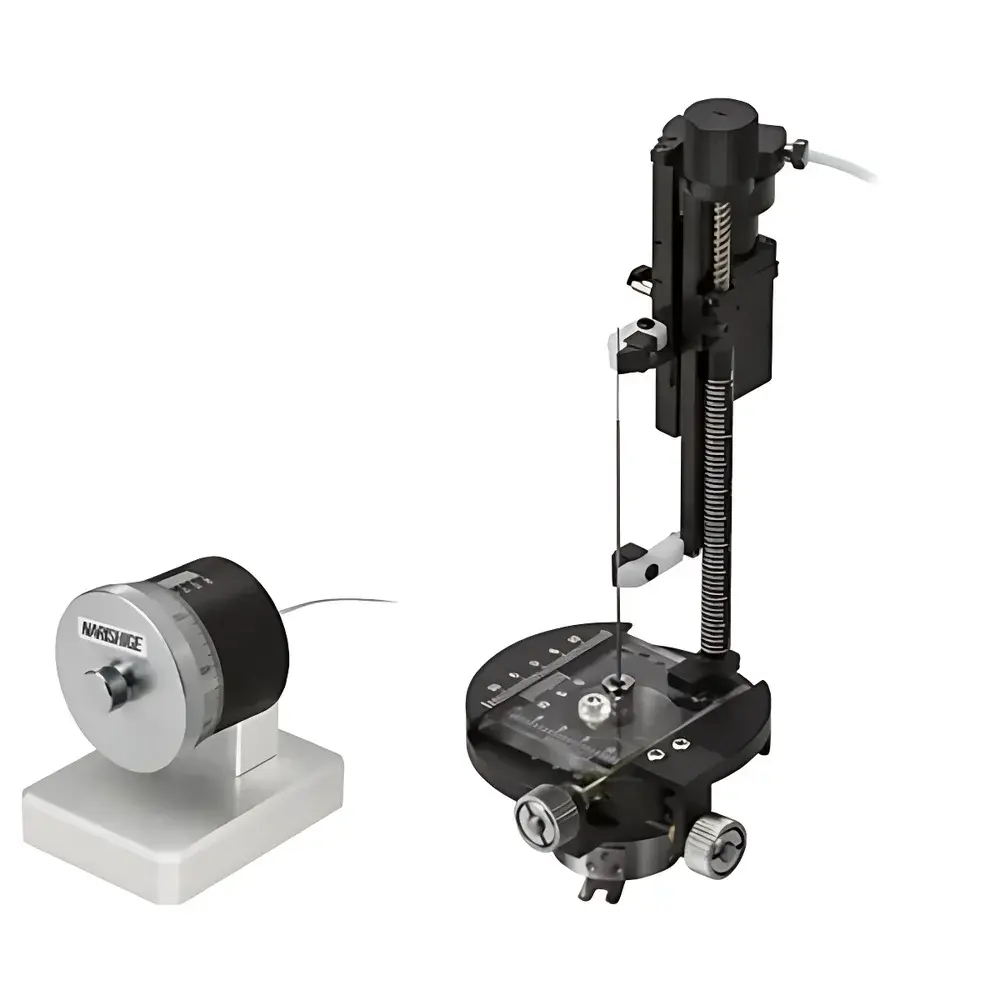
MO-97 Oil-Hydraulic Microdrive Controller by NARISHIGE
| Brand | NARISHIGE |
|---|---|
| Origin | Japan |
| Model | MO-97 |
| Drive Type | Oil-hydraulic |
| Max. Z-axis Travel (Coarse) | 50 mm |
| X/Y Travel | 18 mm each |
| Z-axis Fine Adjustment Range | 30 mm |
| Fine Adjustment Resolution | 2 µm per scale division |
| Full Knob Rotation Displacement | 500 µm |
| Guide Tube | Stainless Steel, Ø0.7 × 60 mm |
| Hydraulic Tubing Length | 1.5 m |
| Control Unit Dimensions | 65 × 88 × 93 mm |
| Control Unit Weight | 630 g |
| XY Stage Material | Acrylic |
| Mounting Method | Stereotaxic Frame-Compatible Direct Head Fixation |
| Compliance | Designed for non-human primate neurophysiology studies under GLP-aligned experimental protocols |
Overview
The MO-97 Oil-Hydraulic Microdrive Controller, engineered by NARISHIGE (Japan), is a precision stereotaxic positioning system specifically developed for chronic and acute electrophysiological experiments in medium-sized non-human primates—primarily macaque monkeys. Unlike motorized or piezoelectric microdrives, the MO-97 employs a closed-loop oil-hydraulic transmission mechanism to deliver smooth, vibration-free, and backlash-free electrode advancement. This principle ensures mechanical stability during deep-brain penetration (up to 50 mm coarse travel), minimizing tissue displacement and neural signal artifact. The controller operates without electromagnetic interference, making it compatible with simultaneous high-fidelity extracellular recording, optogenetic stimulation, and imaging modalities. Its low center of gravity and compact footprint (65 × 88 × 93 mm, 630 g) enable secure integration onto standard primate stereotaxic frames while preserving unobstructed optical access and surgical workspace.
Key Features
- Oil-hydraulic actuation eliminates mechanical chatter and step-induced microvibrations—critical for stable single-unit isolation in subcortical structures such as thalamus, basal ganglia, and brainstem nuclei.
- Two-stage motion control: coarse Z-axis translation (50 mm range) for rapid targeting, coupled with fine Z-adjustment (30 mm range, 2 µm刻度 resolution, 500 µm per full knob rotation) for sub-micron depth calibration.
- Orthogonal X/Y acrylic platform enables real-time visual alignment under surgical microscope or endoscope; transparency supports transcranial fluorescence observation and intraoperative verification of electrode trajectory.
- Stereotaxic head-mounting interface uses a standardized fixation method compliant with NHP skull geometry—ensuring rigid coupling without slippage, even during prolonged recordings or animal movement recovery phases.
- Stainless steel guide tube (Ø0.7 × 60 mm) provides mechanical support and thermal stability for glass or metal microelectrodes; threaded design allows repeatable insertion depth registration across sessions.
- Hydraulic tubing (1.5 m length) permits remote operation from outside the Faraday cage or biosafety enclosure—reducing experimenter-induced perturbation and supporting ISO 14644-1 Class 5 cleanroom-compatible setups.
Sample Compatibility & Compliance
The MO-97 is validated for use with tungsten, platinum-iridium, and glass-coated microwire electrodes (diameters 10–50 µm), as well as silicon-based neuropixels shanks when used with compatible guide cannulae. It meets mechanical safety requirements outlined in ISO 13485:2016 for research-grade neurosurgical instrumentation. While not a medical device, its design adheres to principles referenced in ASTM F2104-21 (Standard Guide for Preclinical Neurophysiology Testing) and supports data integrity practices aligned with GLP documentation standards—including traceable depth calibration logs and operator-accessible mechanical lockout mechanisms. No electrical components reside near the animal interface, eliminating risk of current leakage or grounding artifacts.
Software & Data Management
The MO-97 is a fully manual, analog hydraulic system with no embedded firmware, software interface, or digital connectivity. All positioning is performed via calibrated mechanical knobs and vernier scales—ensuring deterministic repeatability without dependency on drivers, OS compatibility, or cybersecurity patches. Depth settings are recorded manually in lab notebooks or integrated into ELN systems (e.g., LabArchives, Benchling) using standardized templates. For labs requiring audit trails, the fine-adjustment knob’s engraved scale (2 µm divisions) supports photographic documentation synchronized with timestamped electrophysiology acquisition (e.g., via SpikeGLX or Open Ephys). This architecture inherently satisfies FDA 21 CFR Part 11 “non-electronic record” exemptions while enabling seamless integration into GMP-aligned preclinical workflow documentation.
Applications
- Chronic multi-electrode array implantation and repositioning in macaque motor cortex, prefrontal cortex, and hippocampal formation.
- Intraoperative mapping of functional boundaries during awake-behaving neurophysiology experiments.
- Combined electrophysiology and two-photon calcium imaging where mechanical silence is essential for motion artifact suppression.
- Calibration and validation of automated microdrive systems using the MO-97 as a reference-grade manual benchmark.
- Training platform for stereotaxic technique standardization across primate neurophysiology core facilities.
FAQ
Is the MO-97 compatible with MRI environments?
No—the stainless steel guide tube and hydraulic fluid reservoir render it unsuitable for static magnetic fields above 0.5 T. Use only in shielded electrophysiology suites.
Can multiple MO-97 units be operated simultaneously on one animal?
Yes—each unit functions independently via isolated hydraulic circuits; cross-talk is mechanically impossible. Standard practice in bilateral basal ganglia recordings.
What maintenance does the hydraulic system require?
Annual inspection of tubing integrity and oil level; NARISHIGE recommends mineral oil ISO VG 10 as working fluid. No scheduled replacement unless leakage or damping degradation is observed.
Does the acrylic XY stage withstand repeated ethanol sterilization?
Yes—acrylic grade PMMA-995 tolerates up to 10 cycles of 70% ethanol wipe-down without haze or dimensional drift. Autoclaving is not recommended.
How is depth zero calibrated relative to dura surface?
Using the included stainless steel depth stop collar and stereotaxic coordinate referencing; final zero is confirmed histologically post hoc or via impedance transition detection at dura-arachnoid interface.



