
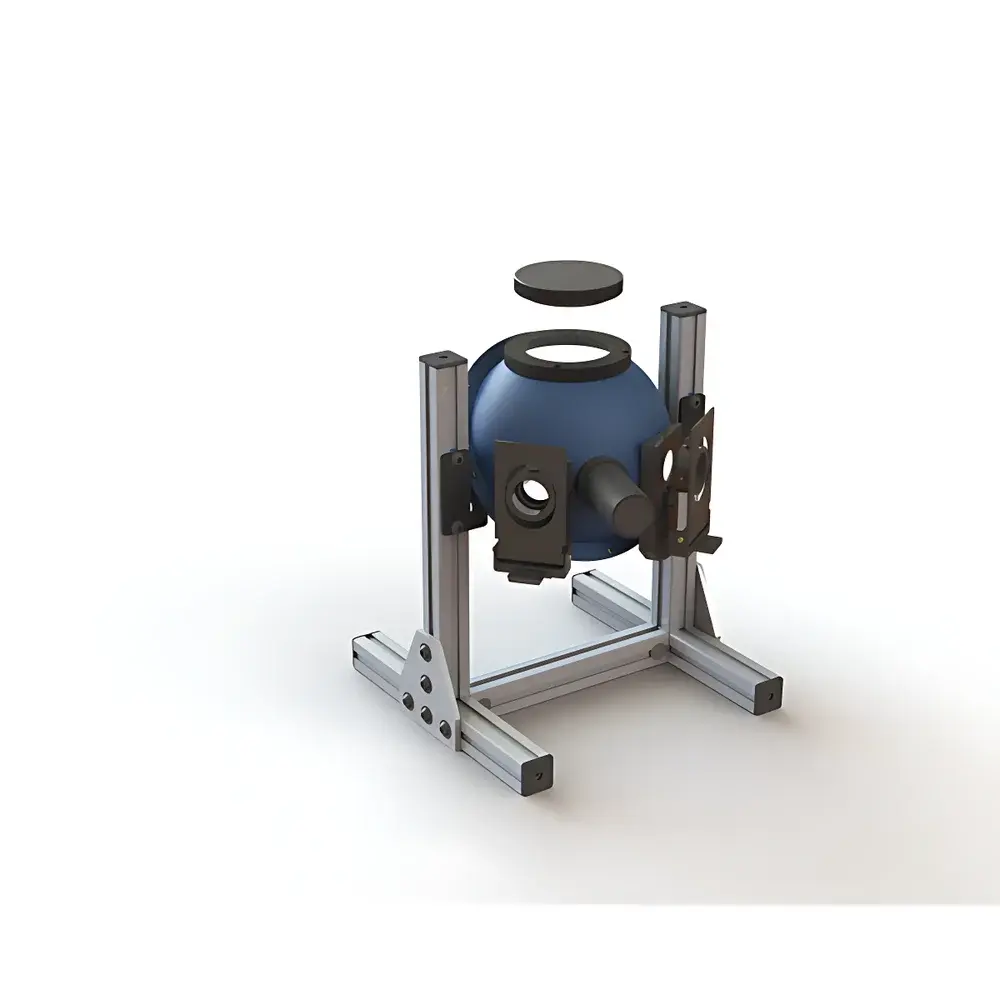
Labsphere CSTM-RC Dual-Beam Laboratory-Grade Transmittance and Reflectance Measurement System
| Brand | Labsphere |
|---|---|
| Origin | USA |
| Manufacturer Type | Authorized Distributor |
| Import Status | Imported |
| Model | CSTM-RC |
| Wavelength Range | 300–1100 nm |
Overview
The Labsphere CSTM-RC Dual-Beam Laboratory-Grade Transmittance and Reflectance Measurement System is an engineered optical characterization platform designed for high-fidelity, traceable measurement of spectral transmittance, specular reflectance, and diffuse reflectance across the ultraviolet–visible–near-infrared (UV-VIS-NIR) spectrum (300–1100 nm). Unlike conventional single-beam integrating sphere systems—where sample insertion alters the effective sphere geometry and introduces systematic radiometric error—the CSTM-RC employs a true dual-beam architecture. This configuration maintains constant optical path geometry during both reference and sample measurements by simultaneously sampling the incident beam (via a dedicated reference channel) and the sphere-integrated signal (via the sample channel), thereby eliminating sphere wall perturbation artifacts and enabling sub-1% relative uncertainty in absolute reflectance determination under controlled laboratory conditions. The system integrates a collimated, stabilized broadband light source with precision optical alignment fixtures, ensuring repeatable illumination geometry without external auxiliary mounts.
Key Features
- Dual-beam optical design with real-time reference monitoring to compensate for source drift and detector responsivity variation
- Modular integrating sphere platform supporting two operational configurations: CSTM-RT (2π hemispherical collection geometry) and CSTM-RTC (center-mounted sample stage enabling variable-angle reflectance studies)
- Integrated light trap mechanism for selective suppression of specular components—enabling independent quantification of diffuse-only and total reflectance
- Factory-aligned collimated source mount with kinematic interface, eliminating need for third-party beam conditioning hardware
- Pre-calibrated, NIST-traceable Spectralon® diffuse reflectance standard (250–2500 nm) included; certified for Lambertian behavior and spatial uniformity per ISO 13697
- Sphere interior coating options: Spectraflect® (300–1800 nm), Spectralon® (200–2400 nm), or InfraGold® (900 nm–10 µm), selected per application spectral requirements
- Compatible with industry-standard fiber-coupled CCD/CMOS spectrometers (e.g., Ocean Insight, Avantes, Hamamatsu) via SMA 905 interface
Sample Compatibility & Compliance
The CSTM-RC accommodates flat, rigid, or semi-rigid samples up to 50 mm in diameter (standard configuration), with optional custom port adapters for irregular geometries. Sample mounting utilizes low-reflectance, non-scattering holders fabricated from anodized aluminum or PTFE-coated stainless steel to minimize edge diffraction and stray light. All optical components—including sphere walls, baffles, and detector ports—conform to ASTM E275, ISO 9050, and USP guidelines for reflectance measurement instrumentation. Calibration protocols follow NIST SP 250-95 procedures for spectral reflectance standards, and full system validation documentation supports GLP and GMP audit readiness. Labsphere’s NVLAP-accredited laboratory (Lab Code 200602-0) provides traceable calibration reports compliant with ISO/IEC 17025.
Software & Data Management
The system operates with Labsphere’s proprietary SpectraSuite™ software suite (Windows 10/11 compatible), which provides instrument control, spectral acquisition, and ISO-compliant data reduction workflows. Key capabilities include automatic dark-current subtraction, wavelength calibration using Hg/Ne emission lines, and reflectance calculation per ASTM E903 methodology. Raw spectral data exports in CSV and XML formats support integration with MATLAB, Python (NumPy/Pandas), or LabVIEW environments. Audit trail functionality records user actions, parameter changes, and calibration events in accordance with FDA 21 CFR Part 11 requirements. Optional IQ/OQ/PQ documentation packages are available for regulated pharmaceutical and aerospace applications.
Applications
- Quantitative evaluation of anti-reflective, high-reflectance, and dichroic optical coatings on lenses, filters, and mirrors
- Characterization of solar absorber materials, PV encapsulants, and transparent conductive oxides (TCOs)
- Quality control of display cover glasses, AR-treated smartphone screens, and automotive HUD substrates
- Validation of diffuse reflectance standards used in remote sensing, hyperspectral imaging, and satellite sensor calibration
- Material R&D for metamaterials, photonic crystals, and nanostructured surfaces requiring angle-resolved reflectance mapping
- Compliance testing against MIL-PRF-13830B (optical surface quality), ISO 13697 (diffuse reflectance), and JIS Z 8722 (colorimetric reflectance)
FAQ
What distinguishes the CSTM-RC from single-beam integrating sphere systems?
The dual-beam architecture eliminates geometric perturbation caused by sample insertion—ensuring consistent sphere efficiency and reducing systematic bias in absolute reflectance values.
Can the CSTM-RC measure bidirectional reflectance distribution function (BRDF)?
The RTC variant supports discrete angular sampling at fixed incidence angles; full BRDF mapping requires integration with a motorized goniometer stage (available as an accessory kit).
Is NIST-traceable calibration included with shipment?
Yes—a factory-certified Spectralon® standard with full spectral reflectance report (250–2500 nm) and uncertainty budget is supplied with each system.
What spectrometer specifications are recommended for optimal SNR?
A minimum resolution of 1.5 nm FWHM, dynamic range >5000:1, and thermoelectric cooling to –10°C are advised for low-light NIR measurements.
Does Labsphere provide installation qualification (IQ) and operational qualification (OQ) documentation?
Yes—customizable IQ/OQ/PQ packages conforming to ISO 13485 and 21 CFR Part 11 are available upon request.





