
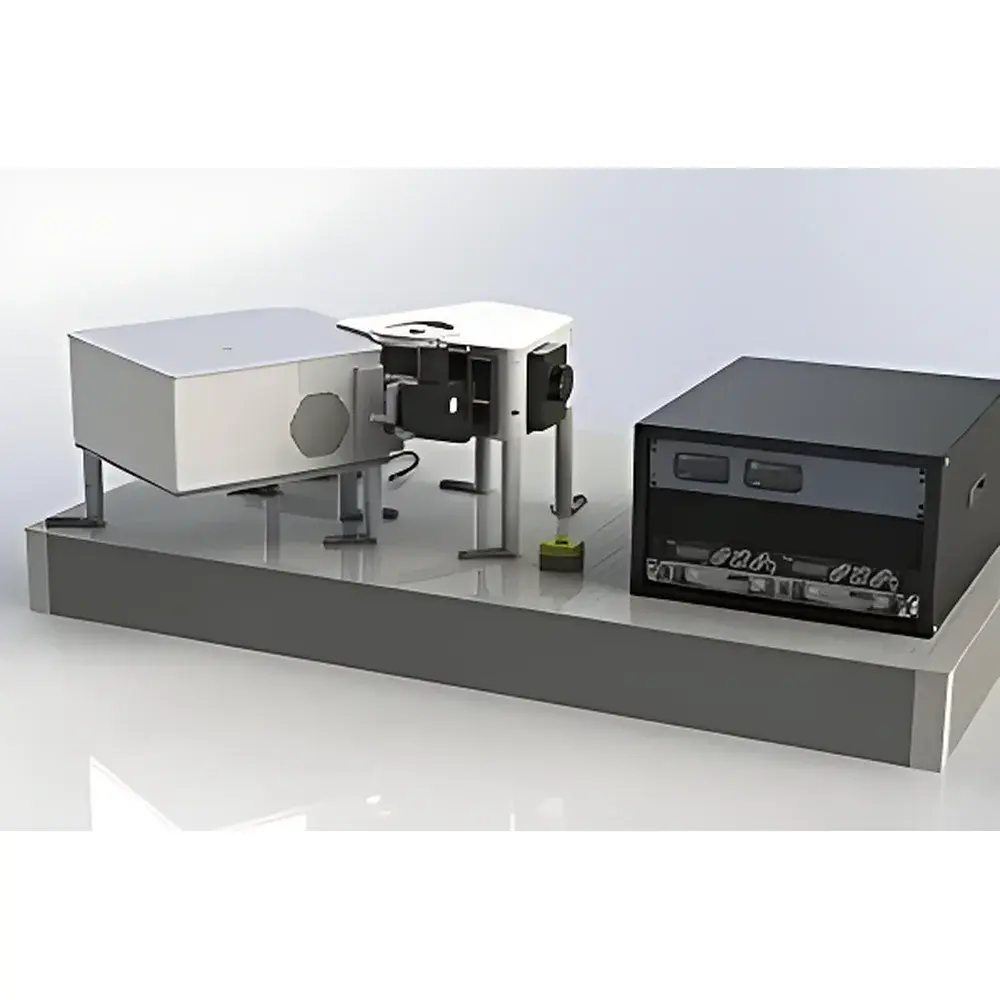
Labsphere SPECTRA-QT Imaging Sensor Quantum Efficiency Test System with Integrating Sphere and Monochromatic Light Source
| Brand | Labsphere |
|---|---|
| Origin | USA |
| Manufacturer Type | Authorized Distributor |
| Product Category | Imported |
| Model | SPECTRA-QT |
| Pricing | Available Upon Request |
| Spectral Irradiance Range | 375–1100 nm |
| Spectral Bandwidth | 5–10 nm |
| Wavelength Accuracy | ±0.6 nm |
| Aperture Diameters | 22 mm, 23.9 mm, 26.2 mm, 29 mm |
| Max Spectral Irradiance (400 nm) | 12 μW/cm²/nm |
| Max Spectral Irradiance (600 nm) | 21 μW/cm²/nm |
| Max Spectral Irradiance (800 nm) | 5 μW/cm²/nm |
| Max Spectral Radiance (400 nm) | 32 μW/cm²·sr·nm |
| Max Spectral Radiance (600 nm) | 54 μW/cm²·sr·nm |
| Max Spectral Radiance (800 nm) | 11 μW/cm²·sr·nm |
| UV-VIS Stability (550 nm) | <1.5% over 5 s |
| VIS-NIR Stability (750 nm) | <0.05% over 5 s |
| NIST-Traceable Calibration | Yes |
| Software Development Kit (SDK) | Included |
Overview
The Labsphere SPECTRA-QT Imaging Sensor Quantum Efficiency Test System is a precision-engineered optical measurement platform designed for quantitative characterization of silicon-based image sensors across the ultraviolet–visible–near-infrared (UV-VIS-NIR) spectrum (375–1100 nm). It integrates a high-stability monochromator-driven light source with a NIST-traceably calibrated integrating sphere to deliver spatially uniform, spectrally defined irradiance and radiance—enabling rigorous determination of quantum efficiency (QE), spectral responsivity, linearity, pixel-level non-uniformity, and module-level response consistency. Unlike broadband or LED-based test sources, the SPECTRA-QT employs a grating monochromator coupled to a stabilized arc lamp or tungsten-halogen source, ensuring narrowband spectral output (5–10 nm FWHM) with wavelength accuracy better than ±0.6 nm—critical for resolving fine spectral features in backside-illuminated CMOS, global shutter sensors, and scientific-grade CCDs.
Key Features
- Four interchangeable aperture sizes (22 mm, 23.9 mm, 26.2 mm, 29 mm) to accommodate diverse sensor formats—from small-format mobile imagers to large-area scientific detectors.
- NIST-traceable spectral irradiance and radiance calibration delivered with each system; full uncertainty budgets provided per ISO/IEC 17025-compliant documentation.
- Dual-source architecture: UV-VIS channel (e.g., deuterium + quartz-tungsten halogen) and VIS-NIR channel (tungsten-halogen), independently optimized for stability and spectral coverage.
- Real-time stability performance: <1.5% irradiance drift over 5 seconds at 550 nm (UV-VIS); <0.05% at 750 nm (VIS-NIR), enabling high-reproducibility measurements without active feedback loops.
- Integrated software development kit (SDK) supporting Python, C++, and LabVIEW APIs—enabling full automation of wavelength sweeps, exposure timing, ROI selection, and data export compliant with ASTM E1318 and ISO 15739 standards.
Sample Compatibility & Compliance
The SPECTRA-QT supports flat-field illumination of bare die, wafer-level sensors, packaged modules (including lens-integrated units), and camera-on-module (CoM) assemblies. Its collimated output geometry and Lambertian sphere coating (Spectraflect®) ensure >98% spatial uniformity (per ANSI PH2.27 and ISO 14524) across the full field of view. The system complies with key regulatory and industry frameworks: calibration traceability adheres to NIST SP 250-94 and ISO/IEC 17025; spectral data acquisition workflows support FDA 21 CFR Part 11 audit trails when integrated with validated LIMS environments; and QE measurement protocols align with ISO 15739 (electronic still-picture imaging — noise measurements) and JEDEC JESD22-A121 (sensor reliability testing).
Software & Data Management
The native SpectraSuite™ control software provides intuitive GUI-based operation for spectral scan definition, real-time irradiance monitoring, and multi-point responsivity mapping. All raw spectral data are stored in HDF5 format with embedded metadata—including timestamps, aperture ID, monochromator slit width, integration time, and calibration coefficients. The SDK enables direct integration with MATLAB-based metrology pipelines, Python-based machine learning models for defect classification, and enterprise QC systems via OPC UA or RESTful API interfaces. Export options include CSV, JSON, and vendor-neutral IEEE 1621-compliant binary formats—ensuring long-term data interoperability and archival integrity under GLP/GMP-compliant laboratory practices.
Applications
- Quantum efficiency mapping of CMOS image sensors during process development and final test (FT) validation.
- Spectral responsivity verification for automotive ADAS cameras operating under ISO 20653 environmental lighting conditions.
- Linearity assessment of scientific sensors used in astronomical instrumentation (e.g., filter wheel characterization for LSST-style observatories).
- Pixel-to-pixel uniformity analysis in medical endoscopy and dental X-ray flat-panel detectors.
- Calibration transfer between reference labs and OEM manufacturing sites using NIST-traceable spectral transfer standards.
FAQ
Is the SPECTRA-QT system compatible with backside-illuminated (BSI) sensors requiring deep-UV sensitivity?
Yes—the UV-VIS channel delivers stable, low-noise irradiance down to 375 nm, and optional fused silica optics and MgF₂-coated gratings extend usable range to 190 nm upon request.
Can the system be used for angular responsivity measurements?
While the standard configuration provides normal-incidence illumination, optional goniometric mounts and motorized tilt stages enable incidence-angle-dependent QE characterization per ISO 9241-307.
Does the SDK support synchronization with external trigger signals from camera readout electronics?
Yes—the hardware interface includes TTL-compatible sync I/O lines for precise frame-trigger alignment, critical for shutter-lag and rolling-shutter distortion analysis.
How frequently does the system require recalibration?
Annual recalibration is recommended; however, built-in reference photodiode monitoring allows daily stability checks and drift correction without interrupting production testing.
Are custom aperture masks or field stops available for specialized sensor geometries?
Yes—Labsphere offers custom machined apertures and field-limiting baffles fabricated to customer-supplied CAD drawings, with surface roughness controlled to <0.4 µm Ra for minimal scatter.



