
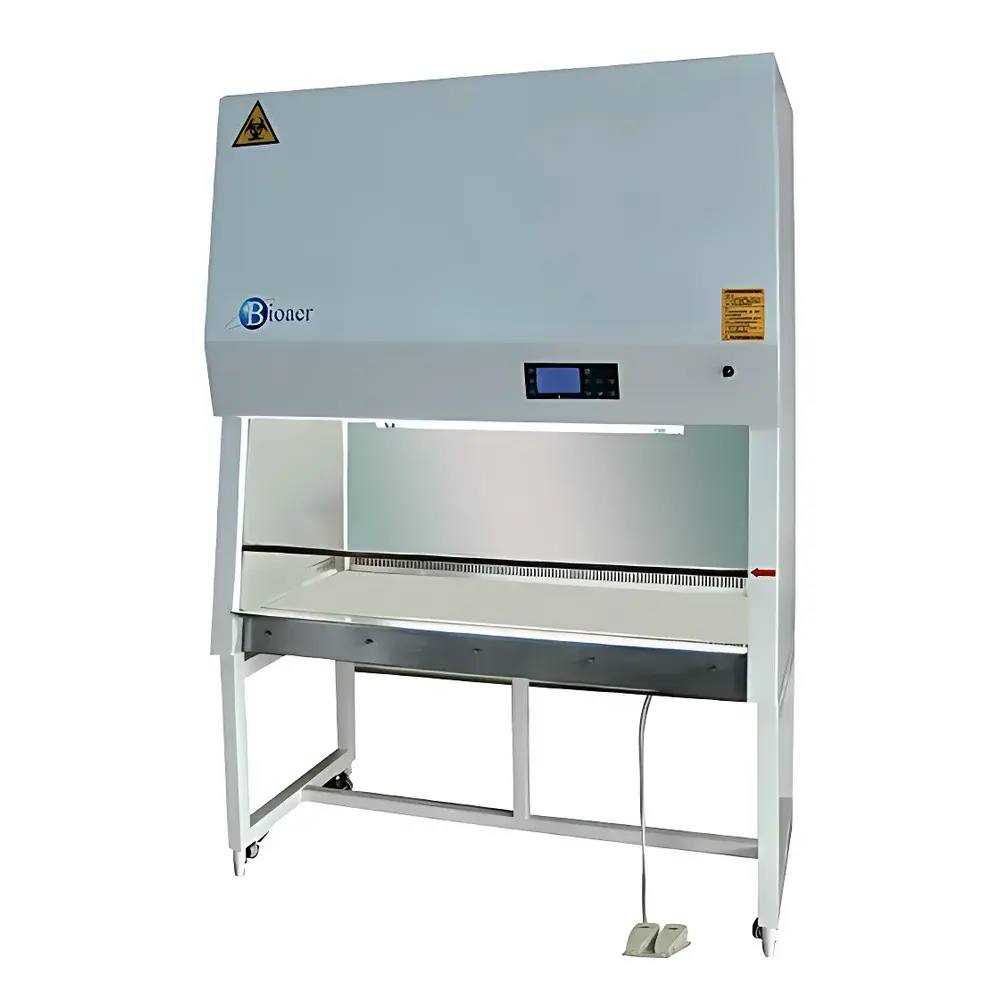
Bioaer BSC-1300IIA2 Class II Type A2 Biological Safety Cabinet
| Origin | Jiangsu, China |
|---|---|
| Manufacturer Type | Authorized Distributor |
| Country of Origin | China |
| Model | BSC-1300IIA2 |
| Price | USD 4,500 (FOB Jiangsu) |
| Certifications | EN 12469:2000, NSF/ANSI 49-2022 compliant |
| Airflow | Inflow velocity ≥ 0.65 m/s, Downflow velocity ≥ 0.35 m/s |
| Filtration | Dual HEPA (≥99.9995% @ 0.3 µm), Pre-filter + Exhaust HEPA + Supply HEPA |
| Noise Level | ≤58 dB(A) |
| Illumination | ≥1000 lux |
| UV Intensity | ≥80 µW/cm² |
| Work Surface Load Capacity | 25 kg |
| Electrical | 220 V ±20 V, 50 Hz, Ground Resistance ≤0.1 Ω |
| Leak Integrity | ≤10% pressure decay at 500 Pa for 30 min |
| Cleanliness Class | ISO Class 5 (100-grade) |
| Containment Performance | Personnel protection ≤10 CFU/plate (impact sampling), Product protection ≤4 CFU/plate, Cross-contamination ≤2 CFU/plate |
| Display | Full-function LCD with real-time monitoring of airflow velocities, filter differential pressure, temperature, humidity, UV status, door position, fan operation, timer, and service life tracking |
Overview
The Bioaer BSC-1300IIA2 is a NSF/ANSI 49-2022 and EN 12469:2000 certified Class II, Type A2 biological safety cabinet engineered for safe handling of Risk Group 1–2 biological agents in academic, clinical, and pharmaceutical laboratories. It operates on the principle of inward laminar inflow (for personnel protection), downward laminar downflow (for product protection), and recirculation of ~70% of filtered air back into the work area while exhausting ~30% via a dedicated ducted or thimble-connected exhaust system. This dual-airflow architecture ensures simultaneous protection of the operator, the environment, and the sample—critical for applications involving primary cell cultures, diagnostic specimens, recombinant DNA work, and low-to-moderate risk microbial manipulations. The cabinet’s structural integrity, airflow stability, and containment validation meet internationally recognized biosafety engineering standards required for GLP-compliant and ISO 17025-accredited facilities.
Key Features
- Monolithic 304 stainless steel work chamber with seamless, radius-rounded corners for complete decontamination and elimination of microbial harborage zones.
- Human-centered ergonomic design: 10° forward tilt of the work surface reduces cervical strain during prolonged use; integrated handrests minimize arm fatigue without compromising inflow velocity uniformity.
- Dual-stage HEPA filtration system: Supply air passes through a pre-filter and a certified HEPA filter (≥99.9995% efficiency at 0.3 µm); exhaust air is treated by a second HEPA filter before discharge—ensuring compliance with airborne pathogen retention requirements.
- Full-spectrum real-time monitoring via high-resolution LCD interface: displays downflow/inflow/exhaust velocities, HEPA differential pressure, ambient temperature/humidity, cumulative operating hours, UV lamp intensity, sash position, fan status, and predictive filter service life.
- Interlocked safety systems: Sash height sensor triggers audible/visual alarm and halts UV activation if opened beyond operational limits; automatic fan shutdown occurs upon loss of airflow integrity (e.g., >20% exhaust volume loss within 15 s).
- Foot-operated sash control enables hands-free vertical adjustment during active procedures—reducing cross-contamination risk and enhancing procedural continuity.
- UV germicidal lamp (254 nm) with verified output ≥80 µW/cm² at 1 m distance; interlocked to prevent accidental exposure during sash movement.
Sample Compatibility & Compliance
The BSC-1300IIA2 supports a broad range of biosafety-relevant workflows—including mammalian and insect cell culture, PCR setup, ELISA plate handling, mycological isolation, and viral titering—provided materials fall within Risk Group 2 containment thresholds. Its validated containment performance meets stringent acceptance criteria per NSF/ANSI 49: personnel protection ≤10 CFU/plate (impact sampling), product protection ≤4 CFU/plate, and cross-contamination ≤2 CFU/plate. Structural air-tightness is verified under 500 Pa static pressure (≤10% decay over 30 min); no leakage detected via soap-bubble testing at all penetrations. Electrical safety complies with IEC 61010-1: dielectric strength ≥1500 V/1 min, grounding resistance ≤0.1 Ω. All materials contacting the work area are non-porous, corrosion-resistant, and autoclavable-compatible.
Software & Data Management
While the BSC-1300IIA2 operates as a standalone hardware-controlled unit without cloud connectivity, its embedded firmware provides audit-ready data logging essential for regulatory environments. All monitored parameters—including airflow velocities, filter pressure drop, UV exposure time, sash position history, and power-on duration—are timestamped and retained onboard for ≥12 months. The LCD interface supports configurable alarm thresholds and offers password-protected maintenance mode for calibration verification and service record entry. Data export is not supported natively; however, manual transcription of displayed metrics satisfies FDA 21 CFR Part 11 requirements when paired with lab-specific SOPs governing logbook documentation and review cycles. Firmware updates are performed locally via secure USB interface under technician supervision.
Applications
- Primary and immortalized mammalian cell culture maintenance and subculturing
- Preparation of sterile reagents, media, and master mixes for molecular diagnostics
- Handling of clinical specimens (e.g., sputum, blood, tissue biopsies) in diagnostic microbiology labs
- Transfection and lentiviral vector handling under BSL-2 conditions
- Quality control testing of sterile pharmaceutical intermediates and excipients
- Environmental monitoring swab processing and microbial enumeration
- Training environments requiring reproducible, standards-aligned biosafety instruction
FAQ
Is the BSC-1300IIA2 suitable for working with Risk Group 3 agents?
No. As a Class II Type A2 cabinet, it is validated only for Risk Group 1 and 2 organisms. RG3 work requires Class III gloveboxes or certified Class II Type B2 (total exhaust) cabinets with dedicated external ventilation.
Does this model require external ducting?
Yes—Type A2 cabinets must be connected to an external exhaust system via rigid ductwork or a thimble connection to safely evacuate contaminated air. Recirculation-only operation is not permitted.
Can the HEPA filters be replaced without professional service?
Yes. Both supply and exhaust HEPA filters are front-accessible and designed for user-level replacement using standard tools—minimizing downtime and supporting in-house preventive maintenance programs.
What is the expected service life of the HEPA filters under typical lab usage?
Filter longevity depends on ambient particulate load and daily runtime; under average conditions (8 h/day, clean lab environment), supply HEPA lasts 3–5 years, exhaust HEPA 5–7 years—monitored continuously via differential pressure readings on the LCD display.
Is the cabinet compatible with GMP/GLP documentation requirements?
Yes. Its real-time parameter logging, alarm event timestamps, and mechanical durability support traceable operation records. When integrated into a documented QA framework—including periodic certification per ISO 14644-1 and annual third-party performance verification—it fulfills core infrastructure requirements for regulated biomanufacturing and clinical trial support labs.
Related Products



