
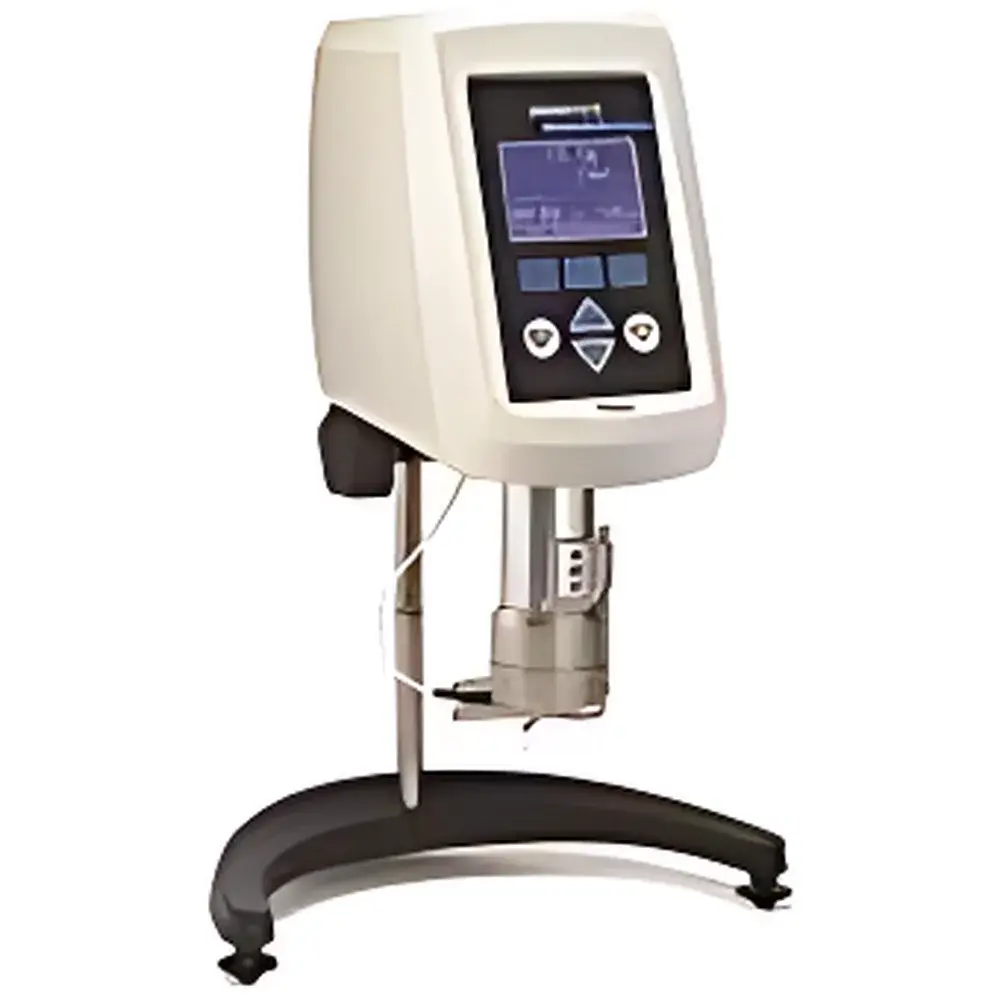
Brookfield DV1 Advanced Rotational Viscometer
| Origin | USA |
|---|---|
| Manufacturer Type | Authorized Distributor |
| Origin Category | Imported |
| Model | Brookfield NEW DV1 |
| Instrument Type | Rotational Viscometer |
| Viscosity Range | 0.3–100,000 mPa·s (cP) |
| Speed Range | 0.3–100 rpm (18 programmable speeds) |
| Accuracy | ±1% of full-scale reading |
| Repeatability | ±0.2% |
| Display | Backlit LCD with large-font parameter readout |
| Interface | USB port for Wingather SQ software and direct label printer connectivity |
| Temperature Monitoring | Optional RTD probe support |
| Compliance | Designed to support ASTM D2196, ISO 2555, ISO 3219, USP <911>, and GLP/GMP data integrity requirements |
Overview
The Brookfield DV1 Advanced Rotational Viscometer is an entry-level yet fully engineered rotational viscometer designed for routine viscosity measurement of Newtonian and mildly non-Newtonian fluids across R&D, QC, and production environments. Based on the Couette principle, it measures torque required to rotate a spindle at a defined angular velocity within a fluid sample — converting mechanical resistance into quantitative viscosity (in mPa·s or cP) via calibrated transduction and real-time digital signal processing. Unlike basic analog instruments, the DV1 integrates continuous torque sensing, microprocessor-based control, and embedded timing logic — enabling reproducible single-point or time-sweep measurements under controlled shear conditions. Its modular architecture supports LV, RV, HA, and HB spindle families, allowing seamless adaptation from low-viscosity solvents (e.g., acetone, ethanol) to highly structured pastes (e.g., epoxy gels, roofing mastics), all within a single platform calibrated to international metrological standards.
Key Features
- 18 precisely controlled rotational speeds (0.3–100 rpm), optimized for wide dynamic range coverage without manual gear changes
- Continuous torque sensing technology — the only instrument in its class offering real-time torque feedback during measurement
- Large-character backlit LCD display showing viscosity, shear rate (calculated), % torque, RPM, and elapsed time simultaneously
- Built-in auto-timing function: programmable start/stop triggers based on torque threshold, temperature setpoint, or absolute duration
- Multi-language UI (English, Chinese, French, German, Spanish, Portuguese, Russian) supporting global lab operations
- USB 2.0 interface compliant with Windows-based Wingather SQ software for automated data logging, curve fitting, and report generation
- Dual connectivity options: direct USB link to PC and parallel interface for thermal-transfer label printers (e.g., Brady BMP21)
- Integrated EZ-Lock quick-connect spindle mounting system — tool-free spindle exchange with tactile alignment feedback
- Optional RTD temperature probe input (PT100 compatible) enabling synchronized viscosity–temperature profiling per ASTM D1074
Sample Compatibility & Compliance
The DV1 accommodates samples ranging from 0.3 mPa·s (deionized water at 25°C) to 100,000 mPa·s (heavy bitumen or filled sealants), depending on spindle geometry and speed selection. Standard configurations include LV (low-viscosity) spindles for thin liquids (e.g., solvents, inks, pharmaceutical syrups) and RV/HA/HB spindles for semi-solids (e.g., lotions, adhesives, food pastes). Optional accessories expand capability: the Small Sample Adapter (SSA) reduces minimum volume to 2 mL; the Ultra-Low Viscosity Adapter (ULA) extends sensitivity down to 0.1 mPa·s; the Thermosel heating jacket enables temperature-controlled testing from 0°C to 150°C. All measurements adhere to traceable calibration protocols aligned with ISO/IEC 17025 requirements. Data output supports audit-ready formats compliant with FDA 21 CFR Part 11 when used with Wingather SQ’s electronic signature and audit trail modules.
Software & Data Management
Wingather SQ software provides full instrument control, real-time graphing, statistical analysis (mean, SD, CV%), and export to CSV, Excel, or PDF. It enforces ALCOA+ principles — ensuring data is Attributable, Legible, Contemporaneous, Original, Accurate, and Complete. Features include method templates (predefined spindle/speed/temperature profiles), pass/fail limits with visual alerts, and batch-level metadata tagging (operator ID, sample ID, environmental conditions). Raw torque-time datasets are stored with timestamped headers, enabling retrospective rheological interpretation. When paired with optional RTD probes, the software plots viscosity vs. temperature curves with automatic inflection point detection per ISO 7885.
Applications
- Quality control of industrial coatings and architectural paints (ASTM D1200, ISO 2555)
- Stability assessment of emulsions and suspensions in cosmetics and agrochemical formulations
- Batch release testing of pharmaceutical liquid dosage forms (USP )
- Rheological screening of food products — from fruit juices (low-shear) to chocolate masses (high-shear)
- Process optimization of hot-melt adhesives and thermoplastic elastomers
- Educational labs requiring robust, intuitive instrumentation for fluid mechanics instruction
FAQ
What spindle series does the DV1 support?
The DV1 accepts all Brookfield standard spindles: LV (for 0.3–6 M cP), RV (0.3–40 M cP), HA (0.3–80 M cP), and HB (0.3–320 M cP), each with dedicated calibration certificates.
Is the DV1 suitable for non-Newtonian fluid characterization?
Yes — by conducting multi-speed flow curves (viscosity vs. shear rate), users can identify shear-thinning or shear-thickening behavior, yield stress estimation (via vane or T-bar spindles), and thixotropy via timed recovery tests.
Does the DV1 meet regulatory requirements for pharmaceutical testing?
When operated with Wingather SQ software, validated RTD probes, and documented calibration records, the system fulfills data integrity expectations under USP , EU Annex 11, and FDA 21 CFR Part 11 for viscosity-critical release assays.
Can I perform temperature-controlled measurements without external baths?
Yes — the optional Thermosel heating system mounts directly onto the instrument base and provides precise ±0.1°C control from ambient to 150°C, eliminating need for circulators in many applications.
How is measurement accuracy verified?
Accuracy is confirmed using NIST-traceable viscosity standards (e.g., Cannon N-series oils) across the full speed and spindle range; annual recalibration is recommended per ISO/IEC 17025 guidelines.



