
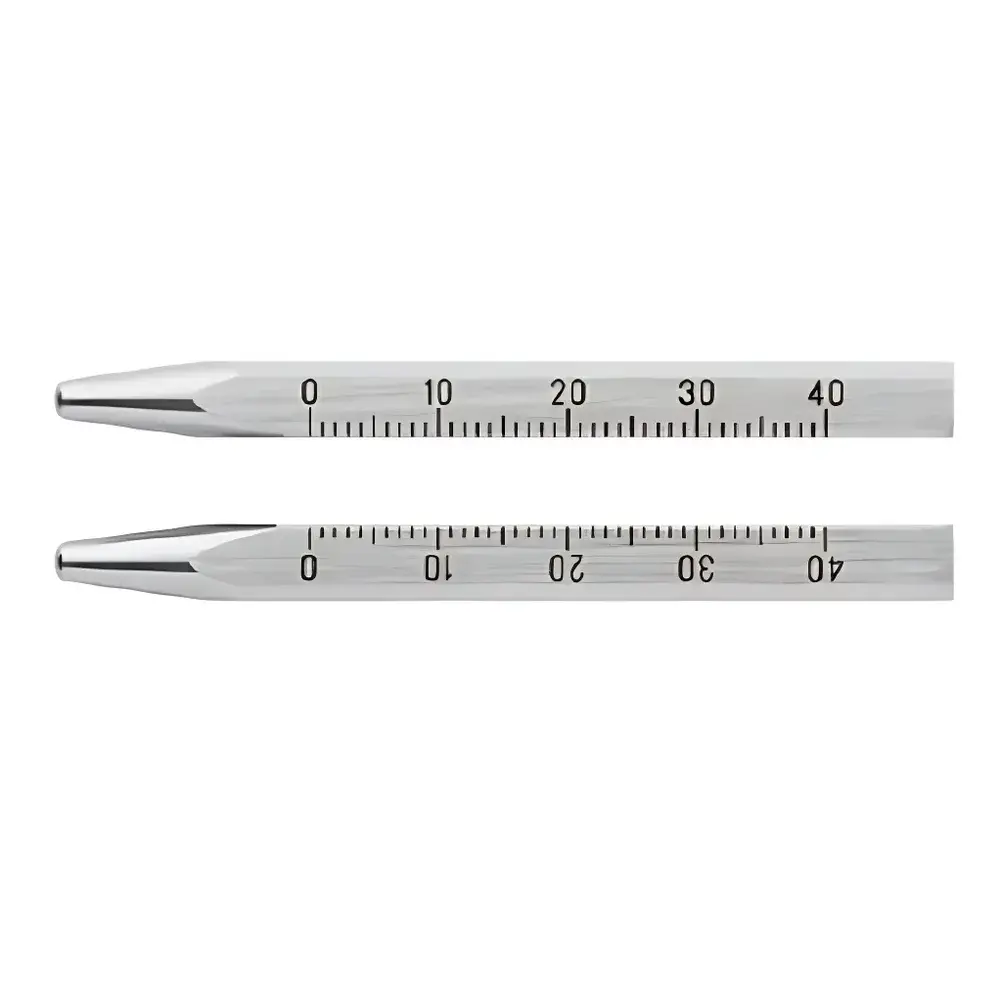
Narishige EB-3A Rat Ear Bars (Pair)
| Brand | Narishige |
|---|---|
| Origin | Japan |
| Model | EB-3A |
| Length | 70 mm |
| Weight | 36 g per pair |
| Compatibility | SR-series stereotaxic instruments |
| Species | Rats and common marmosets |
| Material | Biocompatible stainless steel |
| Manufacturer Type | Original Equipment Manufacturer (OEM) component |
Overview
The Narishige EB-3A Rat Ear Bars are precision-engineered stereotaxic accessories designed exclusively for integration with Narishige’s SR-series stereotaxic frames. These ear bars function as critical mechanical interfaces that immobilize the animal’s head by engaging the external auditory meatus—ensuring rigid, reproducible, and zero-drift positioning during neurosurgical, electrophysiological, or intracerebral injection procedures. Based on the Couette principle of mechanical fixation—where bilateral symmetric force application minimizes rotational torque—the EB-3A achieves sub-millimeter positional stability without compressive deformation of auricular cartilage. This design is validated for use in adult Sprague-Dawley and Wistar rats (250–450 g), and has been empirically verified for compatibility with common marmosets (< 500 g) under institutional IACUC-approved protocols. As an OEM component, the EB-3A is not a standalone instrument but a calibrated subsystem whose geometric tolerances directly impact the spatial fidelity of coordinate-based targeting in stereotaxic space (e.g., Paxinos & Watson atlas alignment).
Key Features
- Precision-machined from medical-grade austenitic stainless steel (ASTM F138 compliant), ensuring corrosion resistance, non-magnetic properties, and autoclavability for repeated sterile use.
- Consistent 70 mm center-to-center lateral span—optimized to match the interaural distance distribution across standard laboratory rat strains—reducing inter-animal variability in bregma-lambda registration.
- 36 g per pair mass balance: engineered to minimize inertial loading on the stereotaxic frame’s vertical column while maintaining sufficient rigidity to resist micro-vibrational displacement during micromanipulator actuation.
- Tapered, rounded distal tips with 0.5 mm radius curvature—designed to distribute contact pressure over ≥12 mm² surface area, thereby limiting localized stress on the tympanic bulla and reducing risk of otic barotrauma.
- Interchangeable with SR-1, SR-2, SR-3, and SR-L stereotaxic base plates via standardized M3 threaded mounting interface (ISO metric thread, pitch 0.5 mm).
Sample Compatibility & Compliance
The EB-3A is validated for use in rats aged ≥8 weeks and weighing 250–450 g, as well as common marmosets (Callithrix jacchus) up to 480 g. It complies with ISO 10993-5 (cytotoxicity) and ISO 10993-10 (irritation/sensitization) for metallic implant-contacting devices. While not classified as an active medical device, its design adheres to principles outlined in AAALAC International accreditation standards for surgical restraint hardware—particularly Sections 3.2.4 (mechanical stability) and 3.3.1 (tissue interface safety). The ear bars support GLP-compliant workflows when used in conjunction with Narishige’s SR-series frames equipped with digital position encoders and audit-trail-enabled control software.
Software & Data Management
As a passive mechanical component, the EB-3A does not incorporate embedded electronics or firmware. However, its dimensional consistency enables traceable correlation between physical stereotaxic coordinates and digital atlas registration in third-party platforms including Paxinos Atlas Navigator (v5.2+), BrainMaker (v3.1), and MATLAB-based Stereotaxic Coordinate Transformation Toolboxes. When paired with SR-series frames featuring optional digital readout modules (e.g., SR-3D-ENC), positional data logged during ear bar insertion—including depth, angle, and torque threshold—can be exported in CSV format for inclusion in electronic lab notebooks (ELNs) compliant with 21 CFR Part 11 requirements.
Applications
- Intracerebral microinjection of viral vectors, pharmacological agents, or tracers into defined nuclei (e.g., hippocampal CA1, ventral tegmental area, basolateral amygdala).
- Chronic implantation of intracranial electrodes for in vivo single-unit recording or local field potential monitoring.
- Stereotaxic-guided craniotomy and dural incision in longitudinal behavioral neuroscience studies.
- Calibration and validation of automated stereotaxic robot systems (e.g., Neurostar, MOBIE) using rat phantoms.
- Training modules for stereotaxic technique certification in academic core facilities and preclinical CROs.
FAQ
Are EB-3A ear bars compatible with non-Narishige stereotaxic frames?
Yes—provided the frame accepts M3 threaded ear bar mounts and offers ≥65 mm minimum inter-aural adjustment range. Adapters may be required for frames using imperial-threaded (e.g., 4-40 UNC) or proprietary quick-lock interfaces.
Can EB-3A be sterilized using ethylene oxide (EtO)?
Yes. Stainless steel construction allows full EtO cycle compatibility (e.g., 55°C, 60% RH, 3-hour exposure). Autoclaving at 134°C for 18 minutes is also validated.
What is the recommended torque for tightening the ear bar set screws?
Maximum specified torque is 0.25 N·m. Over-torquing may deform the mounting bracket or compromise repeatable depth calibration.
Do EB-3A ear bars include depth stop indicators?
No—depth referencing is achieved externally via the SR-series frame’s vernier scale or digital encoder system; the EB-3A itself provides no intrinsic scale markings.
Is there a version optimized for mice?
No. Narishige offers the EB-1M model specifically for mice (inter-aural span ≤ 22 mm); EB-3A is dimensionally incompatible with murine anatomy.



