
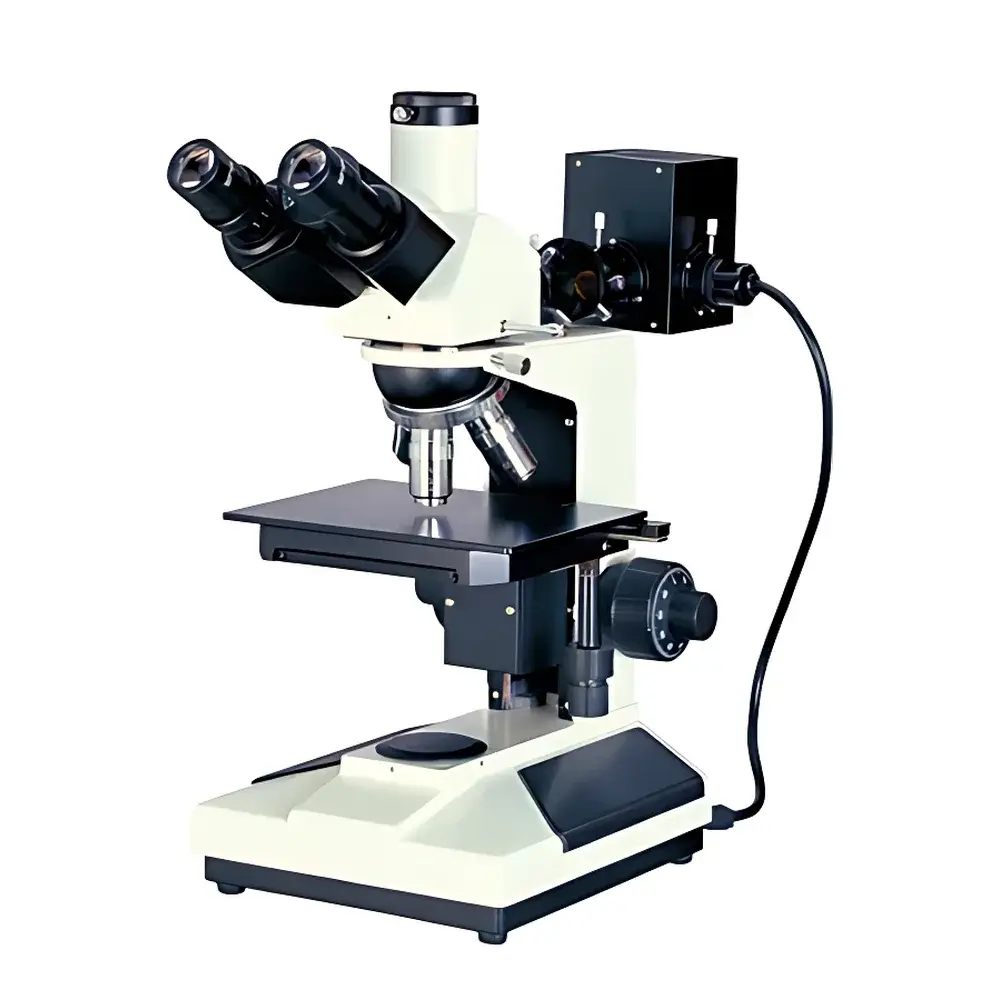
L2003 Upright Metallurgical Microscope
| Origin | Guangdong, China |
|---|---|
| Manufacturer Type | Authorized Distributor |
| Origin Category | Domestic (China) |
| Model | L2003 |
| Price | USD 1,390 (FOB Guangdong) |
| Illumination | 6 V / 20 W Halogen Lamp, Continuously Adjustable Brightness |
| Focus Mechanism | Coaxial Coarse/Fine Adjustment, Fine Focus Graduation: 2 µm, Locking & Travel Limiter |
| Objective Mount | Internal Ball-Bearing Quad- or Penta-Position Turret |
| Stage | Dual-Layer Mechanical Stage (185 mm × 140 mm), 75 mm × 50 mm Travel Range |
| Eyepiece Tube | Trinocular, 30° Inclination, Integrated Analyzer with Toggle for Polarized Light Observation |
| Standard Objectives | Long Working Distance Plan Achromatic (Cover-Slip Free): PL 5×/0.12, PL L10×/0.25, PL L40×/0.60, PL L60×/0.75 (Spring-Loaded) |
| Optional Objectives | PL L50×/0.70, PL L80×/0.80, PL L100×/0.85 (Spring), PL 100×/1.25 (Oil Immersion) |
| Filters | Yellow, Blue, Green Interference Filters + Ground Glass Diffuser |
| Condenser | Reflected-Light Köhler Illumination System with Adjustable Field & Aperture Diaphragms |
| Camera Adapters | 0.4×, 0.5×, 1× C-Mount |
| Digital Imaging Compatibility | USB/Video Output CCD Cameras (DV-1, DV-2, DV-3), DSLR Adapters (Canon A6xx Series), Phototube Couplers (2.5×–4× Zoom w/ 10× Finder) |
Overview
The L2003 Upright Metallurgical Microscope is a precision-engineered optical instrument designed specifically for high-fidelity reflective-light imaging of opaque, polished, or etched specimens—primarily metals, alloys, ceramics, composites, and semiconductor wafers. Unlike transmitted-light microscopes, the L2003 employs an episcopic (incident) illumination path, where light is directed onto the specimen surface via a beamsplitter and reflected back through the objective lens. This configuration enables detailed microstructural analysis—including grain boundary delineation, phase distribution mapping, inclusion identification, and defect characterization—without requiring thin sectioning or transparent mounting media. The system adheres to fundamental principles of Köhler illumination in reflected mode, ensuring uniform intensity, optimal contrast, and minimal glare across the entire field of view. Its rigid mechanical architecture, thermal-stable aluminum alloy frame, and vibration-damped base support long-duration quantitative metallographic workflows in both laboratory and production-floor environments.
Key Features
- Long working distance plan achromatic objectives (cover-slip free), optimized for thick, uncoated, or coated metallographic samples—PL 5×/0.12, PL L10×/0.25, PL L40×/0.60, and spring-loaded PL L60×/0.75 provide consistent focus stability and reduced risk of objective–specimen contact.
- Trinocular observation tube with 30° inclination and integrated rotating analyzer enables seamless transition between brightfield, darkfield (with optional condenser), and polarized light modes; 100% light path diversion supports simultaneous visual observation and high-fidelity digital capture.
- Coaxial coarse/fine focusing mechanism with 2 µm fine-focus graduation, adjustable coarse-drive tension, mechanical travel limiter, and dual-position locking ensures repeatable Z-axis positioning—critical for serial sectioning, focus stacking, and ASTM E3-22 compliant depth-of-field documentation.
- Dual-layer mechanical stage (185 mm × 140 mm) with 75 mm × 50 mm travel range and vernier-scale positioning allows precise coordinate-based navigation across large-area mounts (e.g., ASTM E112 grain size specimens or cross-sectioned PCBs).
- Reflected-light illumination system features a 6 V / 20 W halogen lamp with continuous brightness control, independently adjustable field and aperture diaphragms, built-in linear polarizer, and interchangeable interference filters (yellow, blue, green) for selective wavelength enhancement in color-metallography applications.
Sample Compatibility & Compliance
The L2003 accommodates standard metallographic specimen sizes up to 30 mm in diameter and 40 mm in height, including mounted epoxy/polyester resin blocks, as-polished or chemically etched coupons, and fracture surfaces prepared per ASTM E3, ISO 643, or EN 10360. Its cover-slip-free optical design eliminates refractive index mismatch errors common in oil-immersion setups for rough or textured surfaces. The microscope conforms to ISO 8578:2020 (Microscopy — Nomenclature for Optical Components) and supports GLP-compliant documentation when paired with FDA 21 CFR Part 11–enabled imaging software (e.g., optional DV-1 camera with audit-trail firmware). Polarization functionality meets ASTM E1122 requirements for anisotropic phase identification in titanium alloys, duplex stainless steels, and intermetallic compounds.
Software & Data Management
While the L2003 operates as a standalone optical platform, its trinocular port and standardized C-mount interface (via 0.4×/0.5×/1× adapters) ensure full compatibility with third-party image acquisition and analysis suites—including Olympus cellSens, Zeiss ZEN Core, and open-source tools such as ImageJ/Fiji with metallography-specific plugins (e.g., GrainSize, PhaseQuant). All included CCD cameras (DV-1/DV-2/DV-3) output calibrated 12-bit TIFF or BMP streams with timestamped metadata. Optional reticle-equipped adapters (810003) enable direct measurement traceability to NIST-traceable stage micrometers, satisfying ISO/IEC 17025 calibration reporting requirements for accredited testing laboratories.
Applications
- Metallographic quality control in foundries and heat-treatment facilities (grain size ASTM rating, inclusion rating per ASTM E45, decarburization depth per ISO 3887)
- Failure analysis labs performing fractography on fatigue, creep, or stress-corrosion cracks
- R&D departments evaluating coating adhesion, porosity, and interfacial diffusion in thermal barrier coatings or brazed joints
- Electronics manufacturing for solder joint inspection (IPC-A-610), wire bond integrity, and PCB microsection analysis
- Academic instruction in materials science curricula—supporting hands-on training in specimen preparation, etchant selection, and quantitative stereology
FAQ
Does the L2003 support oil immersion objectives?
Yes—optional PL 100×/1.25 oil immersion objectives (Cat. No. 2240111) are compatible and deliver enhanced resolution for ultrafine precipitate analysis in aluminum or nickel superalloys.
Can the microscope be integrated into automated metrology workflows?
Absolutely—the trinocular port, programmable illumination control (via external dimmer modules), and RS-232–enabled digital cameras allow integration with LabVIEW or Python-controlled stage automation systems.
Is the polarization module suitable for quantitative birefringence measurement?
The built-in linear polarizer and rotatable analyzer support qualitative anisotropy assessment; for quantitative retardation analysis, we recommend coupling with a calibrated λ/4 plate and photometric calibration kit (sold separately).
What is the maximum specimen weight the stage can support?
The dual-layer mechanical stage is rated for static loads up to 2.5 kg—sufficient for standard 30-mm-diameter mounted specimens and most industrial cross-sections.
Are replacement halogen lamps and filters available as consumables?
Yes—original-specification 6 V / 20 W halogen bulbs (Osram HLX 64625) and certified interference filters (OD ≥ 4.0, ±2 nm bandwidth) are stocked and shipped globally with 48-hour dispatch.




