
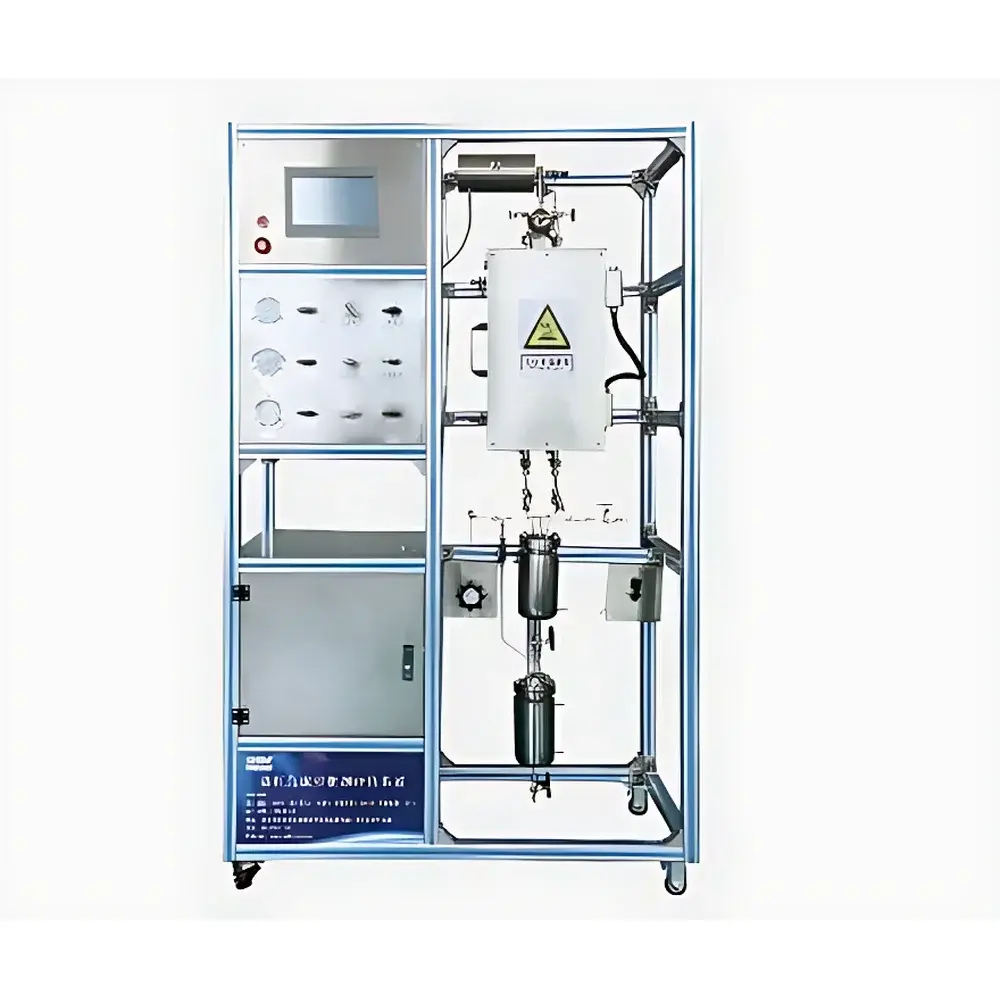
Kemi Continuous Flow Reactor / Catalyst Evaluation System – Model CE-100 Series
| Origin | Anhui, China |
|---|---|
| Manufacturer Type | Authorized Distributor (Beijing HQ) |
| Origin Category | Domestic (PRC) |
| Model | CE-100 Catalyst Evaluation System |
| Price Range | USD 7,000 – 14,000 |
| Vessel Capacity | Benchtop-Scale (0.5–5 L active volume) |
| Construction Material | 316 Stainless Steel |
| Operating Pressure | Medium-Pressure (up to 10 MPa / 1450 psi) |
Overview
The Kemi CE-100 Series Continuous Flow Reactor is a benchtop-scale, tubular fixed-bed catalytic evaluation system engineered for precision kinetic studies, catalyst screening, and process intensification research under controlled temperature and pressure conditions. Based on the principles of plug-flow reactor (PFR) hydrodynamics, it minimizes axial dispersion and backmixing—enabling high conversion efficiency, accurate residence time distribution (RTD) characterization, and reliable scale-up correlation for fast, exothermic, or consecutive reactions. Its modular architecture supports three fundamental reaction regimes: liquid–liquid (L–L), gas–liquid (G–L), and gas–gas (G–G), with optional integration of solid catalyst beds, static mixing elements, and segmented thermal zones. Designed in accordance with ISO 9001-certified manufacturing protocols and aligned with ASTM E2877 (Standard Guide for Laboratory Reactor Safety), the CE-100 meets essential engineering requirements for academic laboratories, R&D centers, and pre-pilot development units conducting heterogeneous catalysis, green chemistry optimization, and continuous process validation.
Key Features
- Tubular reactor core constructed from electropolished 316 stainless steel, rated for continuous operation up to 10 MPa and 450 °C
- Modular flow path configuration: single straight tube, helical coil, or parallel multi-tube assembly for scalability and heat transfer optimization
- Integrated fixed-bed section with standardized catalyst cartridge design (ID: 10–25 mm; bed length adjustable from 50–500 mm)
- Independent axial zoning of heating/cooling: up to three independently controlled temperature segments using PID-regulated electric furnace sleeves or fluid-circulated jackets
- Real-time pressure monitoring and regulation via digital back-pressure regulator (BPR) with ±0.02 MPa repeatability
- Configurable inlet mixing modules: static mixers (Kenics-type), impinging jet mixers, or Venturi injectors—selected per phase behavior and mass transfer demand
- Gas-phase systems include certified high-integrity fittings (Swagelok® SS-400 series), leak-tested to ≤1×10⁻⁹ mbar·L/s He
Sample Compatibility & Compliance
The CE-100 accommodates a broad range of feedstock chemistries without cross-contamination risk due to its fully drainable, non-recirculating flow path. For L–L systems, it handles miscible solvents, immiscible biphasic mixtures, and low-to-medium viscosity suspensions (<500 cP). G–L configurations support sparging-limited reactions such as hydrogenations, oxidations, and carbonylations—achieving volumetric mass transfer coefficients (kLa) exceeding 0.1 s⁻¹ under standard operating conditions. G–G applications include thermal cracking, methanation, and ammonia synthesis simulations over supported metal or metal oxide catalysts. All wetted components comply with ASME B31.3 Process Piping standards and are compatible with common laboratory solvents, H₂, CO, O₂, NH₃, and chlorinated hydrocarbons. The system conforms to GLP documentation requirements and supports 21 CFR Part 11-compliant electronic audit trails when paired with optional KemiControl™ v3.2 software.
Software & Data Management
KemiControl™ v3.2 is a Windows-based supervisory control and data acquisition (SCADA) platform that provides synchronized logging of temperature (±0.5 °C), pressure (±0.1% FS), flow rate (±1% reading), and optional online analytics (e.g., FTIR or GC-TCD via analog/digital I/O). It enables automated method sequencing—including ramp-hold-cool profiles, stepwise pressure modulation, and timed fraction collection triggers. Raw datasets are exported in CSV and HDF5 formats for post-processing in MATLAB®, Python (Pandas/NumPy), or Aspen Custom Modeler®. Audit trail functionality records all parameter changes, user logins, and system events with timestamped digital signatures, satisfying internal QA/QC and external regulatory review needs.
Applications
- Catalyst activity, selectivity, and deactivation kinetics under industrially relevant space velocities (GHSV: 100–10,000 h⁻¹; LHSV: 0.1–5 h⁻¹)
- Residence time distribution analysis via pulse-response or step-change tracer experiments
- Thermal stability mapping of catalytic formulations under adiabatic or near-isothermal conditions
- Process intensification studies for pharmaceutical API synthesis, fine chemical oxidation, and biomass-derived platform molecule upgrading
- Reaction mechanism validation through in situ spectroscopic coupling (e.g., Raman probe ports at multiple axial positions)
- Teaching modules for chemical engineering unit operations courses covering PFR design, mass/energy balances, and safety-critical parameter boundaries
FAQ
Can the CE-100 be used for corrosive media such as HF or hot concentrated acids?
Standard 316 SS construction is not recommended for hydrofluoric acid or >60% sulfuric acid above 80 °C. Optional Hastelloy C-276 or Inconel 625 liner kits are available upon request.
Is remote operation supported?
Yes—via Ethernet-connected OPC UA server interface; full control and monitoring are accessible through secure VPN or institutional intranet.
What catalyst loading protocols are supported?
Pre-packed cartridges (5–10 g capacity), loose-bed manual loading with settling rods, and graded-density layered beds—all with integrated thermocouple sheaths for axial temperature profiling.
Does the system include calibration certificates?
Each unit ships with NIST-traceable calibration reports for pressure transducers and RTD sensors, valid for 12 months from date of shipment.
How is maintenance access designed?
Front-access service panel with quick-release clamps allows full disassembly of reactor tube, mixer, and BPR within 15 minutes—no specialized tools required.
Related Products



