
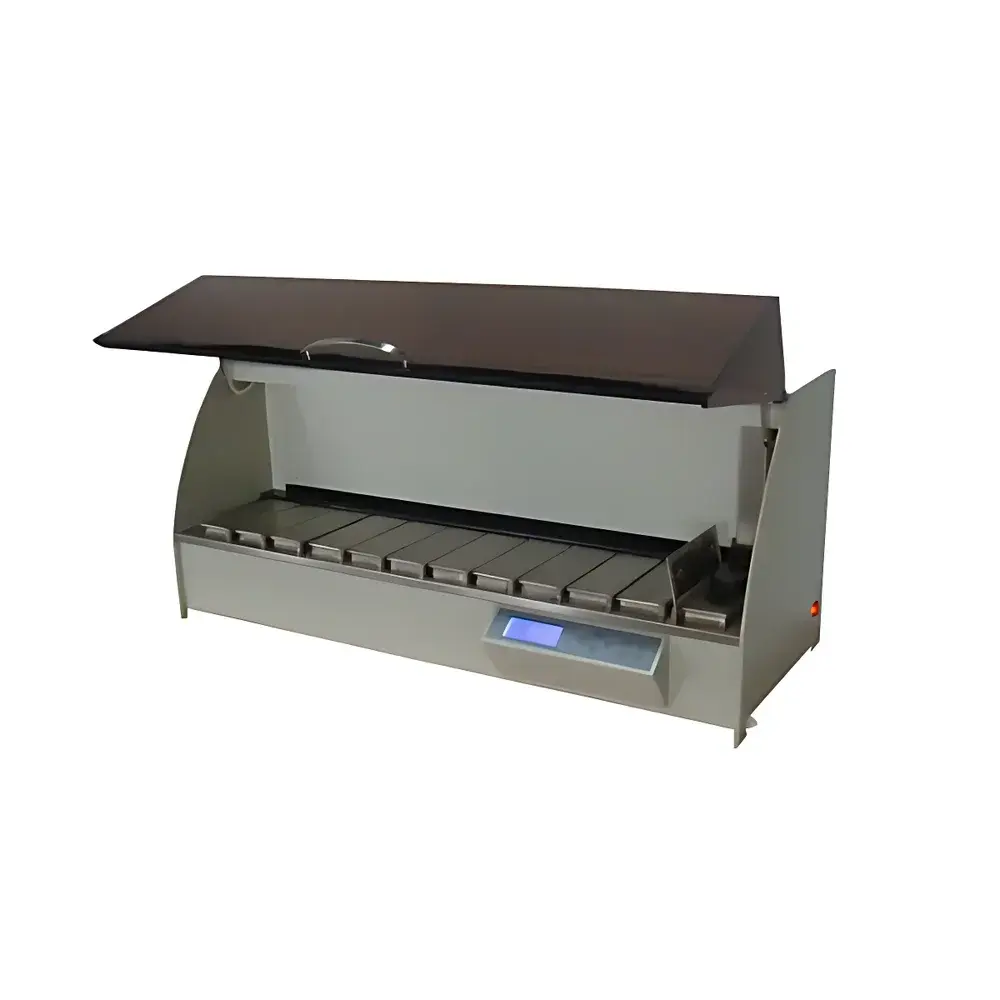
ZEEDO HS-1500 Fully Automated Tissue Dehydrator
| Brand | ZEEDO |
|---|---|
| Origin | Zhejiang, China |
| Model | HS-1500 |
| Chamber Count | 9 reagent + 3 paraffin wax chambers |
| Single Chamber Volume | 1500 mL |
| Reagent Chamber Timing | 0–99 h (Chamber 1), 0–24 h (Chambers 2–9) |
| Wax Chamber Timing | 0–24 h (Chambers 10–12) |
| Temperature Range | Ambient to 99 °C |
| Tissue Protection Chamber Selection | Configurable across Chambers 1–7 |
| Drain/Drain-and-Shake Dwell Time | 10–60 s |
| Post-Entry Heating Activation | Auto-start from Chamber 2 |
| Power Supply | AC 220 V / 50 Hz or AC 110 V / 60 Hz |
| Power Consumption | 800 VA |
| Dimensions (W×D×H) | 1010 × 550 × 420 mm |
| Net Weight | 80 kg |
| Max. Throughput | ≥75 tissue specimens per cycle |
| Stirring Frequency | 0–6 rpm (adjustable) |
| Display | Large LCD with bilingual (English/Chinese) GUI and real-time animation |
| Safety | Sealed exhaust system with activated carbon filtration |
| Power Failure Recovery | >30 h backup operation with status retention and auto-resume capability |
Overview
The ZEEDO HS-1500 Fully Automated Tissue Dehydrator is a microprocessor-controlled, vacuum-assisted instrument engineered for precise, reproducible, and standardized dehydration of biological tissues in pathology laboratories. It operates on the principle of graded solvent exchange—typically ethanol, xylene, and molten paraffin—under controlled temperature and timed immersion conditions to remove water while preserving histomorphological integrity. Designed for compliance with routine histopathology workflows, the HS-1500 integrates vacuum-assisted infiltration to minimize air entrapment in dense or fatty tissues, thereby enhancing penetration uniformity and reducing processing artifacts. Its architecture supports both manual protocol customization and pre-programmed sequence execution, making it suitable for high-volume diagnostic labs, academic pathology departments, and translational research facilities where consistency, traceability, and throughput are critical.
Key Features
- Twelve-chamber configuration: nine dedicated reagent chambers (e.g., graded alcohols, clearing agents) plus three independent paraffin wax chambers—enabling full automation from dehydration through infiltration.
- Precise thermal regulation across all chambers (ambient to 99 °C) with ±0.5 °C stability, ensuring optimal solvent volatility control and wax viscosity management.
- Programmable drain-and-shake cycles: 10–60 second dwell time per chamber with mechanical agitation (0–6 rpm), minimizing cross-contamination and maximizing reagent efficiency.
- Intelligent heating logic: automatic activation only after tissue entry into Chamber 2, reducing standby energy consumption without compromising process kinetics.
- Bilingual graphical user interface with animated process visualization, contextual help prompts, and real-time status feedback—including chamber occupancy, elapsed time, remaining duration, and error diagnostics.
- Integrated environmental safety system: sealed gas path with activated carbon filtration and optional external exhaust routing, compliant with occupational exposure limits for organic vapors (per OSHA 29 CFR 1910.1200).
- Robust power failure resilience: maintains operational state for over 30 hours on internal backup; resumes processing automatically upon power restoration with full audit trail retention.
Sample Compatibility & Compliance
The HS-1500 accommodates standard histology cassettes (up to 75 specimens per run), including biopsy fragments, surgical resections, and experimental animal tissues. It supports both conventional and rapid protocols for formalin-fixed, paraffin-embedded (FFPE) specimen preparation. Chamber configuration allows flexible assignment of solvents (e.g., isopropanol instead of ethanol) and custom wax formulations. The system adheres to core principles outlined in CAP (College of American Pathologists) Laboratory Accreditation Checklists for tissue processors and aligns with ISO 15189:2022 requirements for pre-analytical process validation. While not FDA-cleared as a medical device, its operational parameters meet GLP-relevant documentation standards—including timestamped log files, user-accessible audit trails, and password-protected method editing—facilitating internal QA/QC and regulatory readiness.
Software & Data Management
The embedded firmware records complete cycle metadata—including date/time stamps, operator ID (via optional login), selected program, chamber temperatures, dwell durations, and alarm events—in non-volatile memory. Exportable logs (CSV format) support integration into LIMS environments. The system does not require external PC connectivity for basic operation but offers optional RS-232 or USB interface for centralized logging or remote monitoring. All user-modifiable parameters are subject to hierarchical access control (administrator vs. technician levels), satisfying foundational requirements for 21 CFR Part 11–aligned environments when paired with institutional electronic signature policies.
Applications
- Routine diagnostic histopathology in hospital and reference laboratories.
- Preclinical research involving rodent, porcine, or primate tissue models requiring standardized FFPE processing.
- Botanical and veterinary pathology where variable tissue density demands adjustable agitation and extended dwell times.
- Teaching laboratories seeking reliable, low-maintenance instrumentation for student training in tissue processing fundamentals.
- Core facilities supporting multi-user, multi-project workflows with need for protocol versioning and reproducibility tracking.
FAQ
What is the maximum number of tissue cassettes the HS-1500 can process simultaneously?
Up to 75 standard-sized cassettes per cycle, depending on cassette dimensions and rack configuration.
Does the HS-1500 support vacuum-assisted processing?
Yes—it includes integrated vacuum control for enhanced solvent penetration during dehydration and clearing steps.
Can users define custom temperature profiles for individual chambers?
Temperature is set globally per chamber group; however, each chamber may be assigned an independent target within the 0–99 °C range via programmable protocol steps.
Is the HS-1500 compatible with paraffin wax formulations other than standard melting point grades?
Yes—the wax chambers maintain stable temperature control across 56–62 °C ranges, accommodating low-melt, high-melt, and polymer-enhanced waxes.
How is data integrity ensured during extended unattended operation?
All process variables are continuously logged to flash memory with cyclic overwrite protection; power loss triggers automatic checkpointing and graceful resumption without data corruption.



