
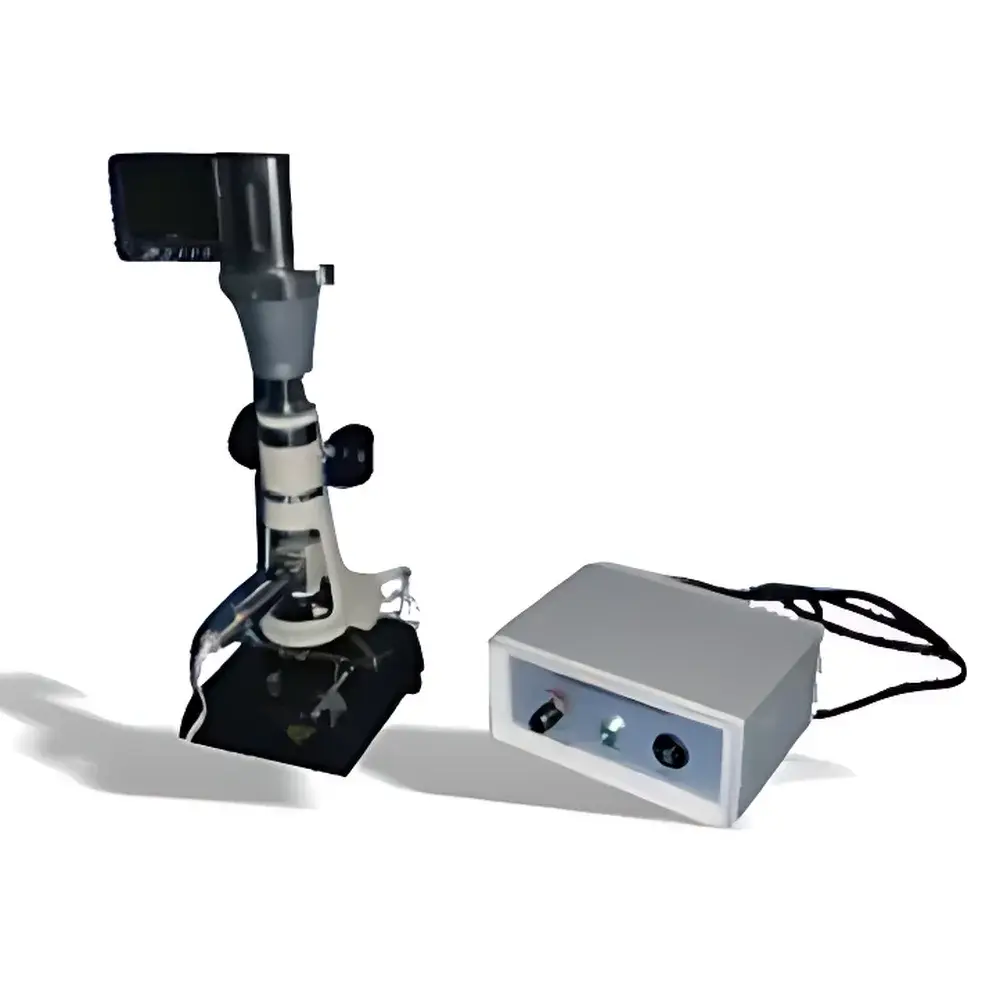
XLB-100 Portable Metallurgical Microscope
| Origin | Beijing, China |
|---|---|
| Manufacturer Type | Authorized Distributor |
| Origin Category | Domestic (PRC) |
| Model | XLB-100 |
| Price | USD 1,600 (approx.) |
| Eyepieces | 10× (18 mm FOV), 12.5× (14 mm FOV) |
| Objectives | 4×/0.10 (WD 17.9 mm), 10×/0.25 (WD 6.5 mm), 40×/0.65 (WD 0.74 mm) |
| Total Magnification Range | 40×–500× |
| Illumination | Integrated 8 V / 9 W Tungsten Halogen Lamp with Continuously Variable Brightness Control |
| Base | Magnetic Mounting System for Ferromagnetic Surfaces |
| Weight | < 1.8 kg |
| Dimensions (L×W×H) | 195 × 85 × 140 mm |
Overview
The XLB-100 Portable Metallurgical Microscope is an engineered solution for in-situ microstructural examination of metallic components without destructive sampling. Designed around the principles of upright reflected-light microscopy, it employs Köhler illumination and parfocal, achromatic objectives to deliver high-contrast, diffraction-limited imaging of polished metal surfaces under ambient or field conditions. Unlike conventional laboratory-based metallurgical microscopes, the XLB-100 integrates a permanent magnetic base that enables rapid, stable attachment to ferromagnetic substrates—such as carbon steel pipelines, pressure vessel welds, turbine casings, and rail axles—eliminating the need for sample removal, sectioning, or mounting. Its compact monocular optical path, lightweight aluminum alloy chassis, and self-contained illumination system make it suitable for use in confined spaces, elevated platforms, or outdoor inspection zones where power supply and environmental control are limited.
Key Features
- Integrated magnetic base with ≥120 N holding force on flat ferromagnetic surfaces (≥3 mm thickness), enabling secure positioning on vertical or overhead structures
- Parfocal and color-corrected objective lens set (4×, 10×, 40×) with standardized DIN mechanical tube length (160 mm) and precise working distance calibration
- Wide-field eyepieces (10×/18 mm and 12.5×/14 mm) providing ergonomic viewing and extended depth-of-field for coarse-to-fine microstructural assessment
- Continuously adjustable tungsten-halogen illumination (8 V / 9 W) with heat-absorbing filter to minimize thermal drift during prolonged observation
- Robust, shock-resistant housing rated IP52 for dust resistance and limited moisture protection—suitable for industrial environments per IEC 60529
- No external power adapter required; operates via integrated low-voltage DC circuitry compatible with standard portable battery packs (optional)
Sample Compatibility & Compliance
The XLB-100 is validated for direct surface evaluation of ferrous alloys—including carbon steels, stainless steels, cast irons, and nickel-based superalloys—following ASTM E3, ASTM E112, and ISO 643 standard preparation protocols. Surface preparation is performed in situ using handheld abrasive discs, diamond pastes (1–0.25 µm), and non-aqueous polishing cloths to avoid oxidation or etching artifacts. The microscope supports qualitative and semi-quantitative analysis of grain structure, inclusion content, phase distribution, and heat-affected zone (HAZ) morphology. It conforms to general requirements for portable inspection equipment under EN 1330-1 (Non-destructive testing — Terminology — Part 1: General terms) and is routinely deployed in third-party inspection workflows compliant with ASME BPVC Section V, API RP 571, and EN 13445-5. While not certified for explosive atmospheres, its low-energy illumination and absence of spark-prone components permit use in classified zones when operated with appropriate site-specific risk assessments.
Software & Data Management
The XLB-100 operates as a standalone optical instrument with no embedded digital camera or proprietary software. However, it features a standardized C-mount thread (Ø23.2 mm) for seamless integration with industry-standard USB 3.0 CMOS sensors (e.g., Thorlabs DCC1545M, Edmund Optics EO-0412) and open-format acquisition platforms such as Ocular Image Capture Suite or MicroManager. Captured images retain native 16-bit grayscale fidelity and support metadata tagging (magnification, objective ID, date/time stamp) via EXIF-compatible headers. All image files export in TIFF or PNG format, ensuring compatibility with ASTM E2015-compliant reporting systems, LIMS integration, and long-term archival under ISO 15189 traceability frameworks. Audit trails for image acquisition—including operator ID, calibration timestamp, and objective selection—are maintained externally through laboratory SOP documentation.
Applications
- In-service inspection of boiler tubes, steam headers, and heat exchanger tubing in power generation facilities
- Weld integrity verification and HAZ microstructural mapping in pipeline girth welds (ASME B31.4/B31.8)
- Root cause analysis of fatigue cracking, stress corrosion cracking (SCC), and hydrogen-induced cracking (HIC) in refinery pressure vessels
- Railway axle and wheelset condition monitoring per EN 13260 and AAR M-107/M-208 specifications
- On-site verification of heat treatment uniformity (e.g., normalizing, tempering) in forged components prior to NDT acceptance
- Field validation of coating adhesion interfaces and thermal spray deposit morphology on structural steel substrates
FAQ
Can the XLB-100 be used on non-magnetic materials such as aluminum or stainless steel (austenitic)?
No—the magnetic base requires ferromagnetic substrate properties. For non-magnetic alloys, optional vacuum suction cups or mechanical clamping fixtures (sold separately) must be employed.
Is the illumination intensity sufficient for photomicrography?
Yes—when paired with a high-sensitivity monochrome sensor and exposure times ≤500 ms, the 9 W halogen source delivers adequate photon flux for grain boundary contrast at 400× magnification.
Does the microscope meet FDA or GLP requirements for regulated industries?
As a manual optical instrument without electronic data logging, it does not fall under 21 CFR Part 11. However, its use within documented inspection procedures satisfies GLP Annex 2 and ISO/IEC 17020 evidence-generation requirements.
What is the recommended maintenance interval for field calibration?
Annual verification of eyepiece reticle scale accuracy and objective magnification factor is advised using NIST-traceable stage micrometers (e.g., Thorlabs R1L3S1).
Are replacement objectives and eyepieces available with longer working distances?
Yes—DIN-standard 4× (WD 21 mm) and 10× (WD 11 mm) long-working-distance objectives are available as accessories for inspecting recessed or contoured surfaces.





