
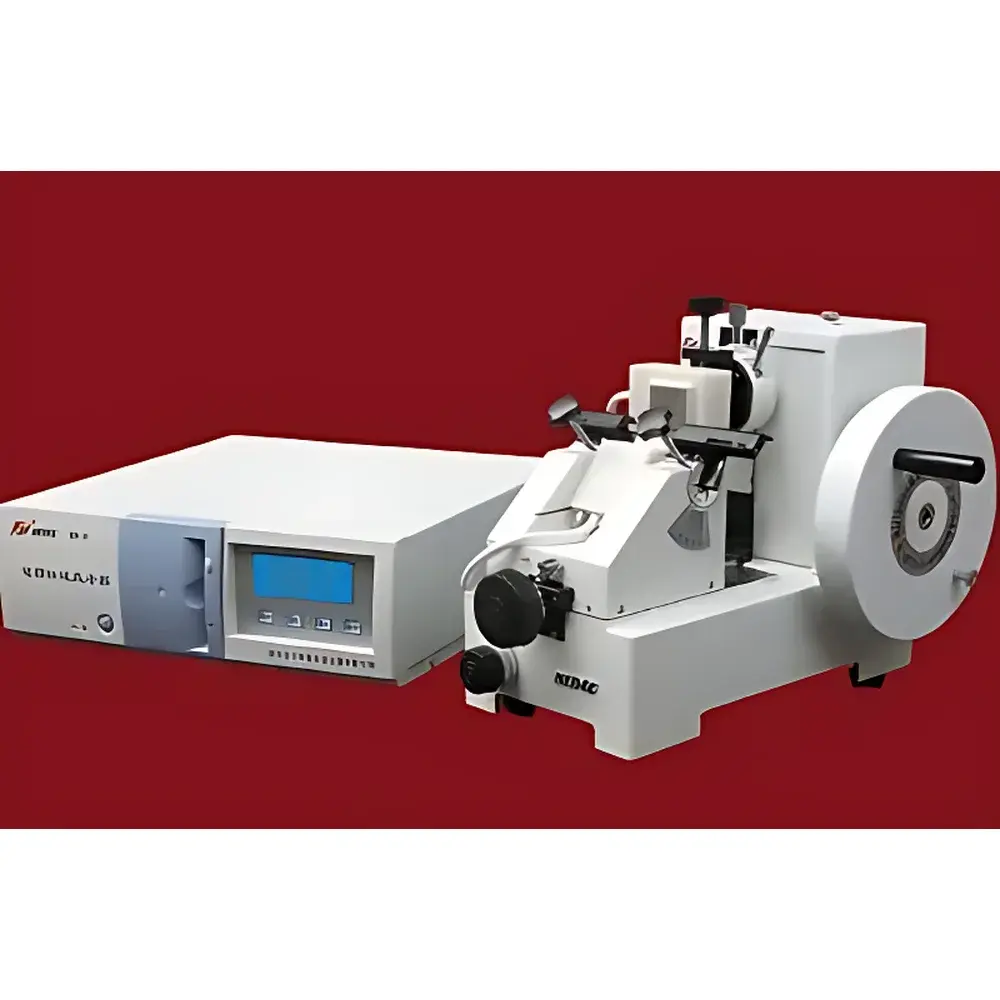
KDSKD-1508A-VI(III) Computer-Controlled Cryo-Rotary Microtome
| Cutting Thickness | 1–35 µm (continuous), >35 µm (stepwise) |
|---|---|
| Max Paraffin Section Area | 50 × 40 mm |
| Minimum Graduation | 1 µm |
| Thickness Accuracy | ±10% |
| Operating Temp Range | Ambient to –55 °C |
| Cold Stage ΔT | ≥60 °C |
| Cold Knife ΔT | ≥50 °C |
| Cold Stage Area | 45 × 40 mm |
| Knife–Stage Angle | 60° |
| Defrosting | Auto-initiated with temp display & auto-resume cooling |
| Pre-cooling Time | 4–7 min |
| Dimensions (Microtome) | 470 × 320 × 320 mm |
| Dimensions (Cryo Unit) | 420 × 190 × 410 mm |
| Weight (Microtome) | 22.5 kg |
| Weight (Cryo Unit) | 8 kg |
Overview
The KDSKD-1508A-VI(III) Computer-Controlled Cryo-Rotary Microtome is a dual-mode precision sectioning instrument engineered for high-fidelity tissue preparation in both paraffin-embedded and frozen specimen workflows. Integrating a robust rotary microtome base (KD-1508A) with an independent, high-efficiency cryogenic module (KD-VI), this system enables seamless transition between room-temperature paraffin sectioning and sub-zero frozen sectioning without mechanical reconfiguration. Its thermoelectric cooling architecture employs high-power semiconductor Peltier elements combined with nano-thermal interface materials to achieve rapid thermal stabilization—reaching operational temperatures from ambient to –55 °C in under seven minutes. The 60° fixed-angle knife-to-stage geometry is optimized per ISO 13772 and widely adopted in diagnostic histopathology laboratories to minimize compression artifacts and maximize ribbon formation consistency during cryosectioning.
Key Features
- Computer-controlled dual-zone temperature management: Independent real-time monitoring and setpoint regulation for both cryostage and cold knife, displayed simultaneously on a bilingual (English/Chinese) LCD interface
- Automated defrost cycle with temperature-triggered initiation and autonomous resumption of refrigeration post-defrost—eliminating manual intervention and thermal drift
- Memory retention of user-defined parameters including target temperature, section thickness, and rapid trimming mode settings across power cycles
- Quick-release specimen chuck system enabling standardized cassette-to-chuck interchangeability compliant with ANSI/AAMI ST79 and CAP-accredited lab protocols
- High-resolution micrometer feed mechanism with 1 µm minimum graduation and mechanical backlash compensation for reproducible section thickness delivery
- Integrated safety interlocks including overheat alarm, open-circuit detection, and thermal runaway protection aligned with IEC 61010-1 requirements for laboratory equipment
Sample Compatibility & Compliance
The KDSKD-1508A-VI(III) accommodates standard OCT-embedded, formalin-fixed frozen tissues as well as paraffin blocks up to 50 × 40 mm. Its cold stage (45 × 40 mm) and optimized 60° knife geometry support consistent sectioning of delicate neural, adipose, and embryonic specimens without crushing or chatter. The system complies with essential regulatory frameworks applicable to clinical histology instrumentation: it supports audit-ready operation under CLIA, CAP, and ISO 15189 environments; its temperature logging functionality meets GLP data integrity expectations; and its electronic controls are designed to facilitate validation against USP Analytical Instrument Qualification guidelines. While not FDA 510(k)-cleared as a medical device, its performance characteristics align with ASTM E2167 standards for cryomicrotome verification.
Software & Data Management
This microtome operates via embedded firmware—not PC-dependent software—ensuring deterministic response and long-term firmware stability. All temperature setpoints, runtime logs, defrost timestamps, and error codes are stored internally with non-volatile memory retention. Optional RS-232 or USB-C serial output enables integration into LIMS or digital pathology workflow platforms for traceable parameter archiving. Audit trail functionality records operator ID (via optional RFID badge reader), session start/end time, temperature deviations exceeding ±2 °C, and any safety event—fully supporting 21 CFR Part 11-compliant electronic record practices when paired with validated third-party middleware.
Applications
- Routine intraoperative frozen section analysis in surgical pathology labs requiring turnaround times under 15 minutes
- Pre-analytical tissue banking where morphological integrity must be preserved prior to RNA/DNA extraction
- Neuroscience research involving hippocampal or cortical slice preparation at –20 °C to –25 °C
- Quality control of biobanked specimens undergoing periodic viability assessment via H&E staining
- Training environments where dual-mode capability reduces capital expenditure versus purchasing separate paraffin and cryo units
- Pharmaceutical toxicology studies requiring serial sectioning of rodent organ tissues across multiple temperature gradients
FAQ
What is the maximum recommended specimen size for frozen sectioning on this unit?
Standard OCT-embedded specimens up to 45 × 40 mm are fully supported by the cold stage dimensions; larger blocks require external trimming prior to mounting.
Does the system support temperature ramping or only fixed-point cooling?
It maintains user-defined setpoints only; no programmable ramping profile is available in the current firmware revision.
Is calibration documentation provided with the instrument?
Yes—a factory calibration certificate covering thermal accuracy (±1.5 °C at –30 °C), section thickness repeatability (per ISO 8599), and mechanical alignment is included with shipment.
Can the microtome base operate independently without the cryo module?
Yes—the KD-1508A rotary base functions as a standalone paraffin microtome with full thickness control and ergonomic handling.
What maintenance intervals are recommended for the Peltier cooling system?
No scheduled maintenance is required for the solid-state thermoelectric modules; annual inspection of thermal interface material integrity and dust filtration is advised per manufacturer service bulletin SB-KD-2023-07.



