
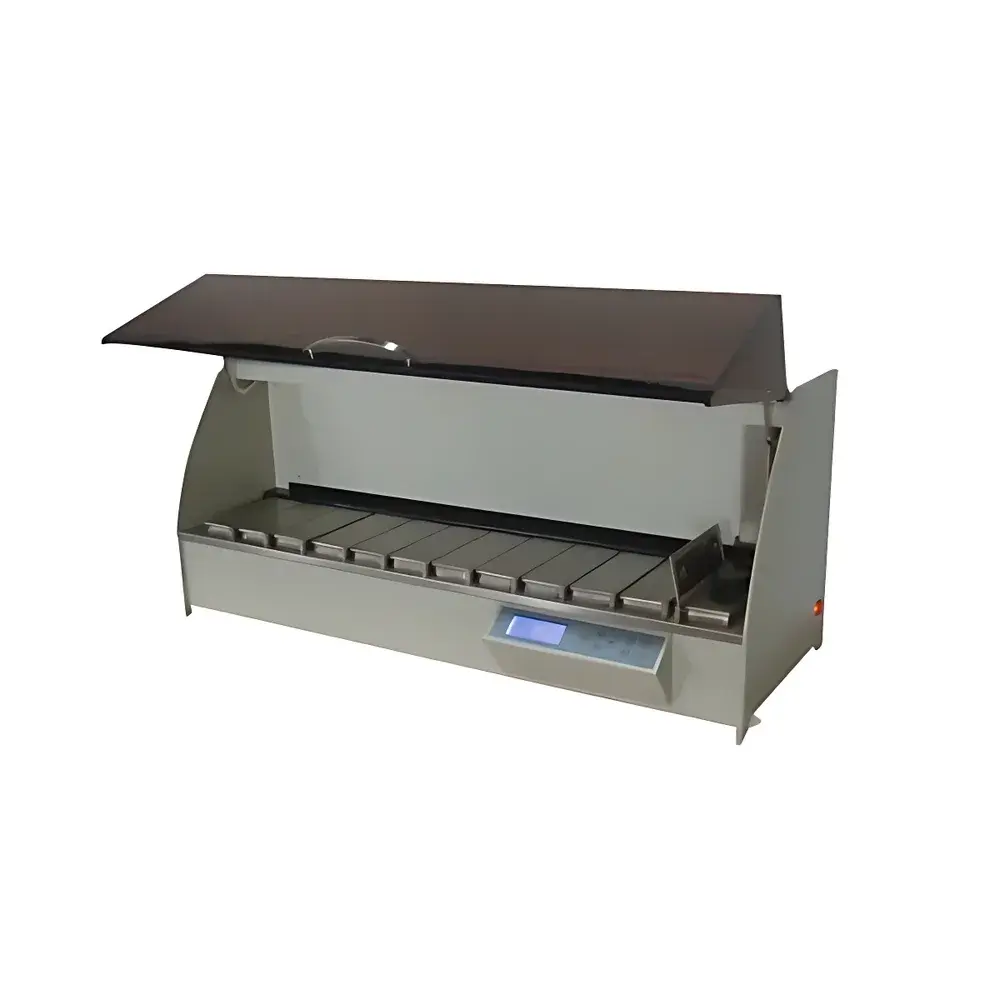
ZEEDO HS-2000 Fully Automated Tissue Dehydrator
| Origin | Zhejiang, China |
|---|---|
| Manufacturer Type | Authorized Distributor |
| Origin Category | Domestic (China) |
| Model | HS-2000 |
| Price Range | USD 1,400 – 7,200 |
| Cylinder Count | 12 (9 reagent tanks + 3 paraffin wax tanks) |
| Single Tank Capacity | 2000 mL |
| Per-Tank Processing Time | Tank 1: 0–99 h |
| Tanks 2–12 | 0–24 h |
| Temperature Control Range | Ambient to 99 °C |
| Adjustable Tissue Protection Tanks | Tanks 1–7 |
| Drain & Shake Dwell Time | 10–60 s (tank-surface drainage + mechanical shaking) |
| Heating Activation | Auto-start from Tank 2 |
| Power Supply | AC 220 V / 50 Hz or AC 110 V / 60 Hz |
| Power Consumption | 800 VA |
| Dimensions (W×D×H) | 1010 × 550 × 420 mm |
| Net Weight | 100 kg |
| Max. Throughput | ≥200 tissue specimens per cycle |
| Agitation Frequency | 0–6 cycles/min |
| Drain Timing Control | Programmable per transfer step |
| Power Failure Resilience | >30 h retained runtime with status display |
| Internal Air Purification | Activated carbon filtration + optional external exhaust ducting |
| User Interface | Dual-language (English/Chinese) LCD with animated process simulation and real-time status feedback |
Overview
The ZEEDO HS-2000 Fully Automated Tissue Dehydrator is an engineered solution for high-throughput, reproducible histological specimen preparation in clinical pathology, academic research, and diagnostic laboratories. It operates on the principle of sequential solvent exchange—replacing water in fixed biological tissues with progressively higher concentrations of ethanol or isopropanol, followed by xylene or xylene substitutes, and concluding with molten paraffin infiltration. This multi-stage dehydration and clearing process ensures optimal tissue morphology preservation prior to embedding. Designed for compliance with standard histotechnological workflows defined in CAP (College of American Pathologists) and ISO 15189-accredited environments, the HS-2000 supports GLP-aligned documentation practices through time-stamped cycle logging and programmable parameter retention. Its fully enclosed architecture minimizes operator exposure to volatile organic compounds (VOCs), while integrated thermal management and low-power circuitry ensure stable operation across variable ambient conditions.
Key Features
- Fully automated 12-tank configuration: nine reagent tanks (for graded alcohols, clearing agents, and transitional solvents) plus three dedicated paraffin wax tanks—enabling complete dehydration, clearing, and infiltration in a single unattended cycle.
- Precise, independent time programming per tank: Tank 1 accommodates extended fixation or initial dehydration steps (0–99 hours); subsequent tanks support rapid, optimized processing (0–24 hours each), facilitating protocol customization for diverse tissue types (e.g., fatty, calcified, or dense connective tissues).
- Programmable tissue protection logic: Users may designate tanks 1–7 as “protected zones” to prevent premature exposure to high-concentration solvents during power interruption—critical for preserving integrity of delicate or rare specimens.
- Tank-surface drainage with mechanical shaking: Adjustable dwell time (10–60 seconds) combined with controlled agitation (0–6 rpm) minimizes carryover between stations, extends reagent service life, and reduces cross-contamination risk.
- Intelligent thermal activation: Heating initiates only upon entry into Tank 2, reducing standby energy consumption and improving temperature stability across the full reagent gradient.
- Dual-voltage compatibility (110 V / 60 Hz or 220 V / 50 Hz) and robust 800 VA power architecture ensure stable performance in global laboratory infrastructures—including regions with fluctuating grid supply.
- Real-time graphical interface with animated process simulation: The 7-inch dual-language LCD provides visual confirmation of current tank position, elapsed time, temperature, agitation status, and fault diagnostics—supporting rapid troubleshooting and training consistency.
Sample Compatibility & Compliance
The HS-2000 accommodates standard histology cassettes (including 30 × 30 mm and 25 × 25 mm formats) and supports batch processing of ≥200 specimens per cycle—suitable for routine surgical pathology, biopsy screening, and preclinical toxicology studies. Its sealed tank design and activated carbon–based internal air purification system meet OSHA PEL (Permissible Exposure Limits) guidelines for ethanol (1000 ppm), xylene (100 ppm), and paraffin vapor. Optional external exhaust integration allows alignment with local ventilation codes (e.g., ASHRAE 110, EN 14175). All firmware logs—including start/stop timestamps, temperature profiles, and user-initiated overrides—are stored locally with read-only export capability (CSV), supporting audit readiness under CLIA, CAP, and ISO 15189 requirements.
Software & Data Management
The embedded control system stores up to ten user-defined protocols, each with full parameter recall (time, temperature, agitation, drain duration). Cycle execution data—including actual vs. setpoint temperatures, total runtime, and anomaly flags (e.g., lid-open detection, low-fluid alerts)—are timestamped and retained for ≥12 months. While the device does not include network connectivity or FDA 21 CFR Part 11-compliant electronic signatures out-of-the-box, its deterministic log structure enables manual export and integration into LIMS or QMS platforms via USB flash drive. Audit trail functionality includes operator ID tagging (via optional keypad login module) and immutable event sequencing—facilitating traceability during internal quality reviews or regulatory inspections.
Applications
- Routine diagnostic histopathology: High-volume processing of surgical resections, biopsies, and cytology specimens in hospital-based labs.
- Academic and pharmaceutical research: Standardized dehydration of murine, porcine, and human tissue models for immunohistochemistry (IHC), in situ hybridization (ISH), and digital pathology slide generation.
- Toxicologic pathology: Reproducible processing of multi-organ sets from GLP-compliant rodent studies, ensuring inter-laboratory comparability.
- Teaching laboratories: Intuitive interface and real-time visualization support competency-based training for histotechnologists and pathology residents.
- Resource-constrained settings: Low-maintenance design, wide voltage tolerance, and >30-hour battery-backed runtime enhance operational continuity in off-grid or intermittently powered facilities.
FAQ
What is the maximum number of tissue cassettes the HS-2000 can process per cycle?
The instrument accommodates ≥200 standard-sized cassettes per run, depending on cassette dimensions and rack configuration.
Does the HS-2000 support remote monitoring or network connectivity?
No—this model operates as a standalone unit with local LCD interface and USB-based data export only. Network integration requires third-party middleware.
Can I use non-standard solvents or custom reagent sequences?
Yes—user-programmable timing and temperature per tank allow adaptation to alternative solvents (e.g., limonene, methyl salicylate) or proprietary dehydration protocols.
Is the HS-2000 compliant with FDA 21 CFR Part 11?
It does not provide built-in electronic signature or audit trail features required for Part 11 compliance; however, exported logs may be incorporated into validated QMS systems.
What safety certifications does the device hold?
It conforms to IEC 61010-1 (Safety Requirements for Electrical Equipment for Measurement, Control, and Laboratory Use) and carries CE marking for the European Economic Area.
Related Products




