
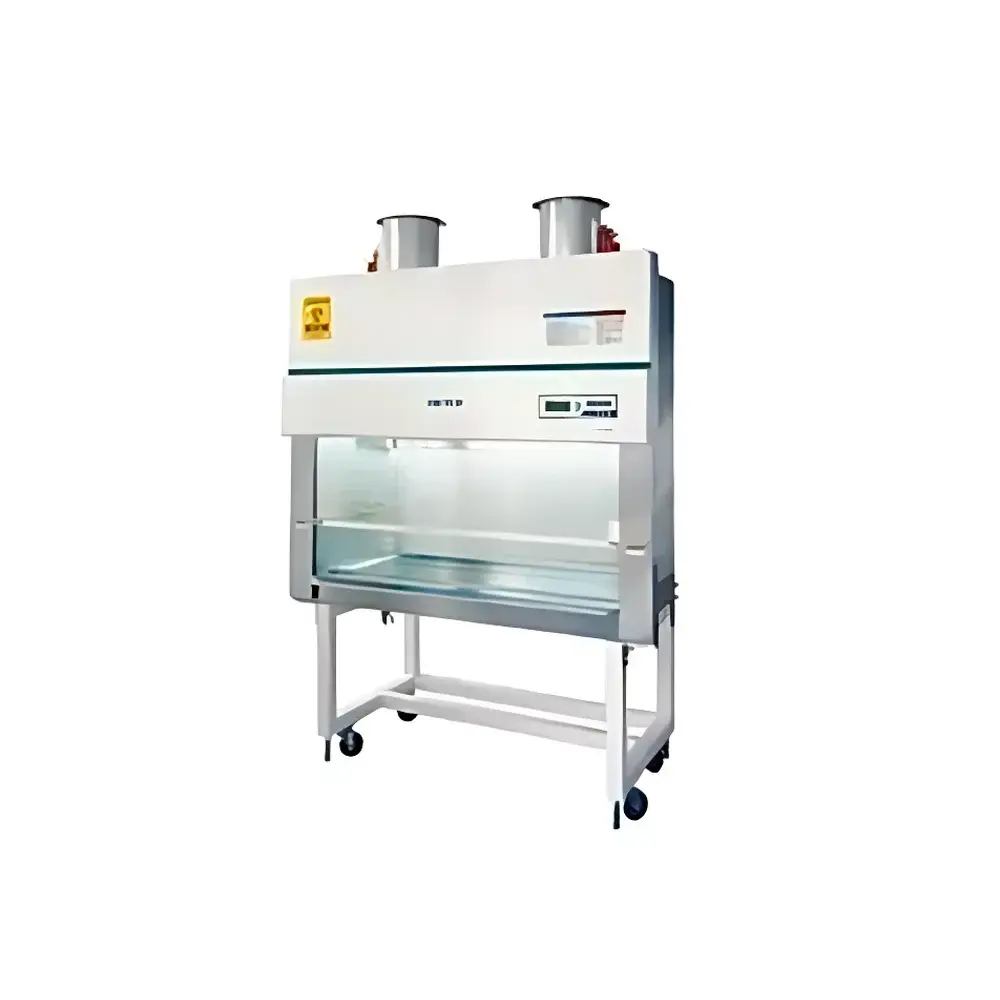
BHC-1300IIB2 Class II Type B2 Biosafety Cabinet
| Origin | Jiangsu, China |
|---|---|
| Manufacturer Type | Authorized Distributor |
| Product Category | Class II, Type B2 (Total Exhaust) Biosafety Cabinet |
| Model | BHC-1300IIB2 |
| External Dimensions (L×W×H) | 1525 × 830 × 2300 mm |
| Internal Work Area Dimensions (L×W×H) | 1300 × 600 × 640 mm |
| Filter Efficiency | HEPA ≥99.995% @ 0.3 µm |
| Downflow Velocity | 0.30 m/s |
| Inflow Velocity | 0.55 m/s |
| Noise Level | ≤58 dB(A) |
| Power Supply | AC 220 V, 1Φ, 50 Hz |
| Total Power Consumption | 2.0 kW (including auxiliary socket) |
| Weight | 340 kg |
| Lighting | 2 × 36 W fluorescent lamps |
| UV Lamp | 1 × 30 W |
| Illuminance | ≥650 lx |
| Duct Port Diameter | Ø250 mm |
| Safety Certification Compliance | EN 12469:2000, NSF/ANSI 49-2022, GB 50346-2011 |
Overview
The BHC-1300IIB2 Class II, Type B2 Biosafety Cabinet is a total-exhaust, externally ducted containment system engineered for high-risk biosafety applications requiring simultaneous protection of personnel, product, and environment. Unlike Type A2 cabinets, the BHC-1300IIB2 recirculates zero air to the work area — all airflow is drawn through the front intake grille, passes unidirectionally across the work surface at a controlled downflow velocity of 0.30 m/s, and is fully exhausted via dedicated ductwork after dual-stage filtration. This configuration eliminates cross-contamination risk and enables safe handling of volatile chemicals, radionuclides, and high-consequence biological agents (BSL-2/3), in compliance with international standards including NSF/ANSI 49-2022 and EN 12469:2000. Its negative-pressure, double-walled stainless steel chassis ensures structural integrity and leak-tight containment under sustained internal pressure of 500 Pa ±10%, validated per IEST-RP-CC002.2.
Key Features
- Full stainless steel 304 work chamber with R10 radius corners and seamless one-piece formed inner liner for enhanced cleanability and corrosion resistance
- Dual-filter configuration: primary HEPA filter (≥99.995% @ 0.3 µm) for supply air and secondary ULPA filter (≥99.999% @ 0.12 µm) on exhaust path, both constructed from borosilicate glass microfiber media compliant with ISO 29463-3 and USP particulate retention requirements
- Imported Japanese AIR TECH intelligent motor-fan system with real-time airflow compensation: maintains ±10% volumetric stability despite up to 50% static pressure variation across filters
- Motor-integrated thermal protection circuitry enabling stable operation at 1.15× rated voltage, ensuring long-term reliability under laboratory power fluctuations
- Electromechanical counterbalanced sash mechanism with 5 mm tempered laminated safety glass; smooth, maintenance-free vertical travel with positional memory and auto-stop at pre-set safety height (e.g., 200 mm)
- Integrated liquid collection trough (capacity >4000 mL) with bottom-mounted drain valve and removable stainless steel work surface for rapid decontamination and spill management
- Microprocessor-based control panel with LCD interface providing continuous monitoring of inflow/downflow velocities, cumulative runtime, filter service life estimation, sash position, and fault diagnostics
Sample Compatibility & Compliance
The BHC-1300IIB2 supports unrestricted use with open-flame devices (e.g., Bunsen burners), volatile organic solvents, and aerosol-generating procedures where recirculation poses unacceptable risk. It meets stringent microbiological performance criteria per NSF/ANSI 49: personnel protection ≤10 CFU/test (impactor), product protection ≤5 CFU/test (slit sampler), and cross-contamination ≤2 CFU/test. Structural integrity is verified by helium leak testing (≤0.005% local leakage for non-scannable ULPA modules; ≤0.01% for scannable units). The cabinet complies with GLP/GMP environmental monitoring prerequisites and supports FDA 21 CFR Part 11–compliant audit trails when integrated with validated data logging systems. All materials contacting the work area are non-pyrogenic, non-leaching, and certified free of heavy metals per RoHS Directive 2011/65/EU.
Software & Data Management
The embedded control firmware logs time-stamped operational parameters (sash position, airflow values, filter delta-P, motor status) to non-volatile memory with 30-day rolling retention. Optional RS-485 or Ethernet interfaces enable integration into centralized lab infrastructure management platforms (e.g., LabVantage, Thermo Fisher SampleManager). Alarms trigger visual (LCD icon + LED strobe) and audible (85 dB pulse tone) alerts for critical deviations: sash over-height (>220 mm), inflow velocity <0.45 m/s, downflow velocity 85% pressure drop). Calibration certificates traceable to NIST standards accompany each unit, and validation documentation packages (IQ/OQ/PQ templates) are provided for GxP-regulated environments.
Applications
This cabinet is routinely deployed in pharmaceutical aseptic processing suites (USP , ), clinical microbiology laboratories handling multidrug-resistant organisms, academic BSL-3 research facilities conducting lentiviral vector production, and biomanufacturing cleanrooms performing cell therapy formulation. Its total-exhaust architecture makes it suitable for cytotoxic drug compounding (NIOSH Alert 2016-161), radioactive iodine labeling, and nanomaterial synthesis where nanoparticle containment is mandated. The ISO Class 4 (10-grade) ULPA-certified work area satisfies requirements for sterile filtration validation studies and high-precision molecular assay setup.
FAQ
Is external ducting mandatory for the BHC-1300IIB2?
Yes. As a Type B2 cabinet, it requires hard-ducted connection to a dedicated exhaust system with minimum static pressure capacity of −150 Pa at the duct collar.
Can this cabinet be used with flammable solvents?
Yes — its zero-recirculation design and spark-proof motor/fan assembly permit safe operation with Class I flammable liquids per NFPA 45 guidelines.
What is the recommended filter replacement interval?
HEPA/ULPA filters should be replaced every 3–5 years depending on usage intensity and ambient particulate load; the control system calculates remaining service life based on cumulative pressure differential and runtime.
Does the unit include validation support documentation?
Yes — factory-issued IQ/OQ protocols, calibration reports, and EN 12469 test summaries are supplied; PQ execution support is available through authorized service engineers.
Is the cabinet compatible with Building Management Systems (BMS)?
Standard analog 4–20 mA outputs for airflow and sash position are provided; Modbus RTU or BACnet MS/TP gateways can be added as optional field upgrades.




