
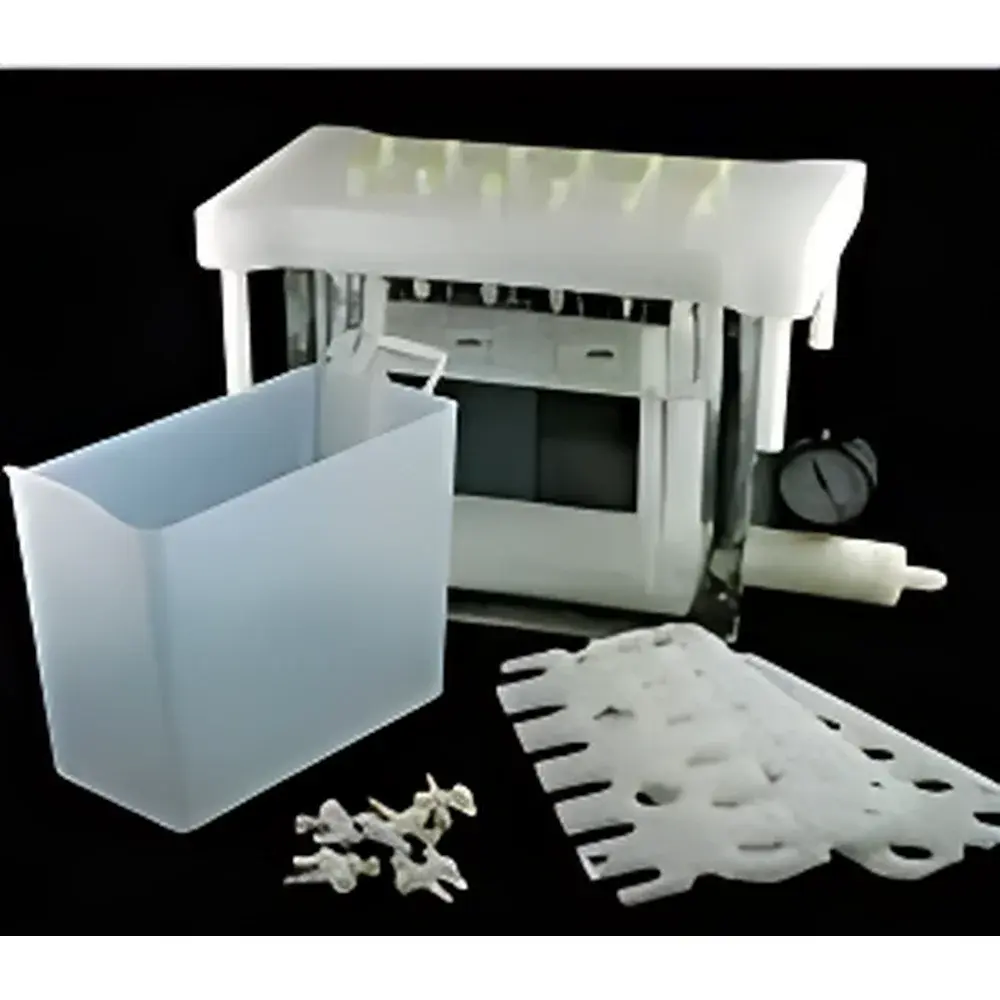
Mediwax 24-Port Manual Vacuum Solid Phase Extraction Manifold
| Brand | Mediwax |
|---|---|
| Origin | USA |
| Model | 24 |
| Automation Level | Manual |
| Number of Channels | 24 |
| Extraction Type | Column-Based SPE |
| Flow Control | Adjustable Stopcock Valves |
| Solvent Compatibility | Multiple Organic/Aqueous Solvents |
| Sample Capacity | 24 × 6 mL |
| Contact Materials | Borosilicate Glass Chamber, PTFE Tubing, Polypropylene (PP) & Stainless Steel Fittings |
| Included Accessories | Adjustable Collection Rack, Vacuum Gauge, 24 Individual Stopcocks, Sealing Gaskets, 13 mm & 16 mm Tube Plates, High-Volume Sampler (4 units) |
Overview
The Mediwax 24-Port Manual Vacuum Solid Phase Extraction Manifold is an engineered platform for reproducible, high-throughput sample preparation in analytical laboratories. Designed around the fundamental principles of solid-phase extraction (SPE), this manifold leverages vacuum-driven flow control to facilitate sequential conditioning, loading, washing, and elution steps across 24 independent SPE columns. Unlike automated systems, its manual architecture provides full operator control over pressure differentials and residence times—critical parameters influencing analyte retention, matrix removal efficiency, and recovery consistency. The system operates on a simple yet robust physical principle: applying regulated negative pressure across a column bed induces controlled percolation of liquid phases through sorbent media, enabling selective adsorption and desorption governed by polarity, ionic interaction, or size exclusion mechanisms. This makes it especially suitable for method development, regulatory-compliant QC workflows, and applications requiring precise tuning of elution gradients.
Key Features
- Borosilicate glass chamber with transparent walls for real-time visual monitoring of solvent flow, column breakthrough, and air bubble formation
- 24 individually adjustable stopcock valves—each calibrated for fine-grained, independent flow rate control during loading, wash, and elution stages
- Modular, height-adjustable collection rack accommodating diverse receiver formats: 13 mm and 16 mm test tubes, autosampler vials, conical flasks, and volumetric flasks
- Vacuum gauge with side-mounted pressure relief valve for rapid system depressurization and safe column disconnection
- Chemically inert fluid path: PTFE tubing prevents cross-contamination and ensures compatibility with aggressive solvents including acetonitrile, methanol, dichloromethane, and dilute acids/bases
- Optional high-volume sampler kit (4 units) supports direct loading of up to 500 mL samples without intermediate transfer, minimizing handling error and analyte loss
- Integrated PP waste tray (included with 12-port variant; optional add-on for 24-port) maintains chamber cleanliness and simplifies waste segregation per EPA Method 525.3 and ISO 17025 documentation requirements
Sample Compatibility & Compliance
The Mediwax 24-port manifold supports standard 1 mL, 3 mL, and 6 mL SPE cartridges from major suppliers (e.g., Waters, Agilent, Thermo Fisher), as well as custom-packed columns. Its glass construction complies with USP and ASTM E2915 for borosilicate glass integrity under repeated thermal and mechanical stress. All wetted components meet FDA 21 CFR §177.1520 (PP) and §177.1550 (PTFE) food-contact material specifications. When operated within validated SOPs—including documented vacuum setpoints, dwell times, and solvent sequencing—the system supports GLP and GMP environments. It is routinely deployed in laboratories performing analyses aligned with EPA Methods 508.1, 525.3, 8081B, and ISO 11337 for pesticide residue, pharmaceutical impurity, and environmental contaminant testing.
Software & Data Management
As a manually operated hardware platform, the Mediwax 24-port manifold does not incorporate embedded firmware or digital interfaces. However, it is fully compatible with laboratory information management systems (LIMS) and electronic lab notebooks (ELN) via standardized procedural documentation. Each workflow step—column conditioning volume, load volume (6 mL nominal), wash solvent type/volume, elution solvent composition, and vacuum pressure setting—is recorded manually or transcribed into structured templates compliant with 21 CFR Part 11 audit-trail requirements. Optional barcode-labeled tube plates and rack identification kits enable traceability integration with downstream autosamplers and LC-MS/MS data acquisition software.
Applications
- Pre-concentration and cleanup of trace-level analytes in drinking water, wastewater, and soil extracts prior to GC-MS or LC-MS/MS analysis
- Isolation of polar pharmaceuticals and metabolites from plasma, urine, and tissue homogenates under bioanalytical method validation (ICH M10)
- Removal of phospholipids and endogenous interferences in clinical lipidomics workflows
- Multi-residue pesticide analysis in fruits, vegetables, and cereals following QuEChERS-compatible SPE refinement
- Separation of acidic, basic, and neutral compounds using mixed-mode sorbents (e.g., WCX, WAX, C8/SCX) in forensic toxicology screening
FAQ
Is the glass chamber resistant to hydrofluoric acid or strong alkalis?
No. The borosilicate glass chamber is compatible with common organic solvents and dilute aqueous acids/bases (pH 1–12), but not with HF, hot concentrated NaOH (>2 M), or molten alkali metals.
Can I use this manifold with 96-well SPE plates?
No. The design accommodates only individual cylindrical SPE cartridges (1–6 mL format). For plate-based workflows, a dedicated 96-well vacuum manifold is required.
What vacuum source is recommended?
A diaphragm pump capable of sustaining ≤150 mbar absolute pressure is optimal. Oil-free pumps are preferred to prevent hydrocarbon contamination of sensitive mass spectrometry applications.
Are replacement gaskets and stopcocks available as spare parts?
Yes. Part numbers 82404 (gaskets) and 82409 (stopcocks) are stocked globally and certified for ≥5,000 operational cycles under standard laboratory conditions.
Does the system support positive-pressure nitrogen drying after elution?
Not natively. Nitrogen manifold integration requires third-party adapters. The current configuration relies solely on vacuum-assisted flow control.



