
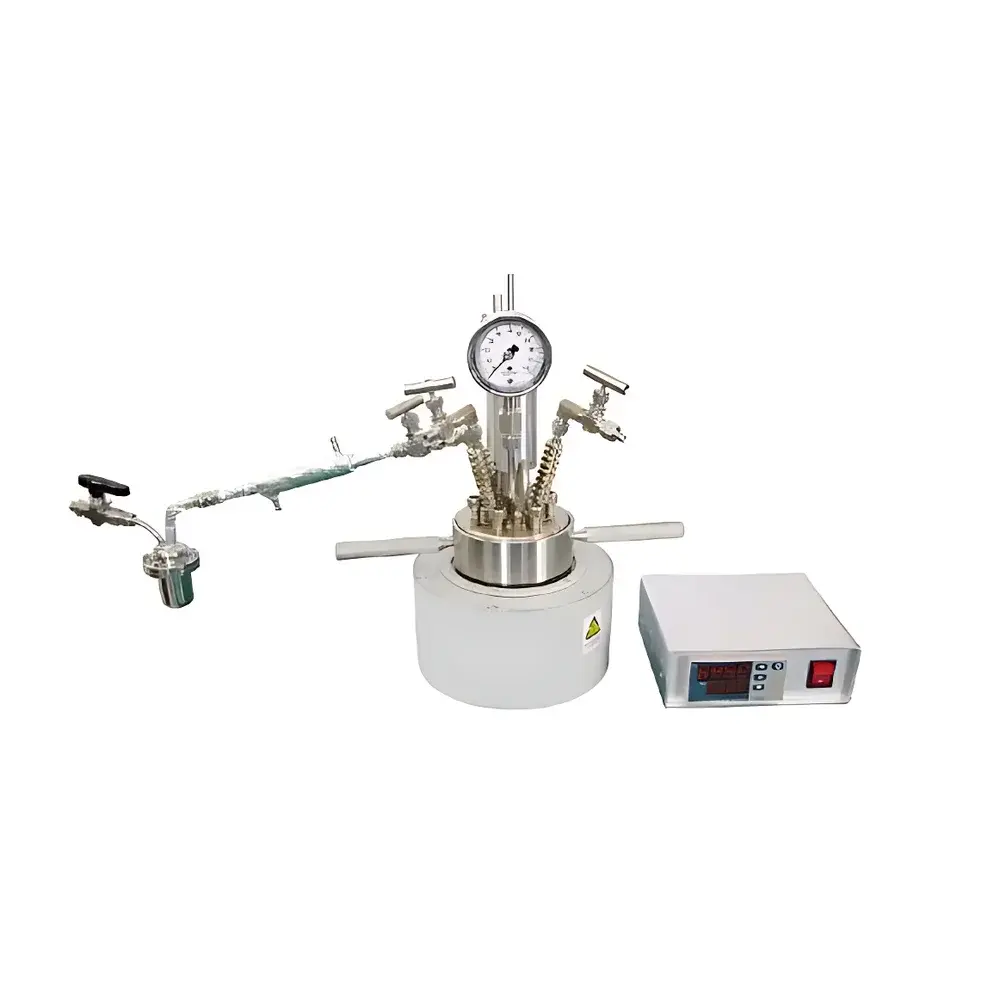
KeMi Polyester Synthesis Reactor – 5L & 10L Stainless Steel Jacketed Lab Reactor
| Origin | Anhui, China |
|---|---|
| Manufacturer Type | Authorized Distributor |
| Regional Origin | Domestic (PRC) |
| Model | KM-PR Series |
| Price Range | USD 2,800 – 7,000 |
| Vessel Capacity | 5 L / 10 L |
| Construction Material | AISI 316L Stainless Steel |
| Design Pressure | ≤ 0.6 MPa (Low-Pressure Class) |
| Heating Method | Thermostatic Oil Circulation via Double-Jacket |
| Control Interface | 7″ Touchscreen HMI with PID Logic |
| Stirring Drive | Magnetic Coupling Transmission with Torque Sensing |
| Optional Features | Motorized Lid Lifting Module, Insulated Bottom Discharge Valve, Condenser + Vacuum Cold Trap Assembly |
| Structural Mounting | Suspended Vessel Support with Adjustable Feet |
| Compliance | Designed per GB/T 25973–2010 (Laboratory Reactors), ASME BPVC Section VIII Div. 1–2023 (Design Basis), ISO 9001–2015 Certified Manufacturing Process |
Overview
The KeMi Polyester Synthesis Reactor (KM-PR Series) is a purpose-engineered laboratory-scale batch reactor system designed for controlled polycondensation reactions—particularly polyester synthesis via melt-phase or solution-phase polymerization. It operates on fundamental principles of mass and energy balance under precisely regulated thermal, pressure, and mechanical agitation conditions. The reactor integrates a double-jacketed AISI 316L stainless steel vessel, thermostatic oil circulation heating (−20 °C to 250 °C), magnetic coupling-driven impeller agitation with real-time torque monitoring, and vacuum-assisted volatile removal. Its architecture supports step-growth polymerization kinetics where water or alcohol byproduct removal dictates molecular weight development; thus, the integrated condenser and cold trap enable efficient azeotropic distillation and vapor phase management under sub-atmospheric conditions (down to 10 mbar absolute). All structural and control subsystems comply with internationally recognized safety and quality frameworks—including design reference to ASME BPVC Section VIII Division 1, manufacturing traceability per ISO 9001:2015, and functional alignment with ASTM D4000–22 (Standard Classification for Plastics) and ISO 1133–2 (Melt Flow Rate Testing prerequisites).
Key Features
- Double-jacketed 316L stainless steel vessel (5 L or 10 L nominal volume) with polished interior surface (Ra ≤ 0.4 µm) for minimal polymer adhesion and ease of cleaning
- Thermostatic oil circulation heating system delivering uniform wall temperature control (±0.5 °C stability over 24 h at 200 °C)
- Magnetic drive transmission with integrated torque sensor (0–5 N·m range), enabling non-invasive agitation and real-time viscosity trend monitoring during polymer growth
- Motorized lid lifting module (standard on 5 L+ units) for safe, repeatable access without manual handling or alignment errors
- Insulated bottom discharge valve with active jacketed heating (maintains ≥180 °C at valve seat) to prevent premature solidification of molten polyester during sample recovery
- Vertical condenser + cryogenic cold trap assembly (−40 °C glycol-cooled) for efficient capture of condensable volatiles (e.g., ethylene glycol, acetic acid) and protection of vacuum pump integrity
- 7-inch industrial-grade touchscreen HMI running embedded Linux OS, supporting multi-stage PID ramp/soak profiles, data logging (CSV export), and password-protected parameter locking
Sample Compatibility & Compliance
The KM-PR Series accommodates a broad spectrum of monomer systems used in aromatic/aliphatic polyester synthesis—including terephthalic acid (TPA), dimethyl terephthalate (DMT), ethylene glycol (EG), diethylene glycol (DEG), and catalysts such as antimony trioxide or titanium tetraisopropoxide. It supports reaction temperatures up to 250 °C and sustained operating pressures ≤0.6 MPa gauge—suitable for low-to-moderate molecular weight PET, PBT, and specialty copolyesters. All wetted components meet USP Class VI biocompatibility requirements for potential pharmaceutical intermediate synthesis. The system is engineered for GLP-compliant operation: audit trails, user-level access control, and timestamped event logs are retained onboard for ≥30 days. Calibration certificates for temperature (Pt100 RTD), pressure (0–1.6 MPa transducer), and torque sensors are supplied with each unit.
Software & Data Management
The embedded control software provides full operational transparency through synchronized acquisition of temperature (vessel wall, headspace, oil inlet/outlet), pressure (absolute and differential), stirring speed (0–300 rpm), torque (0–5 N·m), and vacuum level. Data is stored locally in non-volatile memory and exportable via USB or Ethernet (Modbus TCP) to LIMS or ELN platforms. Optional KeMi LabLink™ software enables remote monitoring, historical trend comparison across batches, and automated report generation compliant with FDA 21 CFR Part 11 (electronic signatures, audit trail, data integrity safeguards). All firmware updates are digitally signed and verified prior to installation.
Applications
- Lab-scale synthesis and optimization of poly(ethylene terephthalate) (PET), poly(butylene terephthalate) (PBT), and poly(trimethylene terephthalate) (PTT)
- Kinetic studies of esterification and transesterification reactions under varying vacuum profiles
- Development of flame-retardant, bio-based, or UV-stabilized polyester variants
- Resin formulation trials for coatings, fibers, and engineering thermoplastics
- Process validation for scale-up to pilot-plant continuous reactors (e.g., twin-screw extruders or falling-film polycondensers)
- Quality assurance testing of raw material reactivity (e.g., acid number evolution, IV build rate)
FAQ
What is the maximum allowable operating temperature for the KM-PR reactor?
The vessel and jacket are rated for continuous operation up to 250 °C using thermostatic oil; short-term excursions to 280 °C are permitted with prior engineering review.
Can this reactor be used for solvent-free melt polymerization?
Yes—its low-pressure rating, high-torque magnetic drive, and vacuum-compatible sealing make it suitable for direct melt-phase polycondensation without solvents.
Is the torque sensor calibrated and traceable to NIST standards?
Each torque sensor is factory-calibrated against ISO/IEC 17025-accredited reference standards, with calibration certificate included.
Does the system support automated vacuum ramping during polymerization?
Yes—the HMI allows programmable vacuum profiles synchronized with temperature ramps, enabling staged removal of condensates.
Are spare parts and technical support available outside China?
KeMi maintains authorized service partners in North America, EU, and APAC regions; critical spares (seals, RTDs, valves) are stocked regionally with <72-h lead time.



