
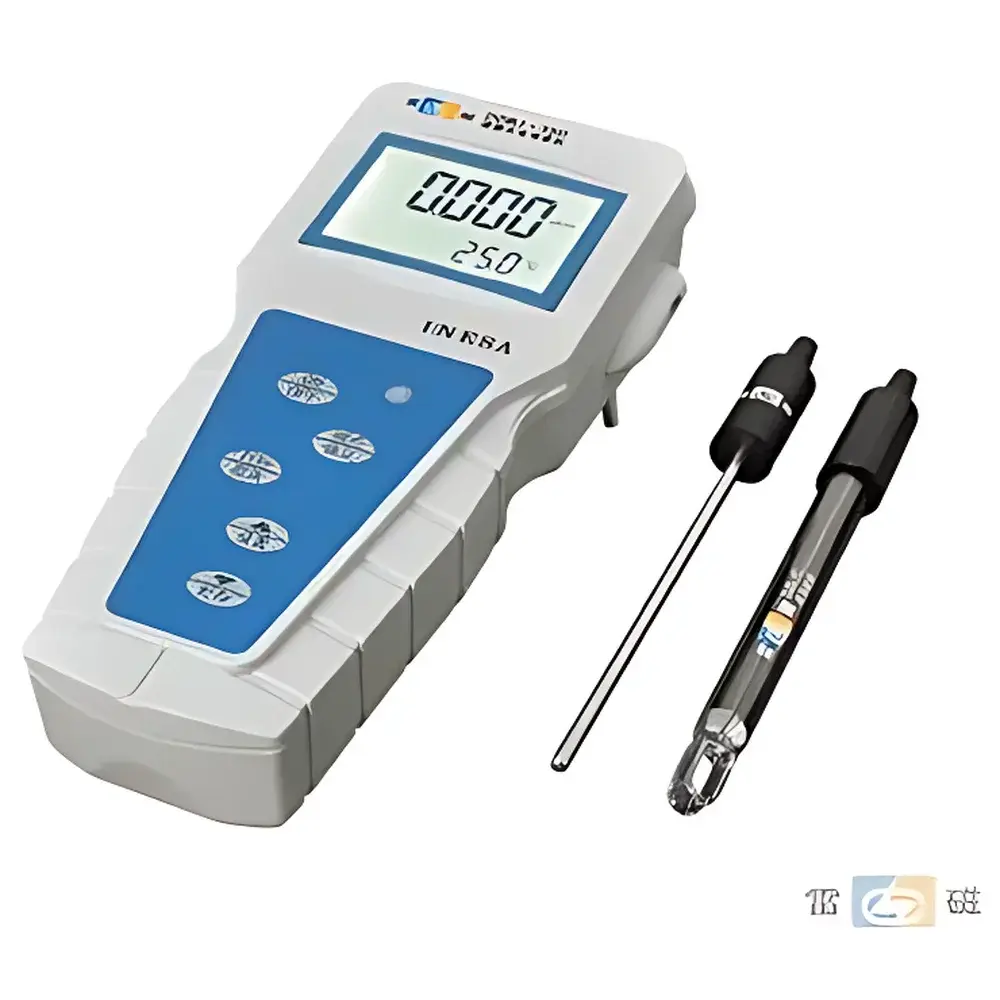
Leichi DDBJ-350 Portable Conductivity Meter
| Brand | Leichi |
|---|---|
| Origin | Shanghai, China |
| Model | DDBJ-350 |
| Portability | Portable |
| Conductivity Range | 0.000 µS/cm to 199.9 mS/cm (5 ranges) |
| TDS Range | 0.000 mg/L to 19.99 g/L (5 ranges) |
| Resistivity Range | Not applicable (mislisted in source |
| Salinity Range | (0.00–8.00)% |
| Temperature Range | 0.0–40.0 °C |
| Accuracy | ±1.0% FS (conductivity & TDS), ±0.2% FS (salinity), ±0.3 °C ±1 digit (temperature) |
| Stability | ±0.7% FS / 3 h |
| Resolution | 0.001 µS/cm (lowest range), up to 0.1 mS/cm (highest range) |
| Power | 4 × AA alkaline batteries |
| Dimensions | 210 × 86 × 50 mm |
| Weight | 0.5 kg |
| Data Storage | 100 sets |
| Interface | RS-232 serial port |
| Electrode | DJS-1CF platinized platinum conductivity cell (cell constant 1.0 cm⁻¹), T-818-B-6F thermistor temperature sensor |
Overview
The Leichi DDBJ-350 Portable Conductivity Meter is a field-deployable, multi-parameter electrochemical analyzer engineered for reliable measurement of electrical conductivity, total dissolved solids (TDS), salinity, and temperature in aqueous solutions. It operates on the principle of two-electrode AC conductometric measurement—applying a low-frequency alternating current across a platinized platinum electrode pair (DJS-1CF) to minimize polarization effects and electrode fouling. Conductivity values are automatically converted to TDS (mg/L or g/L) using user-selectable linear conversion factors (typically 0.4–0.7), and to salinity (% w/w) via the Practical Salinity Scale (PSS-78) algorithm adapted for ambient temperature conditions. Built-in automatic temperature compensation (ATC) follows the DIN/ISO 7888 standard reference curve (25 °C base), utilizing a high-stability NTC thermistor (T-818-B-6F) with ±0.3 °C accuracy. Designed for environmental monitoring, drinking water verification, laboratory fieldwork, and industrial process spot-checking, the DDBJ-350 meets the performance requirements of ISO 7888:2019 and ASTM D1125–22 for conductivity instrumentation.
Key Features
- Backlit LCD display with dual-line readout for simultaneous parameter and unit visibility under low-light conditions
- Five-range auto-ranging conductivity measurement (0.000 µS/cm to 199.9 mS/cm), eliminating manual range selection errors
- Integrated ATC and auto-calibration routines compliant with GLP documentation practices
- Non-volatile memory stores up to 100 complete measurement records—including timestamp, parameter values, temperature, and electrode status—with recall, review, and selective deletion capability
- Configurable electrode constant (0.01–10.00 cm⁻¹) and TDS conversion factor (0.40–0.70) to accommodate diverse sample matrices and regulatory reporting needs
- Intelligent power management: auto-power-off after 10 minutes of inactivity; data retention during battery replacement
- Rugged, IP65-rated housing (210 × 86 × 50 mm, 0.5 kg) optimized for handheld operation in humid or dusty environments
Sample Compatibility & Compliance
The DDBJ-350 is validated for use with natural waters (surface, groundwater, seawater dilutions), potable water, wastewater effluents, boiler feedwater, and aqueous chemical solutions. Its DJS-1CF platinized electrode supports measurements from ultrapure water (≥18.2 MΩ·cm resistivity, inferred) to moderately conductive brines (<200 mS/cm). The instrument complies with IEC 61010-1 for electrical safety and meets the metrological specifications of Class 1.0 instruments per JJG 376–2007 (Chinese national verification regulation), equivalent to ISO/IEC 17025 traceability requirements when used with certified reference standards (e.g., KCl solutions traceable to NIST SRM 3601). While not FDA 21 CFR Part 11–enabled out-of-the-box, audit trails generated via REX software satisfy basic GLP data integrity criteria for non-GMP field applications.
Software & Data Management
Data export and archival are supported through the optional REX Data Acquisition Software (Windows-compatible), which establishes bidirectional communication via RS-232 interface (standard DB9 connector). The software enables real-time graphing, CSV export, batch calibration logging, and customizable report templates aligned with ISO 17025 clause 7.7 (result reporting). When paired with the TP-16 serial printer, hard-copy outputs include date/time stamps, operator ID fields, and measurement uncertainty annotations. All stored datasets retain metadata: measurement mode, range selected, temperature reading, and last calibration date—facilitating internal QA reviews and third-party audit readiness.
Applications
- Field verification of drinking water compliance with WHO and EU Directive 98/83/EC conductivity limits (≤2500 µS/cm)
- Monitoring reverse osmosis (RO) and deionization (DI) system performance via feed/product water conductivity differentials
- Salinity profiling in estuarine and aquaculture environments for ecosystem health assessment
- Process control of cleaning-in-place (CIP) rinse cycles in food & beverage facilities
- Educational laboratories requiring robust, entry-level instrumentation for electrochemistry curricula
- Emergency response teams assessing contamination events (e.g., saltwater intrusion, industrial spills)
FAQ
Does the DDBJ-350 support calibration with multiple standard solutions?
Yes—it accepts single-point calibration at any conductivity value within its five ranges using certified KCl standards (e.g., 84 µS/cm, 1413 µS/cm, 12.88 mS/cm), with user-defined cell constant adjustment.
Can the instrument measure resistivity directly?
No. Resistivity (Ω·cm or MΩ·cm) is calculated in real time from measured conductivity and displayed as a derived parameter—not an independent measurement channel.
Is the DJS-1CF electrode suitable for high-purity water applications?
The DJS-1CF (cell constant 1.0 cm⁻¹) is optimized for general-purpose use. For sub-1 µS/cm measurements, Leichi recommends the optional DJS-0.1CF (0.1 cm⁻¹) or DJS-0.01CF (0.01 cm⁻¹) electrodes, which reduce polarization error and improve low-conductivity resolution.
What battery life can be expected during continuous operation?
With fresh AA alkaline cells, typical operational life exceeds 200 hours under intermittent use (10 measurements/hour); continuous logging reduces this to ~120 hours.
Is firmware upgrade capability available?
Firmware updates are performed exclusively via RS-232 connection using Leichi’s authorized service tools—no field-upgradable bootloader is provided in the standard configuration.
Related Products







