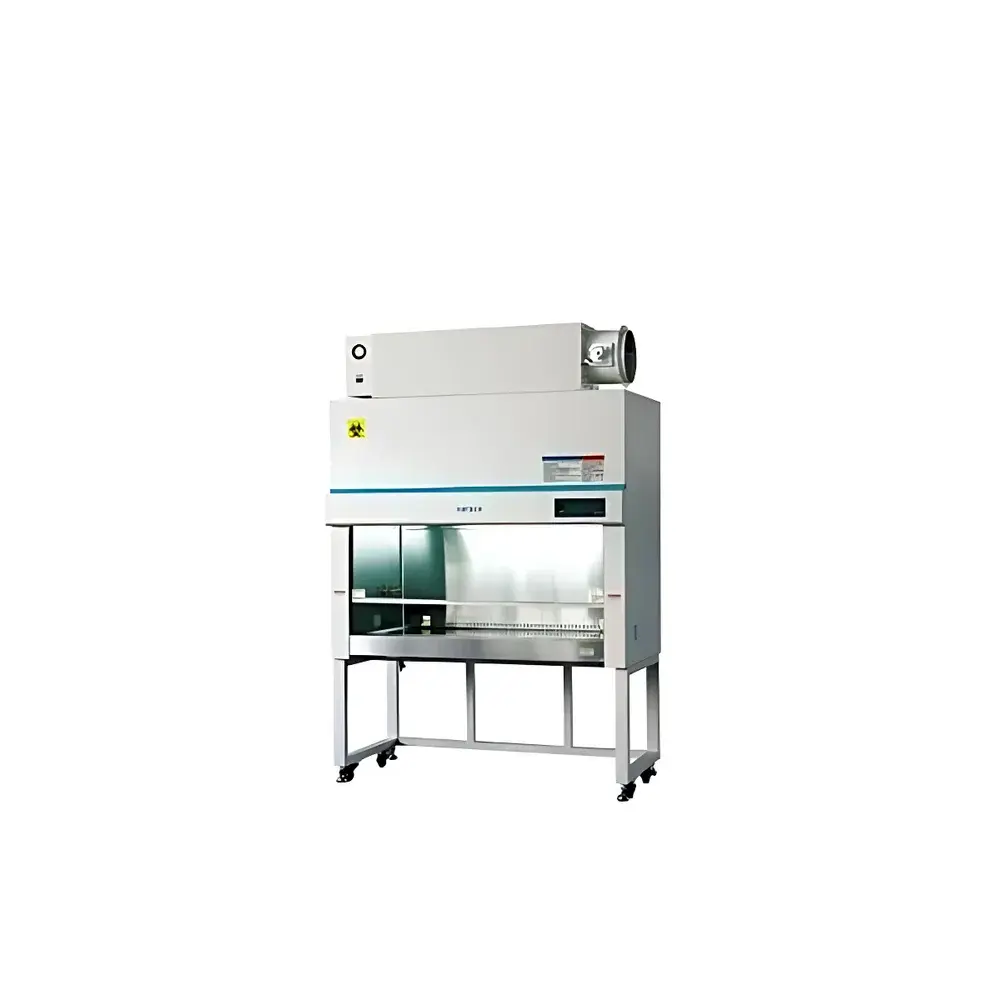
BHC-1300IIA/B3 Biological Safety Cabinet
| Origin | Jiangsu, China |
|---|---|
| Manufacturer Type | Authorized Distributor |
| Product Origin | Domestic (China) |
| Model | BHC-1300IIA/B3 |
| Instrument Class | Class II A2 Biological Safety Cabinet (30% Exhaust) |
| External Dimensions (L×W×H) | 1500 × 815 × 2270 mm |
| Internal Work Area (L×W×H) | 1300 × 600 × 640 mm |
| Filter Efficiency | HEPA ≥99.995% @ 0.3 µm |
| Downflow Velocity (Center) | 0.27 m/s |
| Inflow Velocity | ≥0.5 m/s |
| Noise Level | ≤58 dB(A) |
| Power Consumption | 2.1 kW |
| Weight | 340 kg |
| Lighting | 30 W × 2 Fluorescent Lamps + 30 W UV Lamp |
| Illumination | ≥650 lx |
| Airflow Configuration | Left/Right/Top Exhaust Options |
| Certified Protection Levels | Personnel Protection (≤10 CFU/plate, impact sampler), Product Protection (≤5 CFU/plate), Cross-Contamination Protection (≤2 CFU/plate) |
| Compliance | Meets ISO 14644-1 Class 5 (ISO Class 5, formerly “100”), EN 12469:2000, and GB/T 16292–16294 (Chinese Pharmacopoeia & GMP requirements) |
Overview
The BHC-1300IIA/B3 Biological Safety Cabinet is a Class II A2 (30% exhaust) laminar flow containment system engineered for simultaneous personnel, product, and environmental protection in microbiological, pharmaceutical, and clinical laboratory environments. It operates on the principle of inward airflow (inflow velocity ≥0.5 m/s) combined with vertical downward laminar flow (0.27 m/s at center) across the work surface—both streams conditioned through dual-stage filtration: primary pre-filters capture coarse particulates, while certified HEPA or optional ULPA filters deliver ≥99.995% efficiency at 0.3 µm or ≥99.999% at 0.12 µm respectively. The cabinet employs a balanced air recirculation architecture: approximately 70% of the total airflow is recirculated within the work area after filtration, while 30% is exhausted externally via ducted or canopy-connected systems. This configuration meets internationally recognized biosafety standards including EN 12469:2000 and aligns with ISO 14644-1 Class 5 (equivalent to US FED STD 209E Class 100) for cleanroom-grade particle control.
Key Features
- Dual-wall negative-pressure chamber constructed from seamless SUS304 stainless steel with fully radiused internal corners—enhancing cleanability, corrosion resistance, and structural integrity under continuous decontamination cycles.
- Integrated 4-liter stainless steel liquid collection trough beneath the work surface, designed to contain spills without compromising airflow dynamics or filter integrity.
- Patented unobstructed rear air return design ensures uniform inflow velocity distribution and eliminates turbulence-induced contamination risk at the operator interface.
- Removable ergonomic curved armrests reduce musculoskeletal fatigue during extended procedures and facilitate safe equipment relocation.
- Intuitive Chinese-language HMI with backlit LCD display provides real-time monitoring of downflow/inflow velocities, cumulative fan runtime, HEPA/ULPA filter service life estimation, blockage alarms, and fault diagnostics.
- Interlocked UV lamp and lighting system prevents accidental UV exposure; front sash height limit triggers audible and visual alerts when exceeding safe operational thresholds.
- Imported variable-frequency centrifugal blower with intelligent airflow compensation maintains stable inflow and downflow velocities despite filter loading or minor duct static pressure fluctuations.
- Factory-certified leak-tightness verification per EN 12469 Annex D, including both cabinet shell integrity testing and filter seal integrity validation using PAO (polyalphaolefin) aerosol challenge.
Sample Compatibility & Compliance
The BHC-1300IIA/B3 accommodates a broad range of biological agents classified under Risk Group 1–2 (RG1/RG2) per WHO and CDC guidelines, including recombinant DNA constructs, bacterial cultures, fungal spores, and low-concentration viral suspensions. Its validated containment performance satisfies stringent biosafety assessment criteria: personnel protection verified via microbial challenge using Bacillus atrophaeus (formerly B. subtilis) spores with impactor sampling (≤10 CFU/plate); product protection confirmed by settle plate assays (≤5 CFU/plate); cross-contamination control demonstrated using directional tracer studies (≤2 CFU/plate). The unit complies with national pharmacopeial requirements (ChP 2020 General Chapter 9201), supports GLP-compliant documentation workflows, and is suitable for use in facilities operating under GMP Annex 1 (EU) and FDA 21 CFR Part 211 environments where Grade A local air quality is mandated for aseptic processing.
Software & Data Management
While the BHC-1300IIA/B3 does not incorporate networked software, its embedded microcontroller logs critical operational parameters—including cumulative fan hours, filter usage time, alarm events, and sash position history—with timestamped entries stored in non-volatile memory. These records support audit readiness for regulatory inspections (e.g., FDA pre-approval inspections, MHRA audits) and enable predictive maintenance scheduling. Optional RS-485 serial output allows integration into centralized building management systems (BMS) for remote status monitoring and alarm forwarding. All firmware updates are performed offline via secure USB interface, ensuring data integrity and preventing unauthorized access per IEC 62443-3-3 cybersecurity guidelines.
Applications
This cabinet is routinely deployed in academic research laboratories conducting cell culture, transfection, and plasmid preparation; QC/QA labs performing sterility testing and media fill simulations; hospital clinical microbiology units handling patient specimens; and biopharmaceutical manufacturing sites supporting aseptic formulation, vial filling, and lyophilization support activities. Its 1300 mm work depth supports dual-operator workflows and accommodates standard biosafety accessories—including centrifuges, pipetting stations, and small incubators—without compromising airflow uniformity or containment assurance.
FAQ
What biosafety level (BSL) applications is the BHC-1300IIA/B3 certified for?
It is validated for BSL-2 applications involving Risk Group 2 agents requiring primary containment; it is not intended for BSL-3 or higher-risk work.
Can this cabinet be installed without external ducting?
Yes—it may operate in recirculating (non-ducted) mode with appropriate room ventilation and ceiling-mounted carbon filtration; however, ducted exhaust is required for volatile chemical handling or when local regulations mandate full external venting.
Is the HEPA filter certified to ISO 14644-3 testing protocols?
All installed HEPA filters undergo individual DOP/PAO scanning per ISO 14644-3 Annex B and are supplied with traceable test reports verifying ≤0.01% local penetration.
Does the unit meet FDA 21 CFR Part 11 requirements for electronic records?
While the onboard logging system captures auditable timestamps and event types, full Part 11 compliance requires supplemental procedural controls (e.g., user access logs, electronic signatures) implemented at the facility level—not embedded in the cabinet’s firmware.
What maintenance intervals are recommended for filter replacement?
HEPA filters should be replaced every 3–5 years depending on usage intensity and ambient particulate load; pre-filters require quarterly inspection and cleaning or replacement as needed—validated by differential pressure monitoring.