
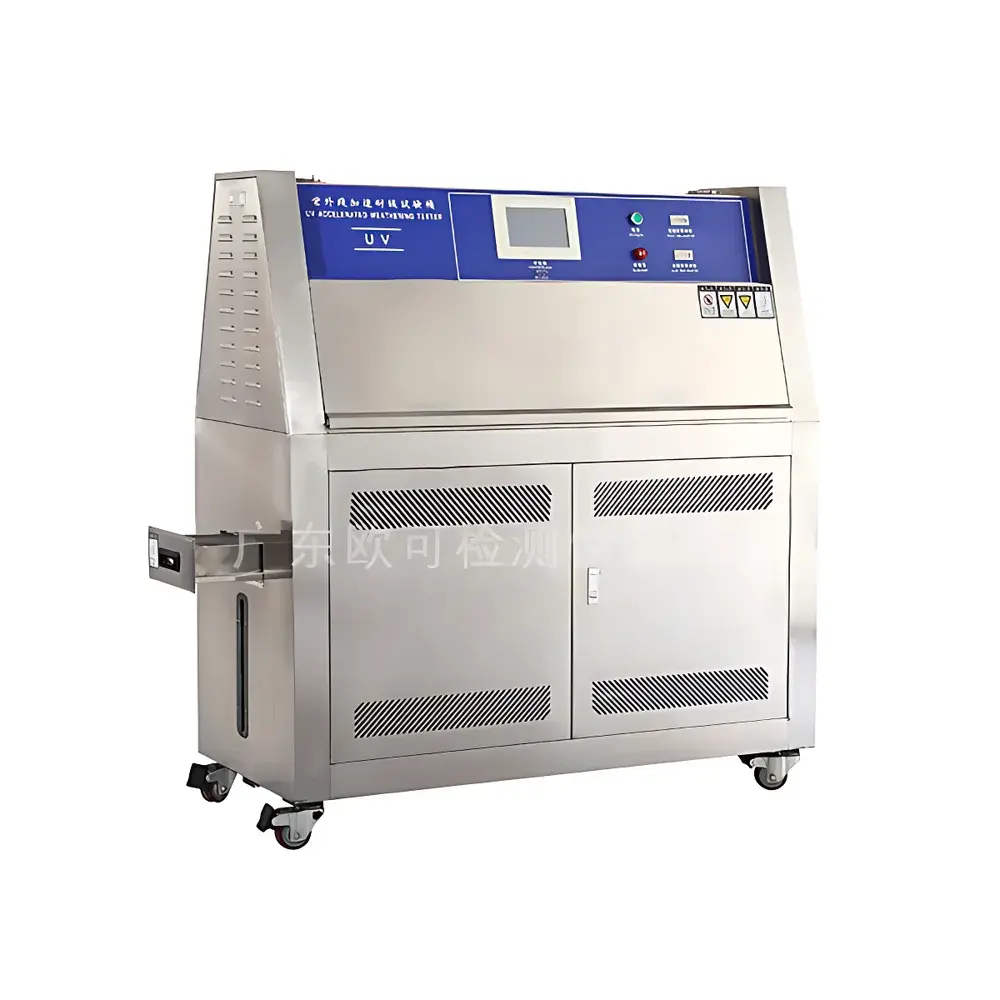
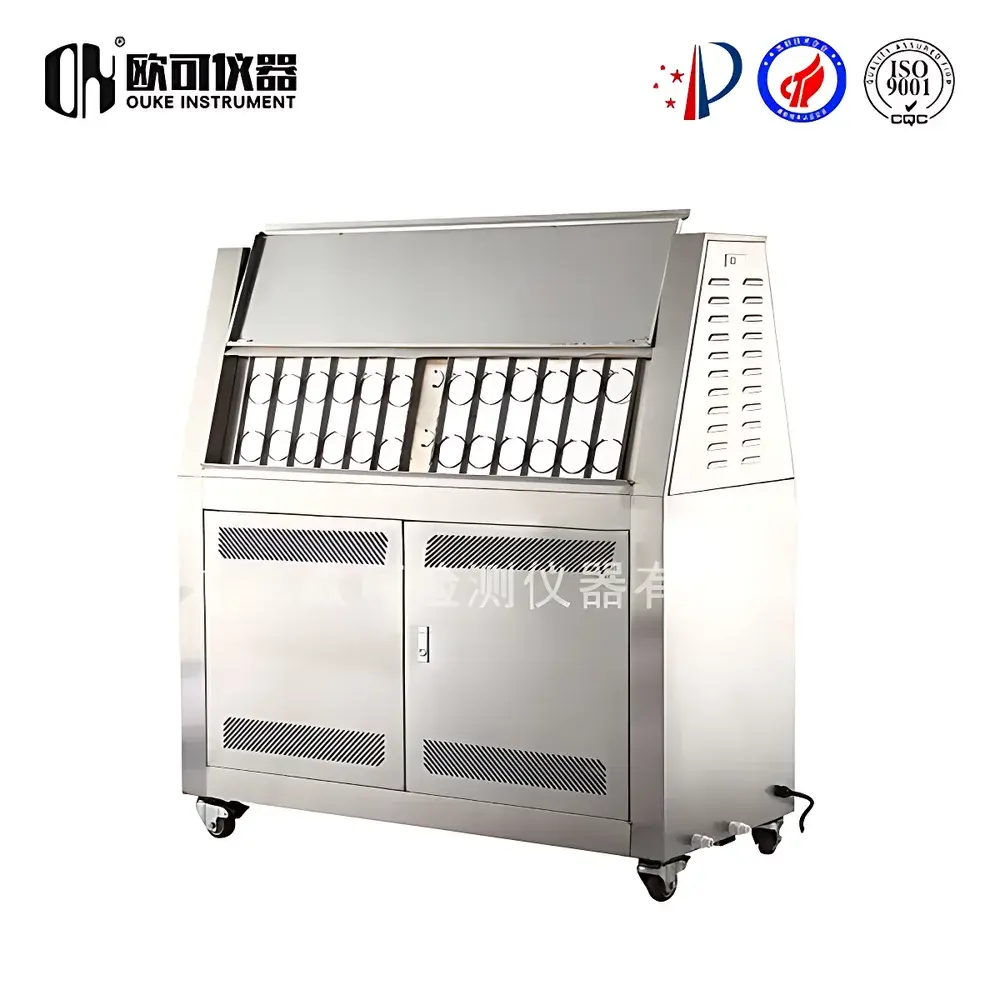
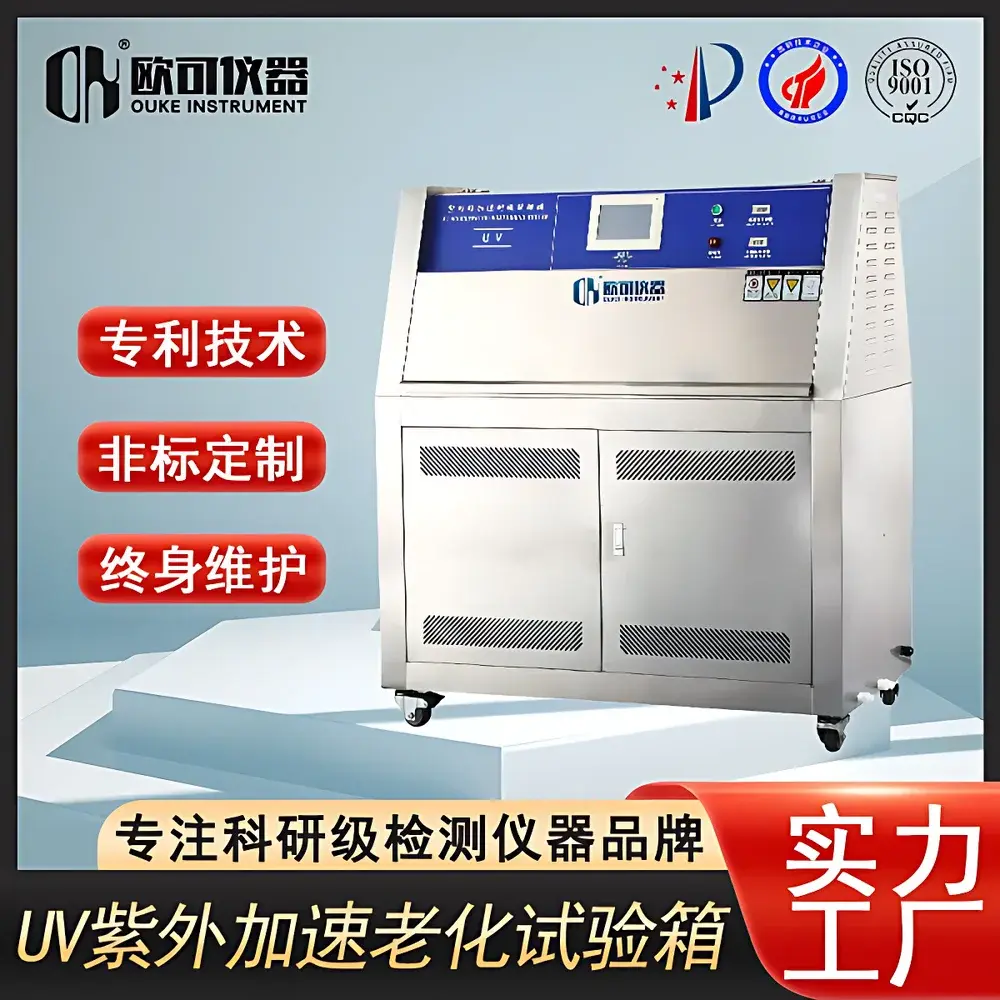
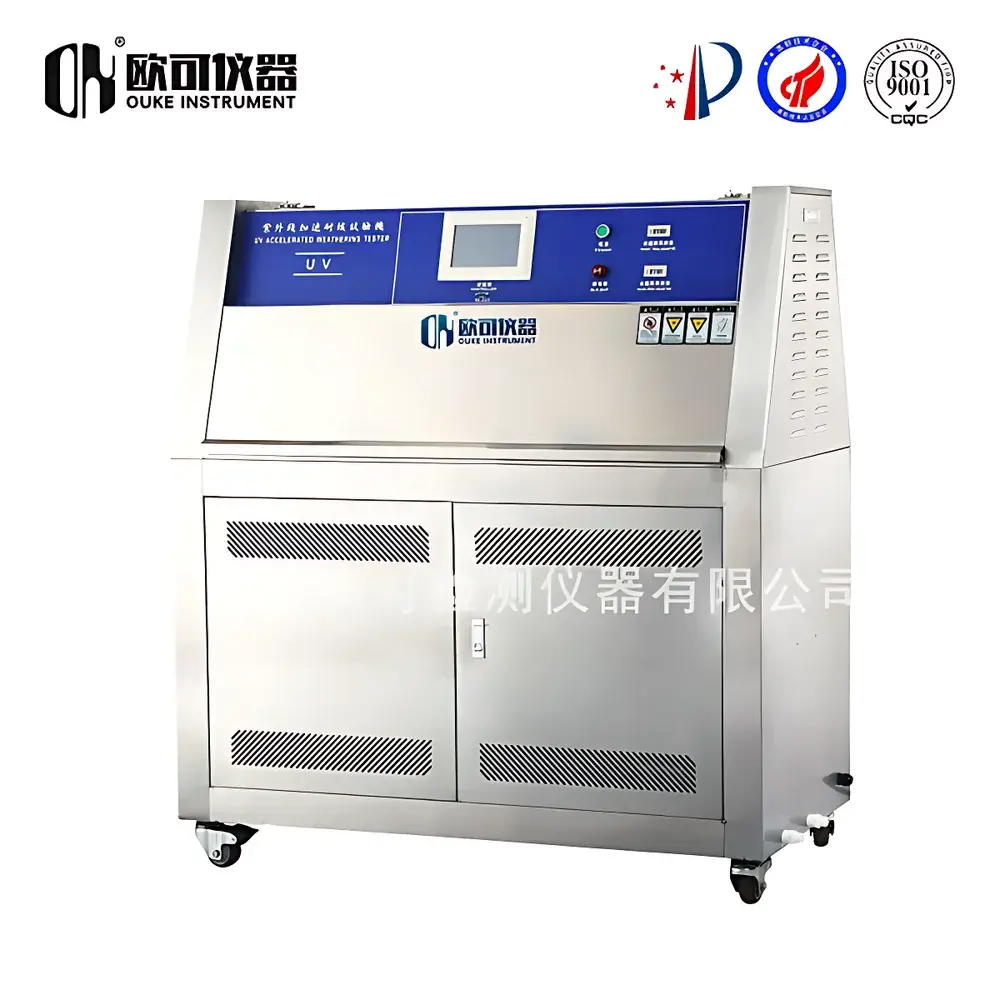
OK Instruments OK-UV-290 UV Aging Test Chamber
| Brand | OK Instruments |
|---|---|
| Origin | Guangdong, China |
| Manufacturer Type | Direct Manufacturer |
| Model | OK-UV-290 |
| Humidity Range | ≥95% RH (in-chamber actual value) |
| UV Lamp Power | 40 W per lamp |
| Irradiance Range | 0.72 W/m² |
| Exposure Time | 1–9999 h (adjustable) |
| Illumination Temperature | 75 °C |
| UV Wavelength Range | 300–400 nm |
| Internal Chamber Dimensions (W×H×D) | 114×40×40 cm |
| External Dimensions (W×H×D) | 135×140×65 cm |
| Temperature Range | Ambient to 70 °C |
| Temperature Control Accuracy | ≤±0.5 °C |
| Temperature Uniformity | ≤±2 °C or ≤±3% |
| UV Source | Fluorescent UV lamps (avg. service life: ~2000 h) |
| UV Spectral Range | 280–400 nm |
| Exposure Time Range | 0–999 h (adjustable) |
| Construction Material | SUS#304 stainless steel (inner & outer chamber) |
| Heating System | U-shaped titanium alloy high-speed heating elements |
| Safety Protections | Interlocked door cutoff (UV power disabled upon door opening), over-temperature protection, low-water level protection |
| Power Supply | AC 220 ±5 V, 50 ±0.5 Hz |
Overview
The OK Instruments OK-UV-290 UV Aging Test Chamber is an engineered environmental test system designed to simulate the photochemical degradation effects of solar ultraviolet radiation, moisture, and thermal cycling on polymeric, coating, and composite materials. It operates on the principle of accelerated UV exposure using fluorescent UV lamps emitting within the critical 280–400 nm spectral band—encompassing both UVA (315–400 nm) and UVB (280–315 nm) regions—thereby replicating the most damaging portion of terrestrial sunlight. Unlike broad-spectrum xenon arc systems, this chamber prioritizes reproducible, spectrally stable UV irradiation under tightly controlled humidity and temperature conditions. The integrated condensation cycle (via water-cooled specimen surfaces) and optional water spray function enable realistic simulation of dew formation and rain-induced stress, aligning with established protocols for evaluating weathering resistance in non-metallic materials.
Key Features
- Fluorescent UV lamp array delivering calibrated irradiance of 0.72 W/m² at specimen plane (typically measured at 340 nm), compliant with ASTM G154 spectral requirements;
- Dual-mode environmental control: precise temperature regulation (ambient to 70 °C, ±0.5 °C accuracy) and high-humidity condensation capability (≥95% RH in working chamber);
- Robust SUS#304 stainless steel construction for inner and outer chambers, ensuring long-term corrosion resistance and cleanroom-compatible surface integrity;
- U-shaped titanium alloy heating system enabling rapid thermal response and uniform temperature distribution (≤±2 °C spatial deviation);
- Safety-integrated interlock mechanism: automatic UV lamp deactivation upon chamber door opening, preventing operator UV exposure;
- Comprehensive protection suite including over-temperature cutoff, low-water-level detection, and thermal fuse redundancy;
- Adjustable exposure timing from 1 hour to 9999 hours, supporting both short-term qualification and extended durability studies.
Sample Compatibility & Compliance
The OK-UV-290 accommodates flat-panel specimens up to 114 cm wide, 40 cm high, and 40 cm deep—suitable for standard ASTM D4329 and ISO 4892-3 specimen racks. Its design conforms to internationally recognized weathering test standards, including ASTM G153 (for enclosed carbon-arc apparatus), ASTM G154 (for fluorescent UV-condensation devices), ASTM D4587 (UV exposure of coatings), ASTM D4799 (wood finishes), SAE J2020 (automotive exterior materials), and ISO 4892-3 (plastics—fluorescent UV exposure). All operational parameters—including irradiance stability, temperature uniformity, and humidity repeatability—are traceable to NIST-referenced calibration practices. The chamber supports GLP-compliant testing when paired with external data loggers meeting FDA 21 CFR Part 11 audit-trail requirements.
Software & Data Management
While the OK-UV-290 features a dedicated digital controller with real-time display of chamber temperature, irradiance status, and elapsed exposure time, it does not include embedded PC-based software. However, its analog/digital I/O interface enables integration with third-party SCADA or LIMS platforms via RS-485 or 4–20 mA signal output. Users may record irradiance decay trends, temperature/humidity profiles, and cycle logs for post-test analysis. For full compliance documentation, OK Instruments provides factory calibration certificates (including lamp spectral output verification and thermal mapping reports) and offers optional validation support (IQ/OQ) aligned with ISO/IEC 17025 laboratory accreditation frameworks.
Applications
This chamber is routinely deployed in R&D and QC laboratories across sectors requiring predictive assessment of outdoor durability. Key use cases include: evaluation of gloss retention and chalking resistance in architectural paints per ASTM D4587; photostability screening of automotive clearcoats and interior trim under SAE J2020 cycles; UV resistance validation of PVC window profiles, polyolefin films, and fiber-reinforced composites; accelerated aging of adhesives and sealants per ASTM D4799; and comparative weathering performance testing of wood stains and laminated veneers. Its controlled condensation mode is particularly effective for assessing hydrolytic degradation mechanisms in ester-based polymers and moisture-sensitive coatings.
FAQ
What UV spectral range does the OK-UV-290 emit?
The chamber utilizes fluorescent UV lamps with a nominal emission spectrum spanning 280–400 nm, covering both UVB and UVA bands. Typical peak intensity occurs near 340 nm, consistent with ASTM G154 Cycle 1 specifications.
Is irradiance monitoring included as a standard feature?
No—irradiance measurement requires an external calibrated UV radiometer. The chamber maintains fixed lamp output; users must periodically verify irradiance using NIST-traceable instrumentation per ASTM G147 guidelines.
Can the OK-UV-290 perform water spray cycles?
Yes—the system supports optional water spray functionality, enabling simulation of thermal shock and surface erosion effects as specified in ASTM D4329 Annex A2.
What is the expected service life of the UV lamps?
Lamps are rated for approximately 2000 hours of continuous operation. Degradation beyond 15% irradiance loss necessitates replacement to maintain test validity per ISO 4892-3 Clause 7.3.
Does the chamber meet regulatory requirements for pharmaceutical packaging testing?
While not specifically validated for ICH Q1B photostability, the OK-UV-290’s spectral output and control fidelity make it suitable for preliminary screening of polymer-based primary packaging—subject to user-defined qualification against ICH Q5C and USP criteria.



