
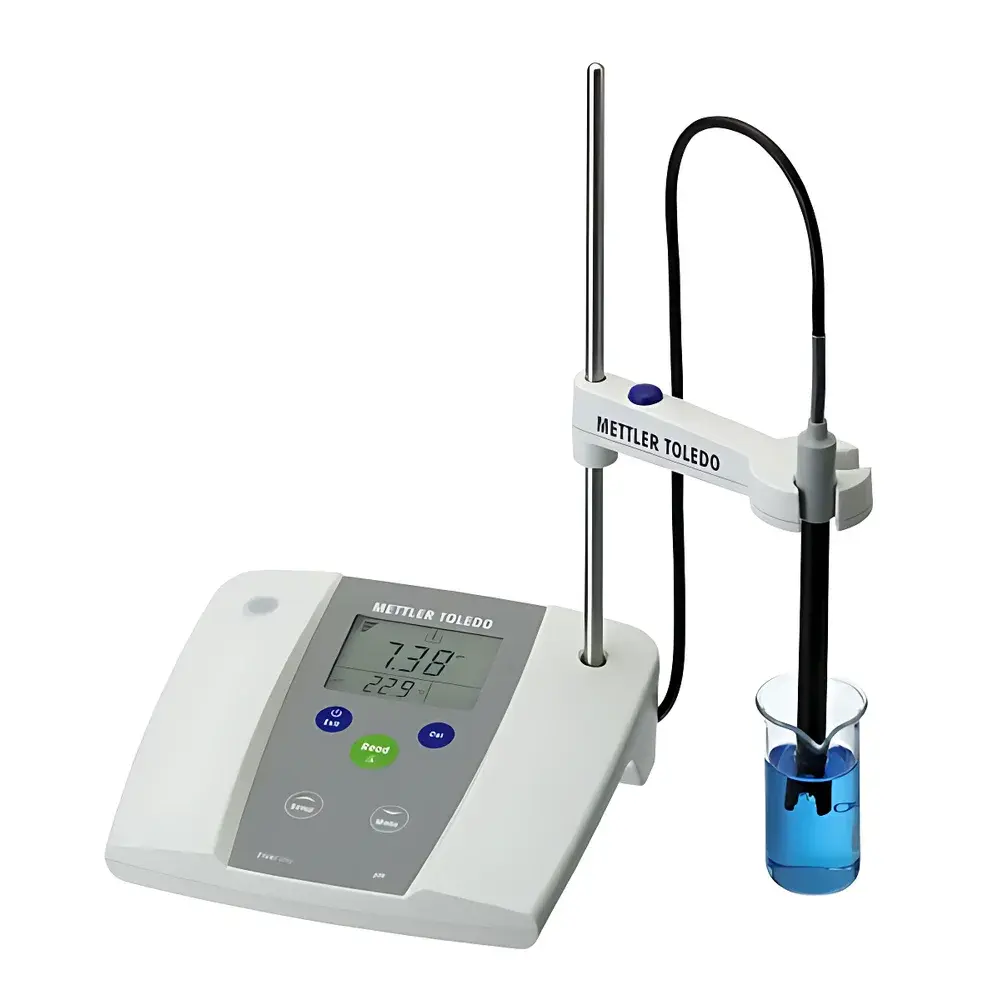
METTLER TOLEDO FE30K Benchtop Conductivity Meter
| Brand | METTLER TOLEDO |
|---|---|
| Origin | Shanghai, China |
| Model | FE30K |
| Form Factor | Benchtop |
| Conductivity Range | 0.1 μS/cm to 199.9 mS/cm |
| TDS Range | 0.1 mg/L to 199.9 g/L |
| Resistivity Range | 0.1 Ω·m to 19.99 MΩ·cm |
| Salinity Range | 0.00 to 19.99 psu |
| Temperature Range | 0.0 to 100.0 °C |
| Conductivity Accuracy | ±0.5% of reading |
| Temperature Accuracy | ±0.1 °C |
| Temperature Compensation | Linear, adjustable from 0.000 to 10.000 %/°C |
| reference temperatures | 20 °C and 25 °C |
| Calibration | Single-point with three pre-stored standard solutions (84 μS/cm, 1413 μS/cm, 12.88 mS/cm) |
| Display | Backlit LCD showing conductivity/TDS/salinity/resistivity, temperature, stability indicator, calibration status, and compensation settings |
| Power Supply | 100–240 V AC, 50–60 Hz |
Overview
The METTLER TOLEDO FE30K is a precision-engineered benchtop conductivity meter designed for routine laboratory and quality control applications requiring reliable, traceable, and compliant measurements of aqueous solution conductivity, total dissolved solids (TDS), salinity, and resistivity. Built upon over six decades of METTLER TOLEDO electrode science and electrochemical sensor design, the FE30K employs two-electrode AC conductivity measurement technology—optimized to minimize polarization effects and ensure stable readings across a wide dynamic range. Its measurement principle conforms to ISO 7888 and ASTM D1125 standards for electrical conductivity determination in water and wastewater analysis. The instrument operates under linear temperature compensation (LTC) algorithms, allowing users to select reference temperatures of either 20 °C or 25 °C and define custom temperature coefficients (0.000–10.000 %/°C) to match sample-specific behavior. Designed for GLP-compliant environments, the FE30K supports audit-ready operation through automatic endpoint detection, real-time stability monitoring, and non-volatile storage of the most recent calibration event.
Key Features
- Intuitive five-button interface enabling one-handed operation for measurement initiation, endpoint confirmation, calibration access, and data review
- Backlit LCD display simultaneously presenting primary measurement value (e.g., conductivity), corresponding temperature, endpoint status (e.g., “STABLE”), temperature compensation mode, and calibration validity indicator
- Automatic endpoint recognition with visual and audible stabilization feedback, reducing operator dependency and improving inter-user reproducibility
- Built-in self-diagnostic routine executed at power-on and prior to calibration, verifying electrode connection integrity, signal path continuity, and internal reference stability
- Single-point calibration workflow with three factory-predefined standard solutions (84 μS/cm, 1413 μS/cm, and 12.88 mS/cm), each traceable to NIST-certified reference materials
- Robust mechanical architecture featuring IP20-rated enclosure, chemical-resistant front panel, and integrated electrode holder compatible with the LE703 conductivity cell (included)
Sample Compatibility & Compliance
The FE30K is validated for use with low- to medium-conductivity aqueous samples including purified water (PW), water-for-injection (WFI), boiler feedwater, environmental surface water, municipal wastewater effluents, and brackish aquaculture solutions. It complies with key regulatory frameworks governing analytical instrumentation in regulated industries: its calibration traceability aligns with ISO/IEC 17025 requirements; temperature compensation logic satisfies USP guidelines for conductivity testing of pharmaceutical waters; and operational logging capabilities support basic 21 CFR Part 11 readiness when paired with METTLER TOLEDO LabX software (optional). The LE703 electrode—supplied with the system—is a platinum black-coated, epoxy-body, two-electrode cell with a fixed cell constant of 1.0 cm⁻¹, certified for CE, RoHS, and REACH compliance.
Software & Data Management
While the FE30K operates as a standalone instrument with no onboard data logging memory, it is fully compatible with METTLER TOLEDO’s LabX™ PC-based software suite via RS232 or USB-to-serial interface. LabX enables automated data capture, customizable report generation (PDF/CSV), electronic signature workflows, and full audit trail management—including user action timestamps, parameter changes, and calibration history export. When deployed in GMP or ISO 13485 environments, LabX facilitates compliance with ALCOA+ data integrity principles by enforcing role-based access control, electronic record retention, and immutable metadata tagging. For laboratories without LabX, manual documentation of calibration events and measurement results remains fully supported through the instrument’s on-screen calibration summary screen.
Applications
- Pharmaceutical water quality verification per USP , EP 2.2.38, and JP 2.05
- Environmental monitoring of surface and groundwater conductivity according to EPA Method 120.1
- Boiler and cooling tower water treatment control in industrial facilities
- Food and beverage process water validation and rinse water monitoring
- Educational laboratory instruction in analytical chemistry and environmental science curricula
- Basic QC testing in cosmetics, electroplating, and semiconductor rinse processes
FAQ
Does the FE30K support multi-point conductivity calibration?
No—the FE30K implements a single-point calibration protocol optimized for rapid, repeatable verification using one of three pre-programmed standards. Multi-point calibration requires higher-tier FiveEasy Plus or SevenCompact instruments.
Can the LE703 electrode be used for high-salinity seawater measurements?
Yes—the LE703 cell is rated for conductivities up to 200 mS/cm and exhibits stable performance in salinities up to 19.99 psu; however, for extended seawater use (>35 psu), a dedicated four-electrode cell (e.g., InLab® 731) is recommended.
Is temperature compensation mandatory during measurement?
Temperature compensation is enabled by default and cannot be disabled; this ensures all reported conductivity values are normalized to the selected reference temperature (20 °C or 25 °C), fulfilling standard reporting conventions in regulatory submissions.
What is the warranty coverage for the FE30K and LE703 electrode?
The FE30K instrument carries a 24-month limited manufacturer warranty; the LE703 electrode is covered for 12 months against material and workmanship defects, excluding damage from improper cleaning or mechanical stress.
How frequently should the LE703 electrode be recalibrated?
Calibration frequency depends on application stringency and regulatory context; daily calibration is recommended for GLP/GMP environments, while weekly calibration suffices for general lab use—always preceded by electrode cleaning and inspection per METTLER TOLEDO Technical Note TN-102.





