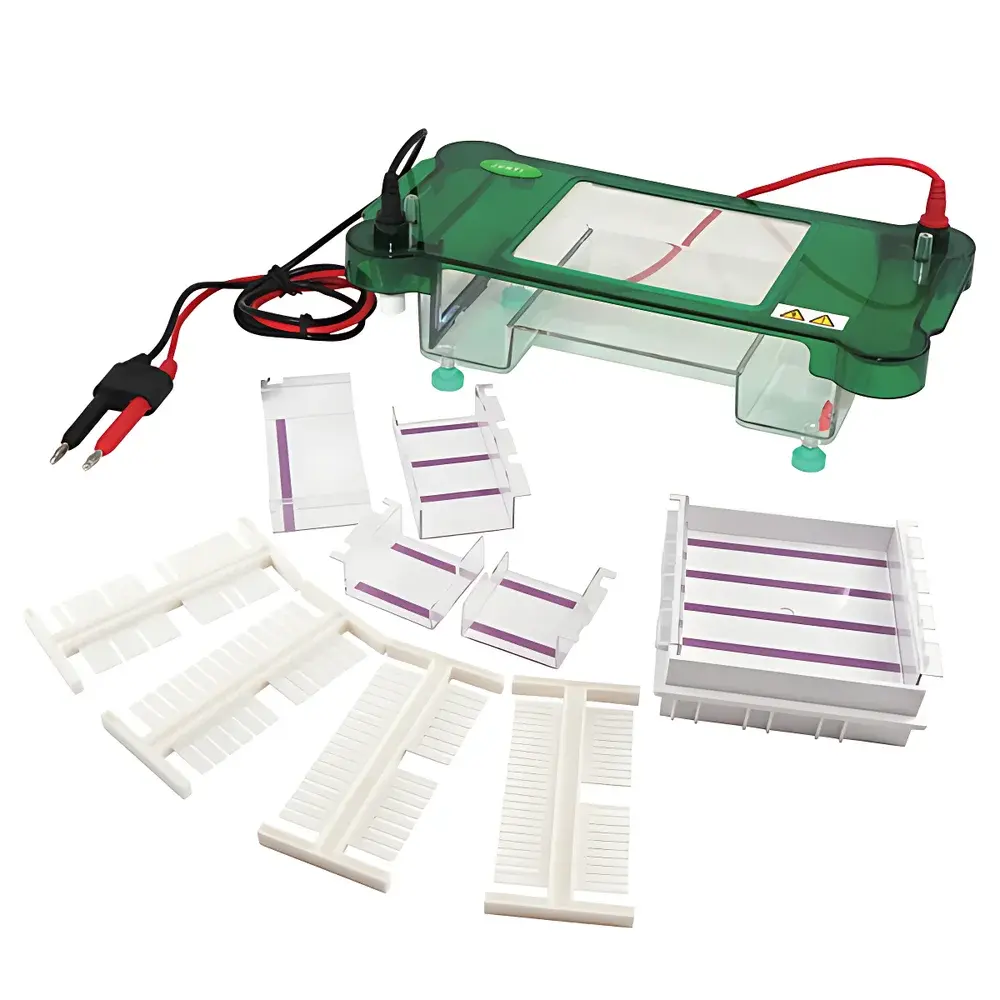
Junyi JY-SPCT Horizontal Electrophoresis Chamber
| Brand | Junyi |
|---|---|
| Origin | Beijing, China |
| Manufacturer Type | Authorized Distributor |
| Country of Origin | China |
| Model | JY-SPCT |
| Instrument Type | Nucleic Acid Electrophoresis System |
| Primary Component | Horizontal Electrophoresis Chamber |
| Gel Dimensions (W×L) | 120×120 mm, 120×60 mm, 60×120 mm, 60×60 mm |
| Sample Capacity | Up to 100 wells (configurable via comb options) |
| Buffer Volume | ~550 mL |
| External Dimensions (L×W×H) | 300×160×75 mm |
| Net Weight | 1.1 kg |
| Comb Options | 1–3 wells (1.5 mm thickness) |
| Safety Feature | Automatic power cutoff upon lid opening |
| Construction Material | Imported high-transparency polycarbonate (PC), one-piece injection molded |
Overview
The Junyi JY-SPCT Horizontal Electrophoresis Chamber is a precision-engineered platform for nucleic acid separation and molecular weight estimation under standard agarose or polyacrylamide gel electrophoresis (AGE/PAGE) conditions. Designed in accordance with widely adopted laboratory protocols—including ASTM D4294 for gel-based molecular analysis and ISO/IEC 17025-compliant workflow principles—the system operates on the fundamental principle of electrophoretic mobility: charged DNA fragments migrate through a porous matrix under a uniform electric field, with separation resolution governed by fragment size, gel concentration, buffer ionic strength, and applied voltage (when used with an external power supply). As a standalone chamber—not integrated with a power source—the JY-SPCT is engineered for interoperability with standard DC power supplies (e.g., 0–300 V, 0–500 mA), enabling flexible optimization across applications ranging from routine PCR product verification to restriction digest analysis and plasmid profiling.
Key Features
- One-piece injection-molded polycarbonate construction ensures optical clarity for real-time gel monitoring and post-staining visualization; material meets USP Class VI biocompatibility standards for low extractables and UV stability.
- Dual-color lid option enhances ergonomic differentiation between open/closed states; integrated safety interlock circuitry automatically interrupts electrical continuity at electrode terminals when the lid is raised—fully compliant with IEC 61010-1 safety requirements for laboratory equipment.
- Gel tray features an integrated handle and anti-drift grooves that mechanically constrain comb positioning during polymerization, minimizing band distortion and improving inter-run reproducibility.
- High-contrast background surface on the casting tray facilitates accurate pipetting under standard lab lighting or transilluminator illumination.
- Adjustable leveling feet allow precise horizontal alignment on non-uniform benchtops—a critical factor in preventing uneven current distribution and band skewing.
- Modular electrode assembly is fully removable without tools, permitting rapid cleaning, replacement of platinum-coated stainless-steel electrodes, or decontamination per GLP-mandated maintenance logs.
Sample Compatibility & Compliance
The JY-SPCT accommodates four standardized gel formats (60×60 mm, 60×120 mm, 120×60 mm, 120×120 mm), supporting both low-throughput analytical runs and higher-density screening configurations. Comb configurations range from 1–3 wells (1.5 mm thickness, ideal for large-insert cloning validation) to 6–25 wells (1.0/1.5 mm, optimized for multi-sample PCR or qPCR product analysis). The ~550 mL buffer reservoir maintains thermal homogeneity during extended runs (up to 90 min at 120 V), reducing edge effects and ensuring consistent migration velocity across the gel matrix. The chamber complies with key regulatory expectations for nucleic acid analysis workflows: its design supports traceable documentation under FDA 21 CFR Part 11–aligned electronic records (when paired with compliant imaging software), and its material composition aligns with ISO 10993-5 cytotoxicity testing requirements for indirect contact devices.
Software & Data Management
As a hardware-only electrophoresis chamber, the JY-SPCT does not include embedded firmware or proprietary software. It is fully compatible with industry-standard gel documentation systems—including Bio-Rad GelDoc™, Azure Sapphire™, and UVP ChemStudio™—enabling seamless integration into validated digital workflows. When used in conjunction with image acquisition platforms supporting audit-trail functionality, the system supports ALCOA+ data integrity principles (Attributable, Legible, Contemporaneous, Original, Accurate, Complete, Consistent, Enduring, Available) required under GMP/GLP environments. Raw gel images exported in TIFF or PNG format retain full metadata compatibility with ImageJ/Fiji, GeneTools, or commercial bioinformatics pipelines for band quantification, molecular weight calibration (via ladder regression), and comparative densitometry.
Applications
- Routine verification of PCR amplification products, restriction enzyme digests, and ligated constructs.
- Molecular weight estimation of linear dsDNA using calibrated ladders (e.g., Lambda HindIII, 1 kb Plus DNA Ladder).
- Quality control of plasmid preps, including supercoiled vs. nicked/open-circular isoform resolution.
- Preparative electrophoresis for excision and purification of target bands prior to downstream sequencing or cloning.
- Teaching laboratory implementation—its mechanical simplicity, visual transparency, and safety interlocks make it suitable for undergraduate molecular biology curricula aligned with ACS and ASBMB learning outcomes.
FAQ
Does the JY-SPCT include a built-in power supply?
No. It is a passive electrophoresis chamber requiring an external DC power supply (0–300 V, 0–500 mA recommended).
Can the chamber be used with SDS-PAGE gels?
It is optimized for nucleic acid electrophoresis; protein electrophoresis requires vertical systems with stacking/resolving gel architecture.
Is the polycarbonate body resistant to common decontamination agents?
Yes—it withstands repeated wiping with 70% ethanol, 10% bleach (diluted), and DNA-away™ solutions without hazing or structural degradation.
What buffer systems are compatible?
TAE (Tris-acetate-EDTA), TBE (Tris-borate-EDTA), and SB (Sodium borate) buffers are all supported; optimal conductivity and resolution depend on gel concentration and run duration.
How is calibration verified for molecular weight accuracy?
Calibration relies on co-electrophoresis of DNA ladders with known fragment sizes; linear regression of log₁₀(size) vs. migration distance yields R² > 0.995 under controlled voltage and temperature conditions.
Related Products