
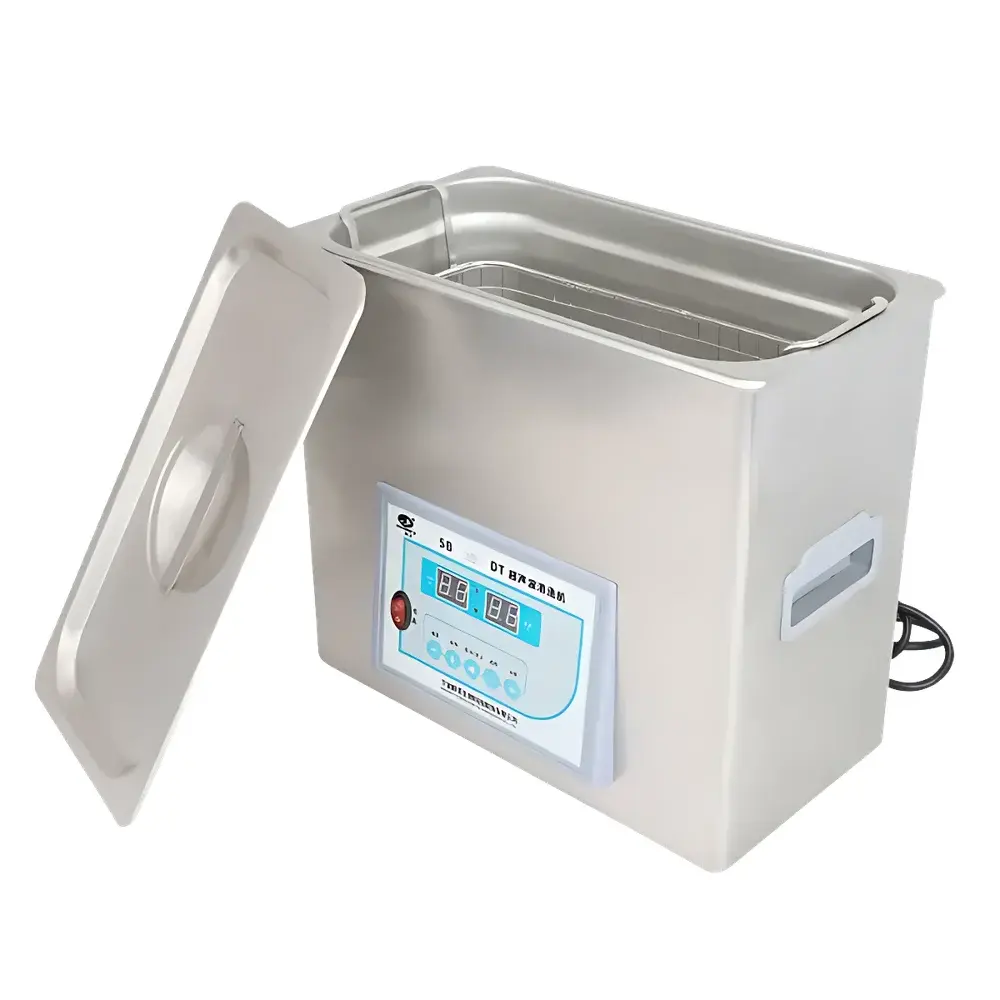
Ningbo Scientz SB-3200DT Digital Ultrasonic Cleaner with Heating and Auto Drain
| Brand | Scientz |
|---|---|
| Origin | Zhejiang, China |
| Manufacturer | Ningbo Scientz Biotechnology Co., Ltd. |
| Type | Benchtop Heated Ultrasonic Cleaner |
| Capacity | 6 L |
| Ultrasonic Frequency | 40 kHz |
| Ultrasonic Power Output | 480 W |
| Adjustable Power | Yes |
| Adjustable Temperature Range | Ambient to 80 °C |
| Timer Range | 1–999 min |
| Sound-Dampening Lid | Integrated |
| Drain System | Automatic |
| Display | Digital LCD with Real-Time Temperature and Remaining Time |
| Safety Features | Auto Shut-off, Power Loss Memory, Over-Temperature Protection |
Overview
The Ningbo Scientz SB-3200DT is a benchtop digital ultrasonic cleaner engineered for precision cleaning, degassing, dispersion, and mild sample disruption in regulated laboratory environments. It operates on the principle of acoustic cavitation: high-frequency (40 kHz) ultrasonic energy is transmitted into the cleaning medium via piezoelectric transducers bonded to the stainless-steel tank base. This generates controlled microbubble formation and implosive collapse—producing localized transient pressures exceeding 1000 atm and liquid-phase shear forces sufficient to dislodge particulate contaminants, organic films, and adsorbed residues from complex geometries—including blind holes, capillary channels, and microstructured surfaces. Unlike mechanical scrubbing or solvent-intensive methods, cavitation-based cleaning preserves substrate integrity while achieving high reproducibility across repeated cycles. The integrated PTC heating system enables temperature-controlled operation up to 80 °C, enhancing solubilization kinetics for waxy, viscous, or polymer-bound contaminants without thermal degradation of sensitive substrates.
Key Features
- Digital microprocessor control with real-time LCD display showing elapsed/remaining time and actual bath temperature
- Adjustable ultrasonic power output (0–100% of 480 W nominal) for optimization across sample types and contamination loads
- Precise temperature regulation (ambient to 80 °C ±1 °C) with PID feedback loop and over-temperature cutoff
- Programmable timer (1–999 minutes) with auto-shutdown and power-loss memory function
- Integrated sound-dampening lid reducing ambient noise to ≤55 dB(A) at 1 m distance
- Stainless-steel tank (304 grade) with automatic drain valve for rapid, spill-free fluid exchange
- Robust transducer array with imported ceramic elements ensuring long-term stability and uniform energy distribution
- Compliance-ready design supporting documentation for GLP/GMP workflows (e.g., audit trails for parameter settings and cycle logs)
Sample Compatibility & Compliance
The SB-3200DT accommodates standard laboratory vessels including borosilicate glassware (vials, beakers, cuvettes), polypropylene centrifuge tubes, stainless-steel surgical instruments, quartz optics, and delicate jewelry components. Its non-abrasive action makes it suitable for pre-analytical preparation of HPLC vials, GC autosampler inserts, and ICP-MS sample introduction components—where particle carryover must be minimized. The unit meets CE safety requirements (EN 61000-6-3, EN 61000-6-4) and conforms to ISO 13485-aligned manufacturing practices. While not certified as a medical device under FDA 21 CFR Part 820, its operational parameters support validation protocols required for cleaning verification per ISO 15883-1 and AAMI ST79 Annex D for reprocessed healthcare equipment.
Software & Data Management
The SB-3200DT operates as a standalone instrument with no external software dependency. All operational parameters—including start time, set temperature, ultrasonic intensity, and duration—are stored in non-volatile memory and retained after power interruption. The digital interface logs the last five executed cycles (timestamp, setpoints, actual bath temperature profile) accessible via manual recall. For laboratories implementing electronic record-keeping, the unit’s deterministic behavior and parameter traceability support integration into validated LIMS or ELN systems through documented SOPs. Optional RS-232 or USB-to-serial adapters (sold separately) enable remote parameter configuration and cycle logging when paired with third-party scripting tools compliant with FDA 21 CFR Part 11 requirements.
Applications
- Cleaning of analytical glassware and plastic consumables prior to trace-metal analysis (e.g., ICP-MS, AAS) to prevent cross-contamination
- Removal of residual lipids and proteins from reusable surgical tools and dental instruments in accordance with ANSI/AAMI ST79 guidelines
- Preparation of chromatographic mobile phases via degassing to eliminate baseline noise and pump cavitation
- Cell lysis and homogenization of soft tissues or cultured cells for downstream protein extraction (limited to low-energy, short-duration protocols)
- Maintenance of optical components—including microscope objectives and fiber-optic connectors—by eliminating hydrophobic film residues without surface scratching
- Restoration of fine metalwork and gemstone surfaces in conservation labs, where chemical immersion is contraindicated
FAQ
What is the maximum recommended operating temperature for aqueous solutions?
The unit supports stable operation up to 80 °C; however, for water-based cleaning baths, sustained temperatures above 60 °C may accelerate evaporation and reduce cavitation efficiency. Optimal performance for general cleaning is observed between 40–55 °C.
Can the SB-3200DT be used with flammable solvents?
No. This model is designed exclusively for aqueous or water-miscible solutions. Use with flammable, volatile, or low-flashpoint solvents poses fire and explosion hazards and voids warranty and safety certifications.
Is the automatic drain compatible with waste neutralization systems?
Yes—the drain outlet accepts standard 1/2″ NPT fittings and can be plumbed into centralized lab waste management infrastructure, provided local chemical compatibility and regulatory discharge limits are verified prior to installation.
How often should the transducer array be serviced?
Under normal use (≤6 hrs/day), no routine transducer maintenance is required. Annual inspection of tank seal integrity and transducer bonding is recommended for GxP environments to ensure consistent energy transfer and acoustic field uniformity.
Does the unit support continuous operation mode?
Yes—when the timer is set to “999 min”, the unit runs continuously until manually stopped or interrupted by safety cutoff (e.g., over-temperature or dry-run detection).
Related Products



