
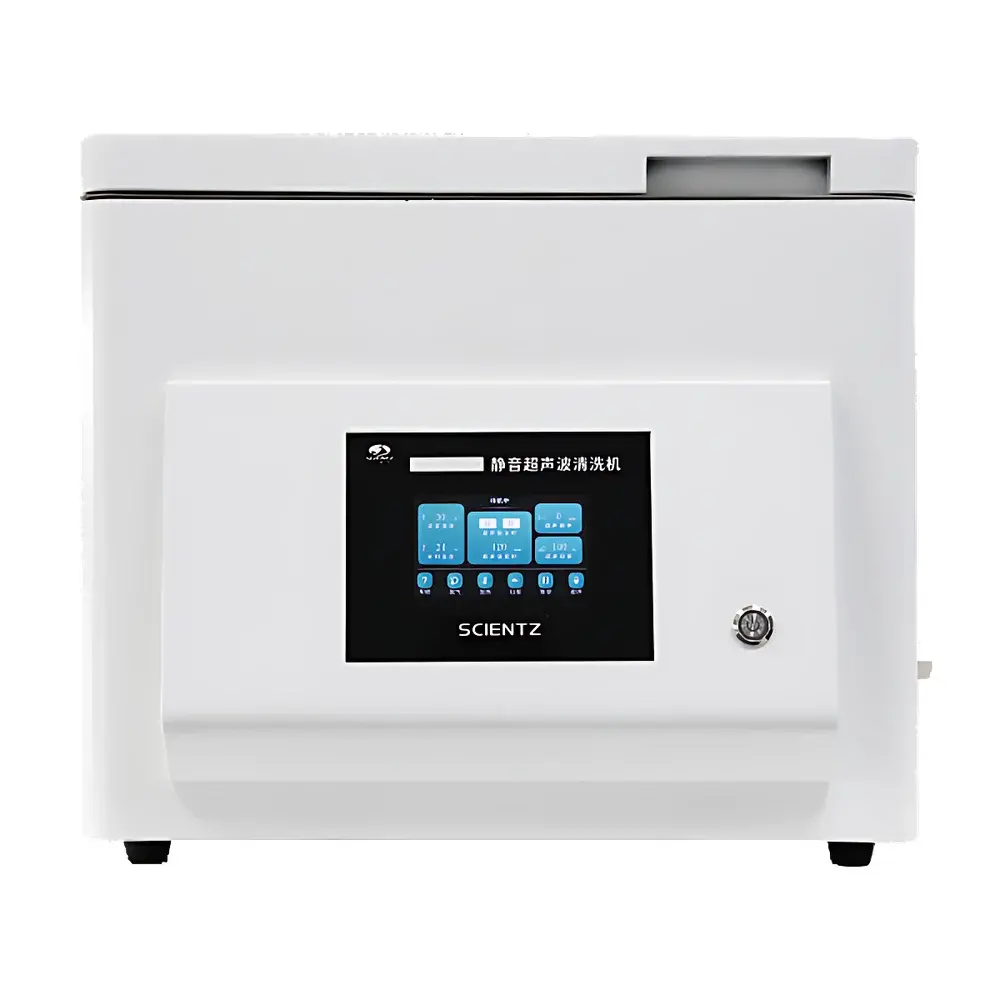
Ningbo Scientz DTD Series Quiet Ultrasonic Cleaner
| Brand | Ningbo Scientz |
|---|---|
| Origin | Zhejiang, China |
| Manufacturer Type | Direct Manufacturer |
| Product Category | Domestic |
| Model | DTD Series |
| Instrument Type | General-Purpose Ultrasonic Cleaner |
| Tank Capacity | 10–30 L |
| Ultrasonic Frequency | 40 kHz |
| Ultrasonic Power | Adjustable (0–100%) |
| Temperature Control Range | Ambient to 80 °C |
| Timer Range | 1–999 minutes |
| Sound-Dampening Lid | Included |
| Drain & Fill Ports | Equipped |
| Noise Level | ≤55 dB(A) |
| Compliance | CE-marked design |
Overview
The Ningbo Scientz DTD Series Quiet Ultrasonic Cleaner is an engineered solution for precision cleaning, degassing, emulsification, dispersion, and sample homogenization in regulated laboratory and industrial environments. It operates on the principle of acoustic cavitation: high-frequency (40 kHz) ultrasonic energy is transmitted into aqueous or solvent-based cleaning media via piezoelectric transducers bonded to the tank bottom. This generates controlled microbubble formation and implosive collapse—producing localized shear forces, microstreaming, and transient hotspots (>5,000 K, >1,000 atm) sufficient to dislodge sub-micron contaminants from complex geometries including blind holes, capillary channels, and porous surfaces—without mechanical abrasion or thermal degradation. Unlike conventional ultrasonic cleaners, the DTD series integrates a multi-layer acoustic isolation system—including three-dimensional eco-acoustic damping foam lining and a hydraulically assisted stainless-steel lid—reducing operational noise to ≤55 dB(A), enabling safe deployment in open-plan labs, cleanrooms, and quality control suites where acoustic interference must be minimized.
Key Features
- Acoustically Optimized Architecture: Integrated sound-dampening enclosure with certified ≤55 dB(A) emission—validated by CNAS-accredited third-party testing reports upon request.
- Intuitive Touch Interface: Full-color LCD touchscreen with real-time display of temperature, time, power level, and operating mode; supports multi-language UI (English default).
- Stable Power Delivery: Self-tracking oscillator circuitry with imported ICs ensures consistent frequency output under variable load conditions; includes auto-resonance tracking, over-current/over-temperature protection, and power-loss memory retention.
- High-Efficiency Transduction: Lead zirconate titanate (PZT)-based transducers with high Q-factor ceramic elements deliver superior electroacoustic conversion efficiency (>92%), maximizing energy transfer to the cleaning medium.
- Configurable Operation Modes: Dual-mode selection—Ultrasonic Cleaning Mode for particulate removal and Degassing Mode for dissolved gas elimination in solvents, buffers, or cell culture media.
- Hygienic Tank Construction: Seamless one-piece 304 stainless-steel tank formed via hydraulic deep drawing—eliminating weld seams and crevices that harbor biofilm or residue; includes removable stainless-steel mesh basket and acoustic lid.
- Flexible Parameter Control: Precise adjustment of ultrasonic power (0–100% in 1% increments), heating setpoint (ambient to 80 °C ±1 °C), and timer duration (1–999 min in 1-min steps).
- Ergonomic Design: Hydraulic gas-spring lid assist mechanism enables smooth, silent, one-handed opening—reducing operator fatigue during high-throughput workflows.
Sample Compatibility & Compliance
The DTD series accommodates a broad range of sample types and container formats—including borosilicate glassware (vials, cuvettes, pipette tips), polymer consumables (centrifuge tubes, microplates), metallic components (surgical instruments, dental tools, watch gears), optical substrates (lens elements, quartz cuvettes), and delicate jewelry (gold, platinum, gemstone settings). All wetted parts are constructed from 304 stainless steel and PTFE-sealed components, ensuring chemical compatibility with common aqueous detergents, ethanol, isopropanol, acetone, and mild alkaline solutions. The unit meets CE safety directives (2014/30/EU EMC, 2014/35/EU LVD) and supports compliance with ISO 13485 (medical device manufacturing), ASTM D2603 (ultrasonic cleaning validation), and USP / environmental control requirements when integrated into validated cleaning SOPs.
Software & Data Management
While the DTD series operates as a standalone instrument without cloud connectivity, its embedded firmware supports full audit-trail functionality per FDA 21 CFR Part 11 principles: all parameter changes, start/stop events, and error logs are timestamped and stored locally in non-volatile memory for ≥12 months. Optional RS-232 or USB-B interface enables integration with laboratory information management systems (LIMS) or electronic lab notebooks (ELN) for automated data capture. Configuration files can be exported/imported via USB flash drive, facilitating method replication across multiple units in centralized QC labs.
Applications
- Pre-analytical preparation of HPLC vials, GC autosampler vials, and ICP-MS sample introduction hardware.
- Removal of organic residues and biofilms from endoscopes, dental handpieces, and orthopedic implants prior to sterilization.
- Degassing of mobile phases, cell culture media, and nanoparticle suspensions to prevent bubble-induced flow instability or sensor drift.
- Cleaning of optical components—including microscope objectives, interferometer mirrors, and laser cavity optics—without surface scratching.
- Homogenization and cell lysis of tissue samples in buffer matrices for downstream proteomics or nucleic acid extraction.
- Maintenance cleaning of precision mechanical assemblies such as fuel injectors, MEMS sensors, and aerospace instrumentation housings.
FAQ
What is the maximum allowable liquid temperature during operation?
The heating system is rated for continuous operation up to 80 °C. For temperatures above 60 °C, use only aqueous solutions with low volatility; avoid flammable solvents.
Can the DTD series be used for sterilization?
No. This device performs cleaning and degassing—not microbial inactivation. Sterilization requires validated autoclaving, dry heat, or ethylene oxide processes per ISO 17664.
Is the tank volume calibrated to ISO/IEC 17025 standards?
Tank dimensions are manufactured to ±0.5% geometric tolerance; volumetric calibration certificates are available upon request for GMP-regulated applications.
How often should the transducer bonding integrity be verified?
Scientz recommends annual performance verification using ASTM E1739 acoustic intensity mapping or direct calorimetric measurement of power delivery efficiency.
Does the unit support remote monitoring via Ethernet or Wi-Fi?
No. Remote supervision requires external PLC integration via digital I/O signals or optional RS-232/USB-to-Ethernet bridge hardware.



