
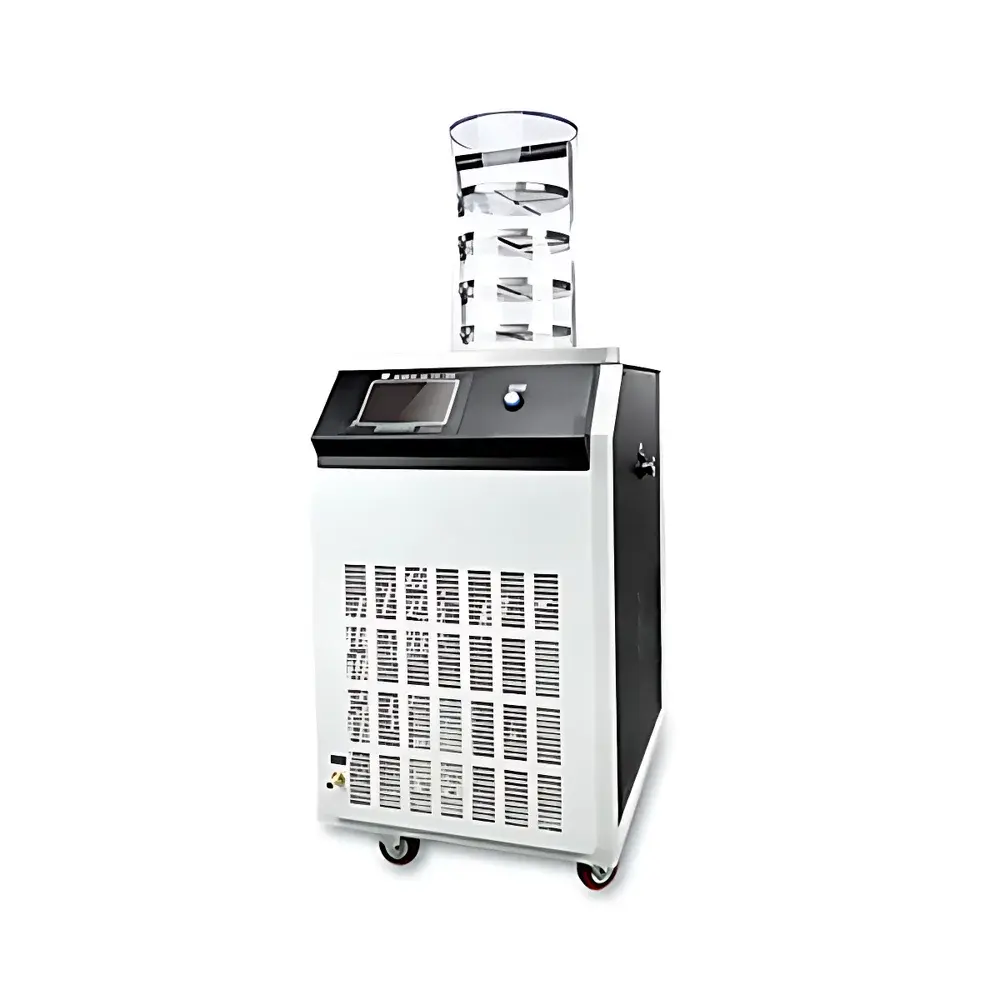
Ningbo Scientz SCIENTZ-18N/A Benchtop Manifold Freeze Dryer
| Brand | Ningbo Scientz |
|---|---|
| Origin | Zhejiang, China |
| Manufacturer Type | Direct Manufacturer |
| Instrument Type | Standard Manifold Freeze Dryer |
| Application Scope | Pilot-Scale |
| Lyophilization Area | 0.12 m² |
| Ultimate Vacuum | ≤5 Pa |
| Condensate Capacity (24 h) | 4 kg/batch |
| Cold Trap Temperature | ≤−56 °C |
| Dimensions (L×W×H) | 600 × 450 × 720 mm + 440 mm (condenser height) |
Overview
The Ningbo Scientz SCIENTZ-18N/A is a pilot-scale benchtop manifold freeze dryer engineered for reproducible, controlled lyophilization of thermolabile biologicals, pharmaceuticals, and research-grade materials. It operates on the fundamental principle of sublimation—removing water from frozen samples under deep vacuum without passing through the liquid phase—thereby preserving structural integrity, bioactivity, and chemical stability. Designed with an integrated cold trap and high-efficiency refrigeration system, the unit achieves stable condensation at ≤−56 °C (optionally −80 °C with dual-stage cascade compressor), ensuring efficient vapor capture and minimal backstreaming. Its compact footprint (600 × 450 × 720 mm + 440 mm) and modular manifold configuration make it suitable for laboratories requiring flexibility in batch size, sample diversity, and process scalability—particularly where GMP-aligned documentation, traceability, and repeatable drying profiles are essential.
Key Features
- Imported high-reliability compressors deliver rapid cooldown and sustained low-temperature performance; optional −80 °C cascade system enables deep freezing of low-eutectic formulations.
- 7-inch full-color TFT touchscreen interface with industrial-grade embedded OS supports real-time monitoring of critical parameters: cold trap temperature, chamber pressure (≤5 Pa), shelf temperature (if equipped), and elapsed cycle time.
- Automated data logging stores complete freeze-drying profiles—including time-stamped vacuum curves, temperature ramps, and condensate accumulation—with USB export capability for offline analysis or regulatory submission.
- Optically transparent polycarbonate drying chamber (one-piece molded, corrosion-resistant, no adhesive joints) allows unobstructed visual observation of sublimation progression and ice morphology.
- Intelligent vacuum control logic delays pump activation until cold trap reaches setpoint, extending pump service life and minimizing oil contamination risk; optional oil mist filter and automatic pressure differential valve available.
- Manifold configuration includes eight standard 24/29 mm O.D. ports compatible with internationally standardized lyophilization flasks and stopper-sealed vials; wide-mouth design facilitates rapid loading/unloading of diverse sample formats.
Sample Compatibility & Compliance
The SCIENTZ-18N/A accommodates a broad spectrum of sample types: microbial cultures, viral suspensions, serum proteins, monoclonal antibodies, plasmid DNA, plant extracts, food matrices (e.g., fruits, meats), environmental samples (soil, sludge), and nanomaterial dispersions. Its validated performance aligns with key international standards governing lyophilization process development and quality assurance—including ASTM F2372 (Standard Guide for Lyophilization Process Development), ISO 22000 (Food Safety Management), and USP (Sterile Preparation). While not pre-certified for 21 CFR Part 11 compliance, its audit-ready data logging architecture—including user-access logs, timestamped parameter records, and tamper-resistant USB export—supports GLP/GMP environments when paired with appropriate SOPs and IT validation protocols.
Software & Data Management
The embedded control system runs a deterministic real-time operating system optimized for deterministic I/O response and cyclic data acquisition at 1-second intervals. All operational events—including start/stop commands, alarm triggers (e.g., ambient temperature exceedance, vacuum leak detection), and manual overrides—are time-stamped and stored locally with ≥10,000-cycle history retention. Exported .CSV files contain synchronized columns for pressure (Pa), cold trap temperature (°C), elapsed time (s), and user-defined annotations. Optional PC-based software enables curve overlay comparison, deviation analysis against reference batches, and PDF report generation with digital signature fields—facilitating internal review and external audit preparation.
Applications
This system serves as a core tool across academic, governmental, and industrial R&D settings:
- Life sciences: Long-term stabilization of bacteriophages, lentiviral vectors, and primary cell lysates; preparation of reference standards for ELISA and qPCR assays.
- Pharmaceutical development: Formulation screening of lyophilized monoclonal antibody intermediates; stability testing per ICH Q5C guidelines.
- Agricultural research: Preservation of fungal spores, pollen, and tissue explants for germplasm banks; dehydration of pesticide residue standards for GC-MS calibration.
- Environmental analysis: Processing of contaminated soil cores prior to heavy metal speciation or microbial community profiling (16S rRNA sequencing).
- Materials science: Drying of hydrogel nanoparticles and porous MOFs without collapse, maintaining specific surface area and pore volume distribution.
FAQ
What is the maximum batch capacity for this model?**
The SCIENTZ-18N/A supports up to 4 kg of ice condensation per 24-hour cycle, with typical load volumes ranging from 500 mL to 2 L across the 8-port manifold.
Is the system compliant with FDA 21 CFR Part 11 requirements?**
Out-of-the-box, it provides audit-trail-capable data logging; full Part 11 compliance requires site-specific validation of user access controls, electronic signatures, and backup procedures.
Can the cold trap temperature be monitored independently during operation?**
Yes—the embedded sensor delivers continuous, calibrated readings displayed in real time and logged at user-configurable intervals.
What vacuum pump options are supported?**
The unit is compatible with multiple two-stage rotary vane pumps (e.g., Edwards RV8, Welch 1402); optional oil mist filters and automatic anti-suckback valves minimize maintenance downtime.
Does the system support eutectic point determination?**
An optional resistive temperature probe kit enables in-situ product temperature monitoring, supporting empirical determination of collapse temperature and optimization of primary drying endpoints.



