
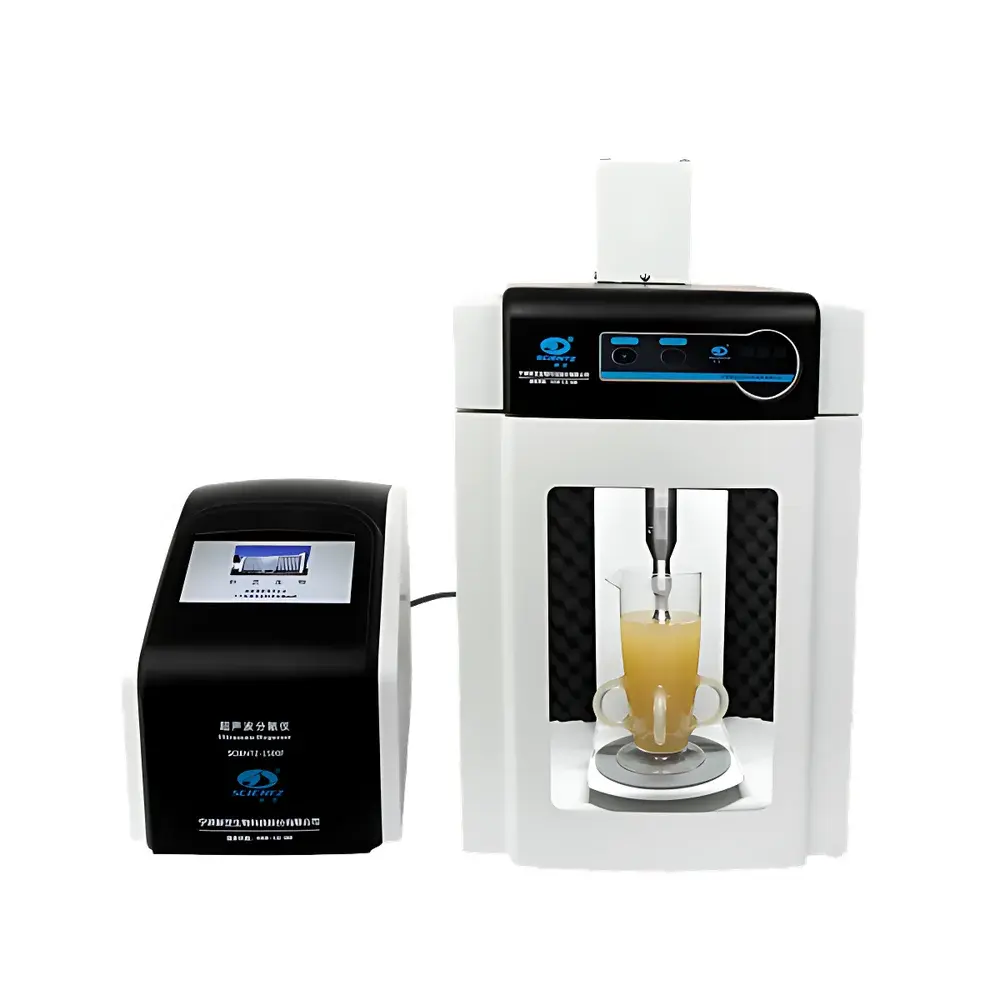
Ningbo Scientz SCIENTZ-3000F Ultrasonic Homogenizer
| Brand | Ningbo Scientz |
|---|---|
| Origin | Zhejiang, China |
| Manufacturer Type | Direct Manufacturer |
| Instrument Type | Ultrasonic Probe Homogenizer |
| Dimensions (W×D×H) | 416 × 244 × 300 mm |
| Sample Volume Range | 10–40,000 mL |
| Operating Frequency | 20–25 kHz |
| Probe Material | Titanium Alloy (Grade 5) |
| Power Output | Adjustable, Continuous & Pulse Modes |
| Safety Features | Overtemperature, Overload, and Timer Alarm |
| Dispersion Mechanism | Acoustic Cavitation in Liquid Media |
Overview
The Ningbo Scientz SCIENTZ-3000F Ultrasonic Homogenizer is an industrial-grade benchtop ultrasonic disperser engineered for high-efficiency deagglomeration, emulsification, and cell disruption across research and production laboratories. It operates on the physical principle of acoustic cavitation—where high-intensity ultrasonic waves (20–25 kHz) propagate through a liquid medium via a titanium alloy probe, generating transient microbubbles that collapse violently near particle surfaces. This implosive energy transfer disrupts interfacial forces, breaks agglomerates, and achieves uniform dispersion of nanoscale and micron-scale particles without thermal degradation or chemical additives. Unlike rotor-stator or high-pressure homogenizers, the SCIENTZ-3000F delivers localized, controllable energy input with minimal sample heating—making it especially suitable for heat-sensitive biological macromolecules, labile nanoparticles, and shear-sensitive colloids.
Key Features
- Titanium Alloy Sonotrode: Precision-machined Grade 5 titanium probe ensures corrosion resistance, mechanical durability, and optimal acoustic impedance matching for consistent energy transmission.
- Adjustable Power & Timing Control: Digital interface enables continuous or pulsed ultrasonic output with stepless power regulation (0–100% full scale) and programmable time intervals (1 s–99 min 59 s), supporting reproducible protocol development.
- Intelligent Safety Architecture: Integrated thermal monitoring, current overload protection, and audible/visual timer alarms prevent probe overheating, transducer damage, and operator error during extended operation.
- Hollow-Horn Transducer Design: The proprietary “gourd-shaped” horn geometry enhances radial and axial wave propagation, improving energy distribution across heterogeneous sample volumes and reducing dead zones in large-volume vessels.
- Benchtop Modularity: Compact footprint (416 × 244 × 300 mm) supports integration into fume hoods, biosafety cabinets, or cleanroom environments; compatible with standard laboratory glassware and jacketed reactors.
Sample Compatibility & Compliance
The SCIENTZ-3000F accommodates diverse sample matrices—including aqueous suspensions, organic solvents, viscous emulsions, and biological lysates—across volumes from 10 mL (microcentrifuge tubes) to 40 L (custom reactor vessels). Its non-invasive, solvent-free mechanism complies with green chemistry principles and avoids contamination risks associated with grinding media or metal leaching. While not certified to ISO/IEC 17025 or FDA 21 CFR Part 11 out-of-the-box, the instrument’s programmable parameters, audit-ready timer logs, and stable output profile support GLP-compliant documentation when integrated into validated SOP workflows. Users routinely reference ASTM D7857 (Standard Guide for Ultrasonic Dispersion of Nanomaterials) and USP (Particulate Matter in Injections) when qualifying dispersion protocols for pharmaceutical applications.
Software & Data Management
The SCIENTZ-3000F operates via embedded firmware with no external PC dependency; however, its digital control panel stores up to 10 user-defined protocols with timestamped execution records. For traceability in regulated environments, operators may manually log parameter sets (power %, duration, pulse ratio, probe immersion depth) into electronic lab notebooks (ELNs) or LIMS systems. Optional RS-232 or USB interfaces (available upon request) enable remote triggering and basic data export for trend analysis—though advanced analytics require third-party software integration. All firmware updates are distributed directly by Ningbo Scientz through secure download channels, with version history and release notes provided per ICH Q5A guidelines.
Applications
- Nanomaterial processing: Deagglomeration of carbon nanotubes, graphene oxide, SiO₂, TiO₂, and Fe₃O₄ nanoparticles in water or polar/nonpolar solvents.
- Pharmaceutical formulation: Preparation of nanoemulsions, liposomal suspensions, and injectable colloidal dispersions meeting USP monograph requirements.
- Food science: Homogenization of plant-based milks, stabilization of functional ingredient suspensions (e.g., curcumin, resveratrol), and enzymatic extraction enhancement.
- Biotechnology: Cell lysis of bacterial, yeast, and mammalian cultures; chromatin shearing for ChIP-seq; viral capsid disruption for antigen release.
- Materials R&D: Dispersion of conductive fillers in polymer matrices, catalyst slurry preparation, and ceramic precursor homogenization prior to spray drying or extrusion.
FAQ
What is the maximum recommended sample volume for optimal cavitation efficiency?
For consistent energy delivery and temperature control, the SCIENTZ-3000F achieves highest dispersion uniformity within 500–5,000 mL using the standard 20 mm diameter probe. Volumes >10 L require custom horn configurations and active cooling to mitigate thermal accumulation.
Can the instrument be used with corrosive solvents such as chloroform or concentrated acids?
Titanium Grade 5 offers excellent resistance to most organic solvents and dilute mineral acids; however, prolonged exposure to hydrofluoric acid, hot concentrated sulfuric acid, or alkaline solutions above pH 12 is not recommended without protective sleeve accessories.
Is calibration traceable to national standards?
Power output and frequency stability are factory-verified against internal reference transducers. Full metrological calibration (e.g., to NIST-traceable acoustic intensity standards) requires third-party service providers specializing in ultrasonic field mapping.
How does pulse mode improve dispersion reproducibility?
Pulse mode (e.g., 5 s ON / 3 s OFF) allows heat dissipation between cycles, reduces probe erosion, and minimizes localized overheating—critical for preserving nanoparticle surface chemistry and preventing Ostwald ripening in colloidal systems.



