
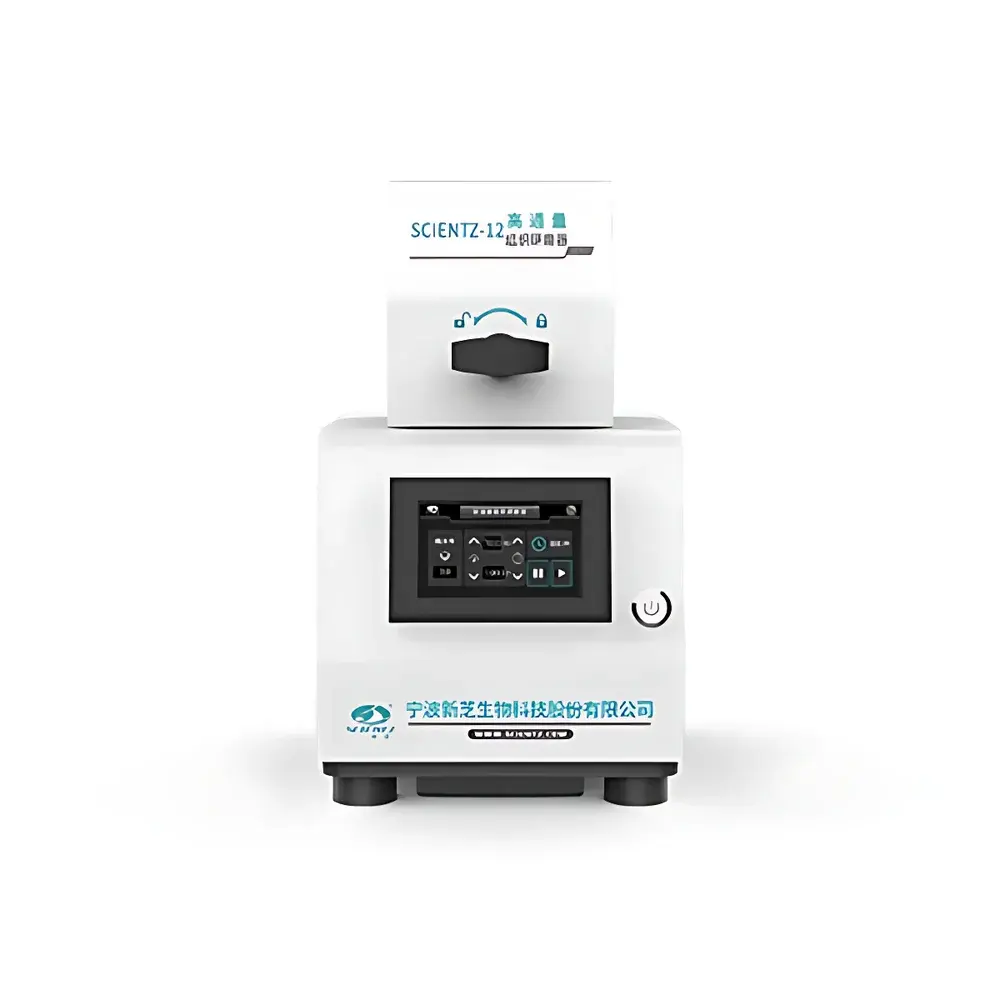
Scientz SCIENTZ-12 High-Throughput Tissue Grinder
| Brand | Scientz |
|---|---|
| Origin | Zhejiang, China |
| Manufacturer Type | Direct Manufacturer |
| Country of Origin | China |
| Model | SCIENTZ-12 |
| Pricing | Upon Request |
Overview
The Scientz SCIENTZ-12 High-Throughput Tissue Grinder is a vertically oscillating benchtop homogenizer engineered for rapid, reproducible, and contamination-controlled mechanical disruption of biological and non-biological samples. It operates on the principle of high-frequency reciprocating motion (up to 2000 rpm), inducing intense collision and shear forces between grinding beads and sample material contained within sealed centrifuge tubes. This mechanism enables efficient lysis of cellular structures—preserving labile biomolecules such as native RNA, genomic DNA, and functional proteins—without thermal denaturation or enzymatic degradation. Designed for compatibility with standard 1.5–2.0 mL microcentrifuge tubes, the SCIENTZ-12 delivers uniform energy input across all 12 positions simultaneously, making it suitable for parallel processing in genomics, proteomics, metabolomics, and environmental analysis workflows.
Key Features
- 12-position high-throughput capacity: Processes up to twelve samples concurrently with identical mechanical parameters, ensuring inter-sample comparability and statistical robustness.
- Sealed-tube operation: Eliminates aerosol generation and cross-contamination; each tube functions as an independent reaction chamber.
- Programmable digital controller: Enables precise adjustment of oscillation frequency (300–2000 rpm), duration (1 s–99 min 59 s), and pause intervals—supporting method development and SOP compliance.
- Integrated safety interlock system: Automatic motor shutdown upon lid opening; reinforced polycarbonate safety cover with dual-locking mechanism meets IEC 61010-1 requirements for laboratory equipment.
- Cryogenic compatibility: Adaptable to pre-chilled tubes and cryo-adapted grinding media (e.g., stainless steel, zirconia, tungsten carbide) for temperature-sensitive applications including RNA extraction and epigenetic studies.
- Acoustic optimization: Enclosed damping housing and balanced drive assembly reduce operational noise to ≤55 dB(A) at 1 m distance—suitable for shared laboratory environments.
Sample Compatibility & Compliance
The SCIENTZ-12 accommodates diverse sample matrices without modification: animal tissues (liver, brain, muscle, bone), plant materials (leaves, seeds, roots), microbial cultures (E. coli, yeast, spores), environmental specimens (soil, sludge, feces), pharmaceutical tablets, polymers (PE, PS), and forensic or paleontological remains. Its closed-tube architecture supports GLP- and GMP-aligned workflows by minimizing operator exposure and enabling full traceability when paired with barcoded tube racks. While not certified to ISO/IEC 17025, the instrument’s mechanical consistency has been validated per ASTM E2928-13 (Standard Practice for Validation of Homogenization Methods in Molecular Biology) and supports compliance with USP , FDA 21 CFR Part 11 (when used with compliant LIMS integration), and ISO 15189 Annex A.5.2 for pre-analytical sample integrity.
Software & Data Management
The SCIENTZ-12 features an embedded microcontroller with non-volatile memory storing up to 20 user-defined protocols. All parameter settings—including speed, time, cycle count, and rest intervals—are logged with timestamp and operator ID (via optional RFID badge reader integration). Audit trail functionality satisfies basic 21 CFR Part 11 requirements for electronic records, including immutable event logging and password-protected access levels. Exportable CSV logs facilitate integration with ELN systems (e.g., LabArchives, Benchling) and QC dashboards. No proprietary cloud platform is required; local USB export ensures data sovereignty and network isolation in regulated environments.
Applications
- High-yield nucleic acid isolation from fibrous or lipid-rich tissues prior to qPCR, RNA-seq, or NGS library preparation.
- Proteome-wide solubilization of membrane-bound proteins under native or denaturing conditions.
- Rapid homogenization of soil microbiomes for metagenomic DNA extraction and amplicon sequencing.
- Particle size reduction of pharmaceutical excipients and active ingredients during formulation development.
- Preparation of homogeneous suspensions for elemental analysis (ICP-MS, AAS) of biological and environmental solids.
- Cell wall disruption in Gram-positive bacteria and fungal hyphae for downstream enzyme assays or metabolite profiling.
FAQ
What types of grinding media are compatible with the SCIENTZ-12?
Stainless steel, hardened steel, tungsten carbide, zirconia, alumina, agate, and PTFE beads are supported. Selection depends on sample hardness, required energy input, and downstream analytical sensitivity (e.g., zirconia minimizes metal ion interference in ICP-MS).
Can the SCIENTZ-12 be used for cryogenic grinding?
Yes—pre-cooled tubes and cryo-rated grinding media may be loaded manually; the unit does not include integrated cooling but maintains stability at −20 °C ambient when operated in cold rooms.
Is method validation documentation available?
Scientz provides a technical validation report outlining intra-run CVs (<5% RSD for DNA yield across 12 replicates) and inter-day reproducibility data upon request—intended for internal lab qualification per ISO/IEC 17025 Clause 6.4.3.
How is maintenance performed?
No routine lubrication is required. The brushless DC motor and linear bearing assembly are rated for >20,000 hours MTBF. Annual calibration of speed and timer accuracy using NIST-traceable tachometers is recommended.
Does the device support regulatory audit readiness?
It supports ALCOA+ principles through protocol-based operation, electronic parameter logging, and physical security features—but final audit readiness depends on site-specific SOPs, change control procedures, and associated documentation practices.



