
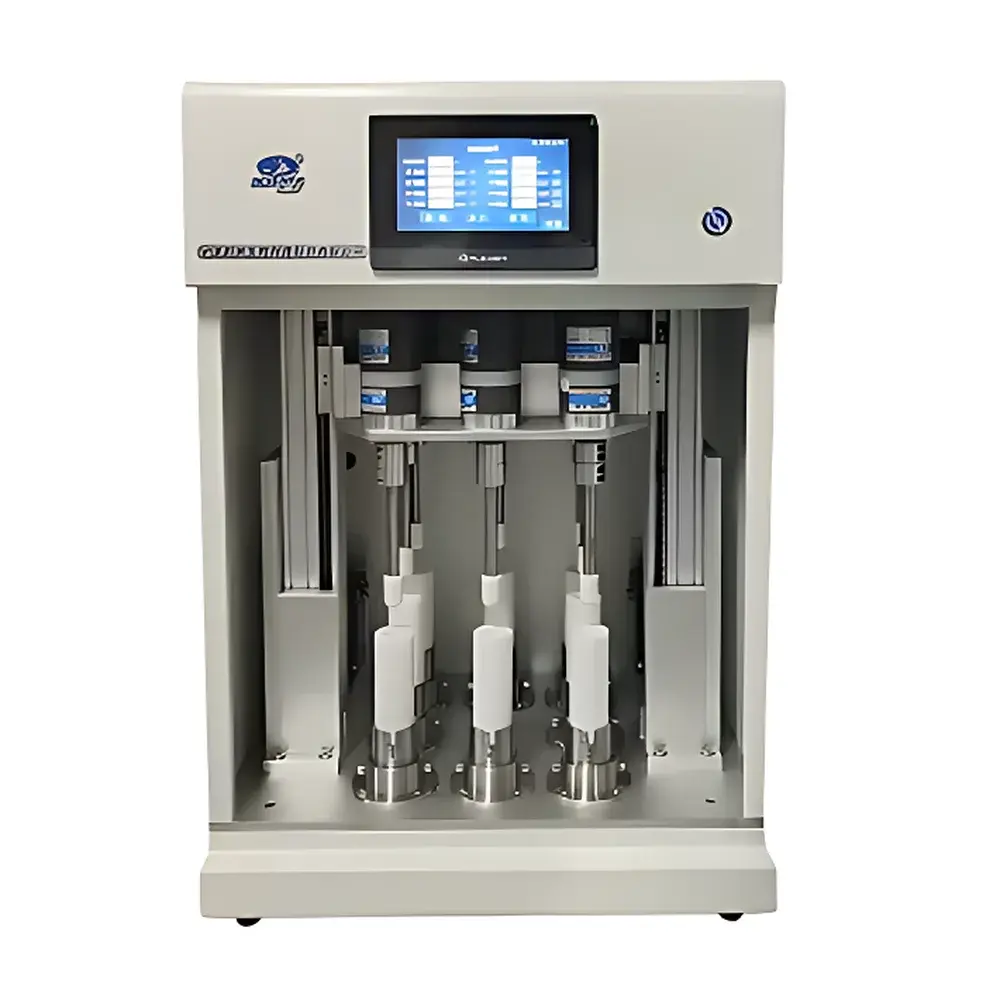
Ningbo Scientz SCIENTZ-1600DY Automated Tissue Homogenizer
| Brand | Scientz |
|---|---|
| Origin | Zhejiang, China |
| Manufacturer Type | Direct Manufacturer |
| Instrument Type | Benchtop Homogenizer |
| Instrument Subtype | Adjustable High-Speed Disperser |
| Sample Processing Volume | 200 mL |
| Output Power | 800 W |
Overview
The Ningbo Scientz SCIENTZ-1600DY Automated Tissue Homogenizer is a precision-engineered benchtop instrument designed for gentle, reproducible mechanical homogenization of biological tissues using controlled rotor–stator shear and low-shear研磨 (grinding) mechanics. Unlike high-energy bead-beating or ultrasonic methods, the SCIENTZ-1600DY employs a motor-driven, vertically actuated PTFE-coated homogenizing probe that reciprocates within a disposable or reusable PTFE homogenization vessel—mimicking the biomechanical motion of manual glass-on-glass grinding while eliminating operator variability. This principle ensures minimal thermal stress and membrane disruption, making it especially suitable for isolating intact subcellular organelles—including mitochondria, nuclei, lysosomes—and native-state proteins from animal, plant, and microbial samples. The system operates on a closed-vessel configuration to prevent aerosol generation and cross-contamination, aligning with biosafety Level 2 (BSL-2) laboratory requirements.
Key Features
- Gentle yet effective homogenization: Optimized low-speed, high-torque motor (rated at 800 W continuous output) delivers consistent shear energy without excessive heat buildup—critical for preserving enzymatic activity and organelle integrity.
- PTFE-based wetted components: Both the homogenizing rod and vessel are constructed from medical-grade polytetrafluoroethylene (PTFE), ensuring chemical inertness, non-stick surface properties, resistance to acid/base exposure, and elimination of metal ion leaching—essential for trace-metal-sensitive assays and proteomic workflows.
- Automated stroke control: Programmable vertical displacement and dwell time allow precise replication of grinding cycles; eliminates manual fatigue and inter-operator variability inherent in traditional glass homogenizers.
- Benchtop compact footprint: Designed for integration into standard fume hoods or laminar flow cabinets; includes integrated safety interlock to halt operation when lid is open.
- Noise-dampened architecture: Acoustic enclosure and vibration-isolated motor mount reduce operational noise to <65 dB(A) at 1 m—supporting shared laboratory environments and long-duration protocols.
Sample Compatibility & Compliance
The SCIENTZ-1600DY accommodates sample volumes up to 200 mL in standardized PTFE vessels (available in 10–200 mL configurations), supporting soft to moderately fibrous tissues (e.g., liver, brain, leaf mesophyll, bacterial pellets). It is compatible with common lysis buffers—including RIPA, HEPES-based mitochondrial isolation media, and chaotropic salt solutions—without degradation of PTFE surfaces. While not certified to ISO/IEC 17025 for calibration traceability, the instrument meets general electrical safety standards per GB 4793.1 (equivalent to IEC 61010-1) and is routinely deployed in laboratories adhering to GLP-compliant sample preparation SOPs for preclinical toxicology and biopharmaceutical upstream processing.
Software & Data Management
The SCIENTZ-1600DY operates via an embedded microcontroller interface with tactile keypad and LCD display. Parameter settings—including stroke frequency (rpm), total cycle count, and pause duration—are stored in non-volatile memory and can be recalled as user-defined protocols. Though it does not feature Ethernet or USB data export, all operational parameters are logged with timestamped start/stop events internally—supporting audit-ready documentation when paired with lab notebook entries or LIMS-integrated workflow logs. For regulated environments requiring electronic records, the device may be operated under 21 CFR Part 11-compliant procedural controls when used with validated SOPs and change-controlled protocol templates.
Applications
- Subcellular fractionation: Isolation of functional mitochondria, synaptosomes, and microsomal fractions from neural, hepatic, and muscle tissues.
- Proteomics & phosphoproteomics: Preparation of native lysates retaining post-translational modifications and protein–protein interactions.
- Food safety testing: Homogenization of composite food matrices (e.g., dairy products, meat emulsions, plant-based alternatives) prior to microbial enumeration or allergen extraction.
- Environmental microbiology: Disruption of biofilm-embedded bacteria and soil microaggregates for DNA/RNA recovery in metagenomic studies.
- Vaccine development: Cell lysis of insect or mammalian expression systems during early-stage antigen purification workflows.
FAQ
What types of tissue are compatible with the SCIENTZ-1600DY?
Soft to moderately fibrous mammalian, avian, and plant tissues—as well as dense microbial pellets—are routinely processed. Highly keratinized or calcified tissues (e.g., bone, horn) require pre-mechanical fragmentation prior to homogenization.
Can the instrument be validated for GMP use?
While the unit itself is not supplied with IQ/OQ documentation, its design supports installation and operational qualification under client-led validation protocols aligned with Annex 15 and USP <1058> guidelines.
Is PTFE vessel sterilization possible?
Yes—vessels withstand autoclaving at 121°C for 20 minutes (up to 50 cycles); however, repeated steam exposure may gradually reduce surface hydrophobicity; visual inspection before critical applications is recommended.
How does this differ from rotor–stator homogenizers?
Unlike high-shear rotor–stator systems that generate turbulent flow and localized heating, the SCIENTZ-1600DY uses linear reciprocating motion with defined clearance—producing laminar shear profiles ideal for fragile organelles.
Does the system support multi-vessel batch processing?
No—it is configured for single-vessel operation per cycle; however, sequential runs with identical parameters ensure high inter-batch reproducibility across sample sets.



