
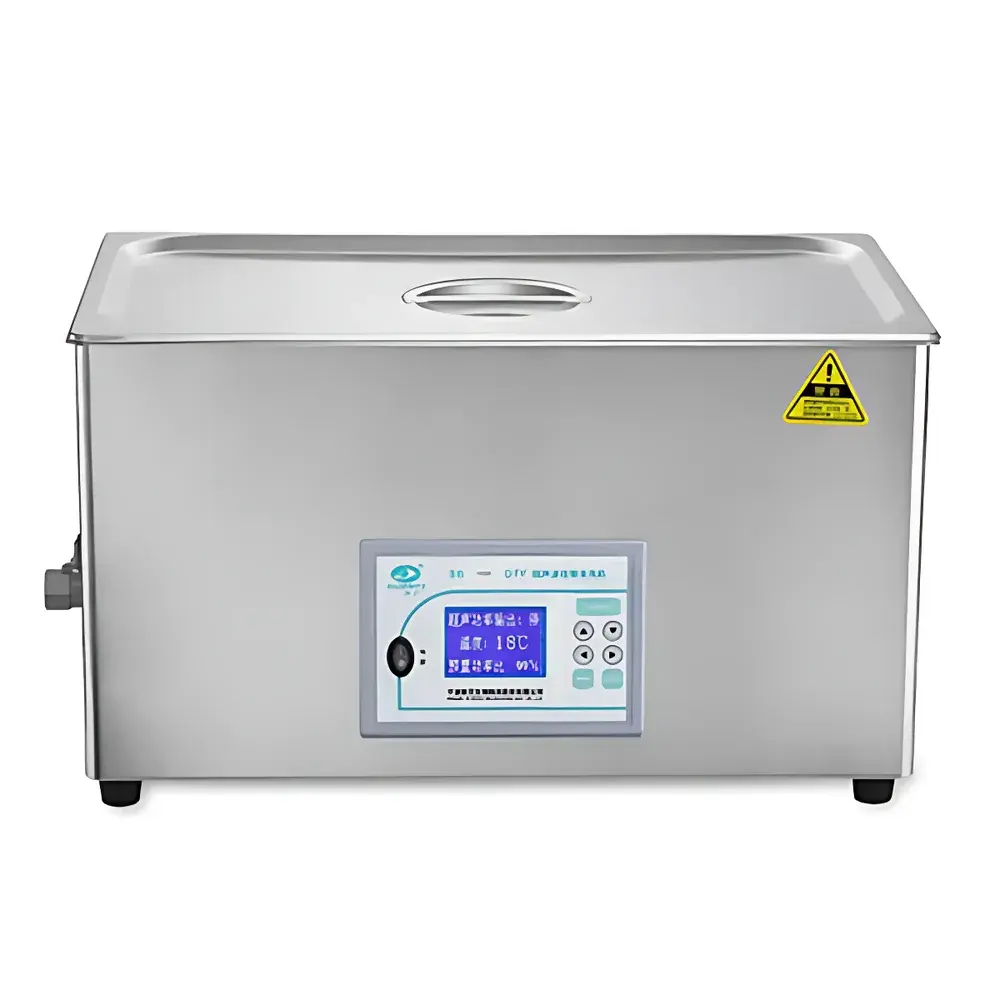
Ningbo Scientz SB-500DTY Sweep-Frequency Ultrasonic Cleaner
| Brand | Ningbo Scientz |
|---|---|
| Origin | Zhejiang, China |
| Manufacturer Type | Direct Manufacturer |
| Instrument Type | General-Purpose Ultrasonic Cleaner |
| Tank Capacity | 22.5 L |
| Operating Frequencies | 25 kHz / 33 kHz / 40 kHz / 59 kHz (Sweep-Frequency Mode) |
| Ultrasonic Power Output | 600 W |
| Power Adjustment | Yes (40–99% in 1% increments) |
| Temperature Control Range | Ambient to 80 °C |
| Timer Range | 1–999 min |
| Lid with Sound-Dampening Design | Yes |
| Integrated Drain & Fill Fitting | Yes |
Overview
The Ningbo Scientz SB-500DTY Sweep-Frequency Ultrasonic Cleaner is an engineered laboratory-grade cleaning system designed for reproducible, non-destructive removal of particulate, organic, and oily contaminants from complex geometries—including blind holes, microchannels, porous surfaces, and delicate optical components. It operates on the physical principle of acoustic cavitation: high-frequency mechanical vibrations generated by piezoelectric transducers are transmitted through a liquid medium, inducing transient microbubble formation and violent implosions. These implosions generate localized shockwaves (up to ~5,000 K and ~1,000 atm), resulting in intense microjetting and shear forces at solid–liquid interfaces—enabling effective cleaning without abrasion or thermal degradation. Unlike fixed-frequency units, the SB-500DTY implements sweep-frequency modulation across four discrete bands (25, 33, 40, and 59 kHz), minimizing standing-wave node formation and ensuring uniform energy distribution throughout the tank volume. This architecture enhances cleaning consistency across heterogeneous sample loads and reduces the risk of ultrasonic erosion on sensitive substrates.
Key Features
- Sweep-frequency operation across four user-selectable frequencies (25/33/40/59 kHz) with independent time allocation per frequency—optimized for multi-stage cleaning protocols
- Digitally controlled heating system with PID regulation, maintaining temperature stability within ±1 °C across the full 20–80 °C range
- High-resolution LED display showing real-time elapsed/remaining time, actual bath temperature, active frequency, and power level
- Adjustable ultrasonic power output (40–99% in 1% steps), enabling precise energy dosing for fragile samples such as coated optics or polymer-based microfluidic devices
- Integrated sound-dampening lid with safety interlock switch—reduces airborne noise to <55 dB(A) at 1 m and prevents operator exposure to aerosolized solvents
- Stainless steel 316L tank (22.5 L capacity) with reinforced transducer mounting and corrosion-resistant sealing—designed for long-term compatibility with aqueous, mild alkaline, and low-concentration solvent-based cleaning media
- Auto-memory function retains last-used parameters (frequency sequence, power level, temperature, timer) after power interruption—ensuring protocol continuity in regulated environments
Sample Compatibility & Compliance
The SB-500DTY accommodates a broad spectrum of laboratory and industrial specimens: borosilicate glassware (vials, cuvettes, chromatography columns), stainless-steel surgical instruments, titanium dental implants, quartz optical lenses, silicon wafers, MEMS devices, and 3D-printed polymer parts. Its cleaning efficacy has been validated against ASTM D2272 (Standard Test Method for Determining Cleaning Efficiency of Aqueous Cleaners) and ISO 15883-1 (Washer-disinfectors for medical devices). While not certified as a medical device under FDA 510(k) or CE IVD, the unit supports GLP/GMP-aligned workflows when used with documented cleaning SOPs—including traceable parameter logging, operator ID entry (via optional external software integration), and audit-ready timer records. The absence of mechanical agitation preserves surface integrity critical for SEM sample preparation, thin-film metrology, and calibration standard maintenance.
Software & Data Management
The SB-500DTY operates via embedded firmware with no proprietary PC software dependency. All operational parameters are set and monitored locally using the front-panel interface. For laboratories requiring electronic record retention, the unit supports RS-232 serial output (optional adapter) to export timestamped logs—including start/stop times, temperature profiles, frequency cycling events, and power settings—to LIMS or ELN platforms. When integrated into 21 CFR Part 11–compliant systems, these logs may be digitally signed and archived with role-based access control. No cloud connectivity or remote firmware updates are implemented—ensuring data sovereignty and eliminating cybersecurity vectors common in IoT-enabled lab equipment.
Applications
- Routine decontamination of HPLC vials, pipette tips, and centrifuge tubes prior to trace-metal analysis (ICP-MS, AAS)
- Pre-sterilization cleaning of reusable laparoscopic trocars and endoscope channels per AAMI ST91 guidelines
- Removal of photoresist residues and etch-byproducts from semiconductor wafers during R&D prototyping
- De-gassing of mobile phase solvents and viscous polymer solutions prior to filtration or injection
- Cell lysis and subcellular fractionation in preparative biochemistry—leveraging controlled 59 kHz cavitation for gentle membrane disruption
- Restoration of anti-reflective coatings on microscope objectives and laser optics without compromising nanoscale surface roughness (Ra < 0.5 nm)
FAQ
Does the SB-500DTY support continuous operation beyond 999 minutes?
No—the maximum programmable cycle duration is 999 minutes. For extended cleaning, users must initiate sequential cycles manually or via external timer relay.
Is the 59 kHz mode suitable for cleaning nanostructured surfaces?
Yes—higher frequencies produce smaller, more numerous cavitation bubbles with lower collapse energy, reducing the risk of nanoscale pitting on soft metals, thin films, and biomaterial-coated substrates.
Can the unit be operated without the sound-dampening lid?
Operation without the lid is physically possible but strongly discouraged: it violates OSHA 1910.95 noise exposure limits, increases solvent vapor release, and voids the warranty due to uncontrolled acoustic field dispersion.
What cleaning fluids are compatible with the stainless steel tank?
Aqueous alkaline detergents (e.g., Alconox®, Tergazyme®), ethanol/water mixtures (10% HNO₃) due to stress-corrosion cracking risks.
Is temperature calibration traceable to NIST standards?
The internal PT100 sensor is factory-calibrated; however, end-user NIST-traceable recalibration requires third-party metrology service—no built-in self-calibration routine is provided.



